Unbeatable Beets

0
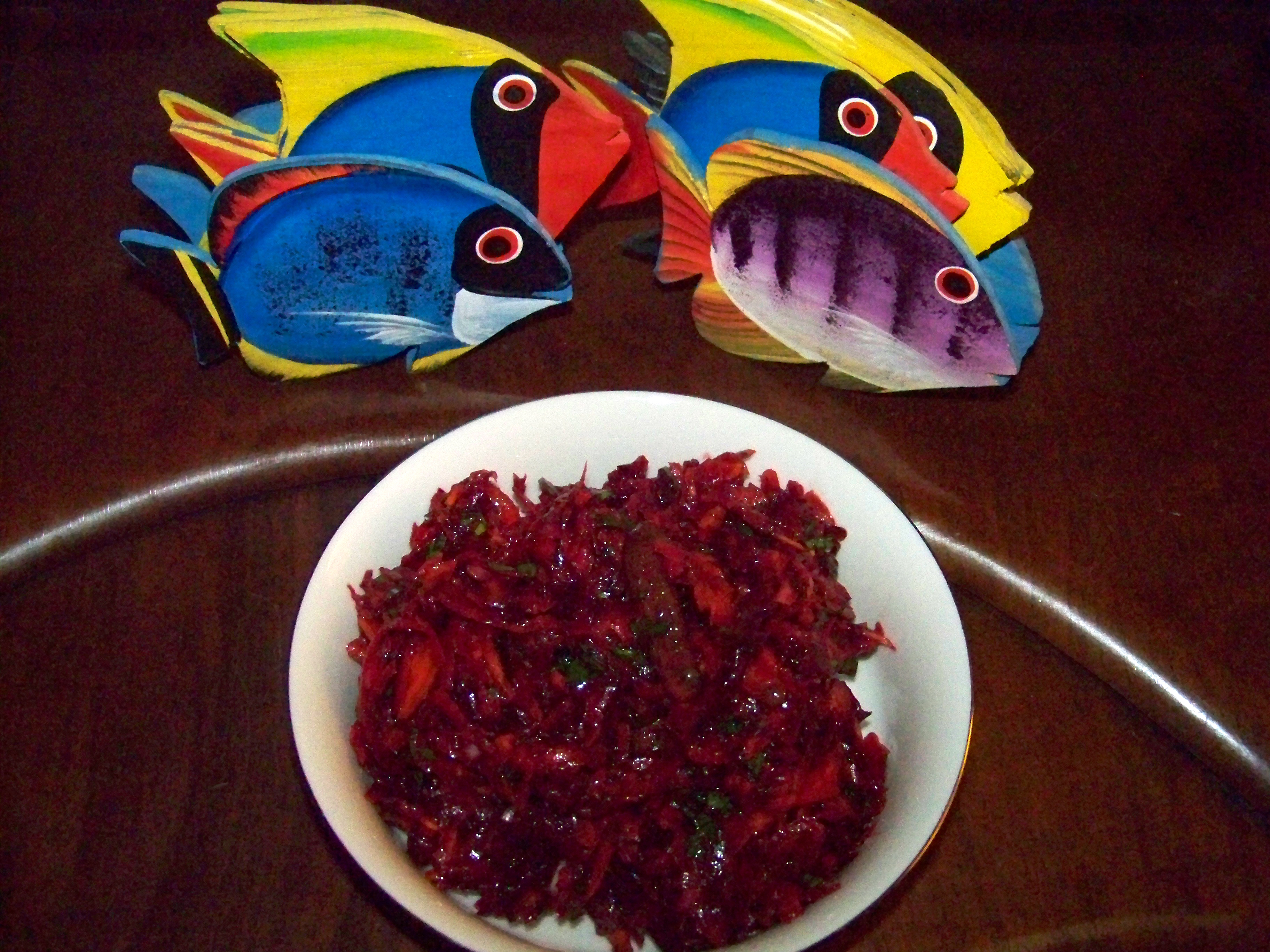
Best. Beets. Ever. Sans the hard-cooked eggs, which Tanis said were optional.

Best. Beets. Ever. Sans the hard-cooked eggs, which Tanis said were optional.

“As Bokonon [actually the late author Kurt Vonnegut] says: ‘Peculiar travel suggestions are dancing lessons from God.'” And I’m sure, were Bokonon here, he’d be happy to include “peculiar dining suggestions.” A couple of weeks ago, my pal Dan Fredman sent me an email about a wine dinner happening at Lucques in Beverly Hills, celebrating both the loose confederation of wine producers known as In Pursuit of Balance and the release of chef David Tanis‘ latest cookbook, One Good Dish. It was on a Thursday night, which interfered with The Bride’s workout schedule, and it was to start at 7 PM, which is always a challenge in Los Angeles traffic. I knew of Tanis tangentially, but I was not deeply acquainted with his history, so my natural tendency was to give it a miss. But Bokonon spoke to me, as he often has before, so I made the reservation, albeit with some reservations. But not many: dinner at Lucques has always been delightful, and at the worst, I’d have a chance to hang with Dan, which is always edifying. Also, as part of the deal, I’d get a copy of the cookbook, which kinda made the whole thing a bit of a no-brainer.

When we arrived, Dan greeted us and bade us to sit at his table, where Tanis himself was ensconced, along with a couple of other of our acquaintances whose conviviality is highly evident. The author was, by design, supposed to circulate. In practice, though, he hung out mostly at our table, often serving the dishes that he himself created.

He cooks, he scores. He even serves.

He cooks, he scores. He even serves.

The entire menu was — and this is a technical term — really tasty. All of it came from One Good Dish, with page numbers thoughtfully included. No doubt I could wax poetic about the crostini, or the espresso-hazelnut bark, and perhaps I will after I have made them. But this time, I’m going to lavish my praise upon the beets.
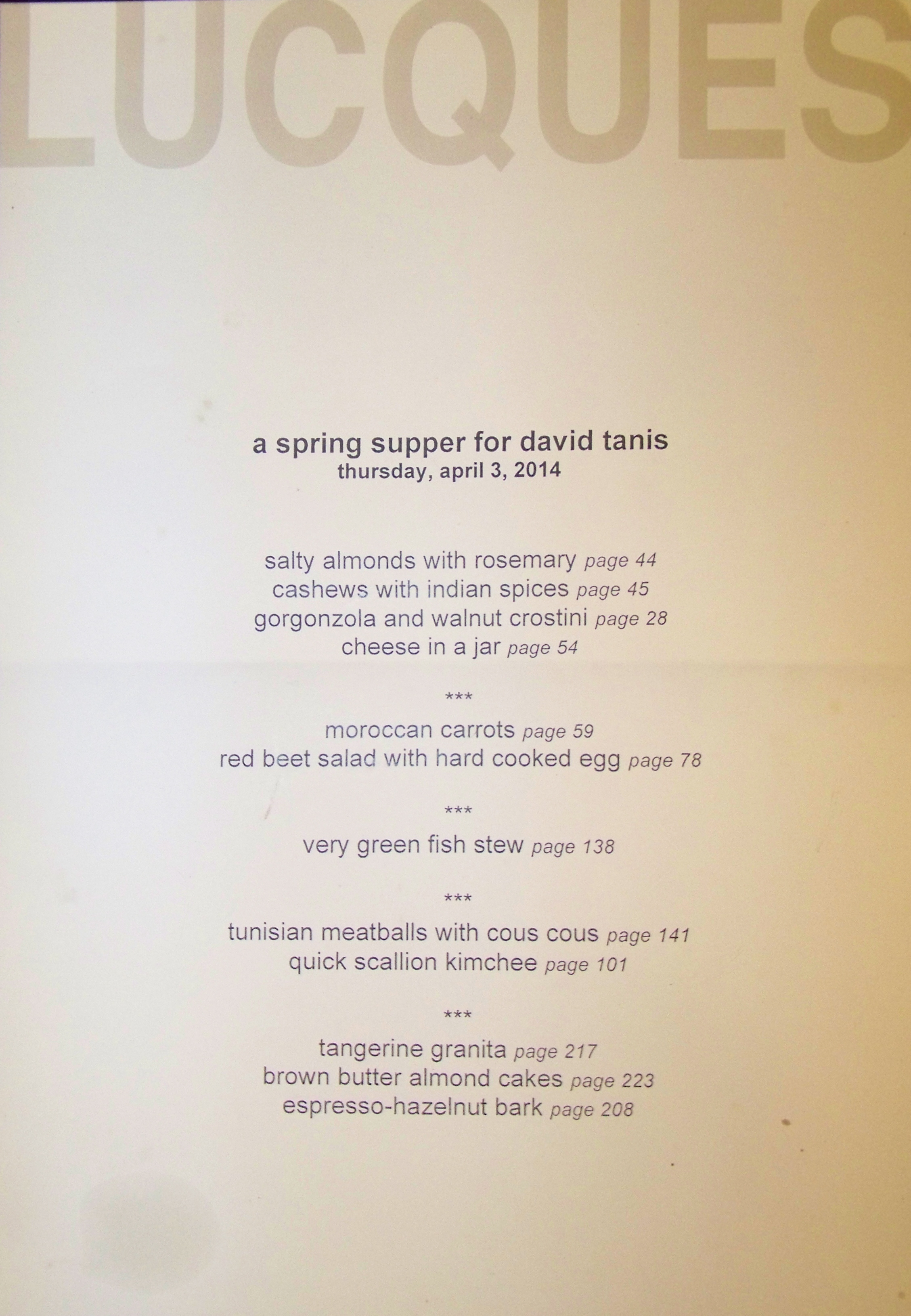
A perfect meal.

A perfect meal.

I’ve never been a big fan of beets. I’ve tried roasting them, cooking them in soup, glazing them, whatever. It’s not like I haven’t tried to like them, but I never had a beet-eating experience that made me want more. Until April 3, 2014, when The Bride, with whom I have been paired for more than three decades now, heard these words pass my lips for the first time ever: “May I have some more of the beets, please?”

Tanis’ Red Beet Salad, at its heart, is grated raw beets served in a fancy vinaigrette. And the Bugatti Veyron, at its heart, is a motorcar. The ingredients aren’t hard to locate or particularly sophisticated, but it’s absolutely worth using the very best available to you, especially super-fresh beets, and really good Dijon mustard, red wine vinegar, and olive oil. I used some red wine vinegar that I had picked up at Turley Wine Cellars, and cold-pressed extra virgin olive oil from Oliana.

A minor digression: The difference between $15 olive oil and $3 olive oil is often hugely significant. I highly recommend splurging whatever your budget can afford on a great bottle of olive oil for finishing soups and salads, serving on bread, etc. Oliana in West Hollywood (sadly now closed) and Beyond the Olive in Pasadena (whose storefront is also now closed, but still sells online) and Stonehouse California Olive Oil in the San Francisco Ferry Building all have tasting rooms, where you can select from a variety of olive oils with a wide spectrum of characteristics. Most major cities in America have some gourmet store that offers a similar experience. [2017 update: Of late, we’ve been subscribing to a thrice-yearly variety package from Olea Farm in Templeton, CA.] Do give it a go; if you haven’t done it before, you will be shocked — pleasantly, but shocked nonetheless — at just how different olive oils can be.

All you need to make this excellent salad.

All you need to make this excellent salad.

Basically, you need to peel and grate the beets (I used both red and golden beets for my version), being very careful not to give yourself a case of what I like to call “box grater rash.” Alternatively, you can julienne the beets with a sharp knife. You might be well advised not to be wearing your bestest white shirt while doing this. Fresh beets are juicy, n’est–ce pas?
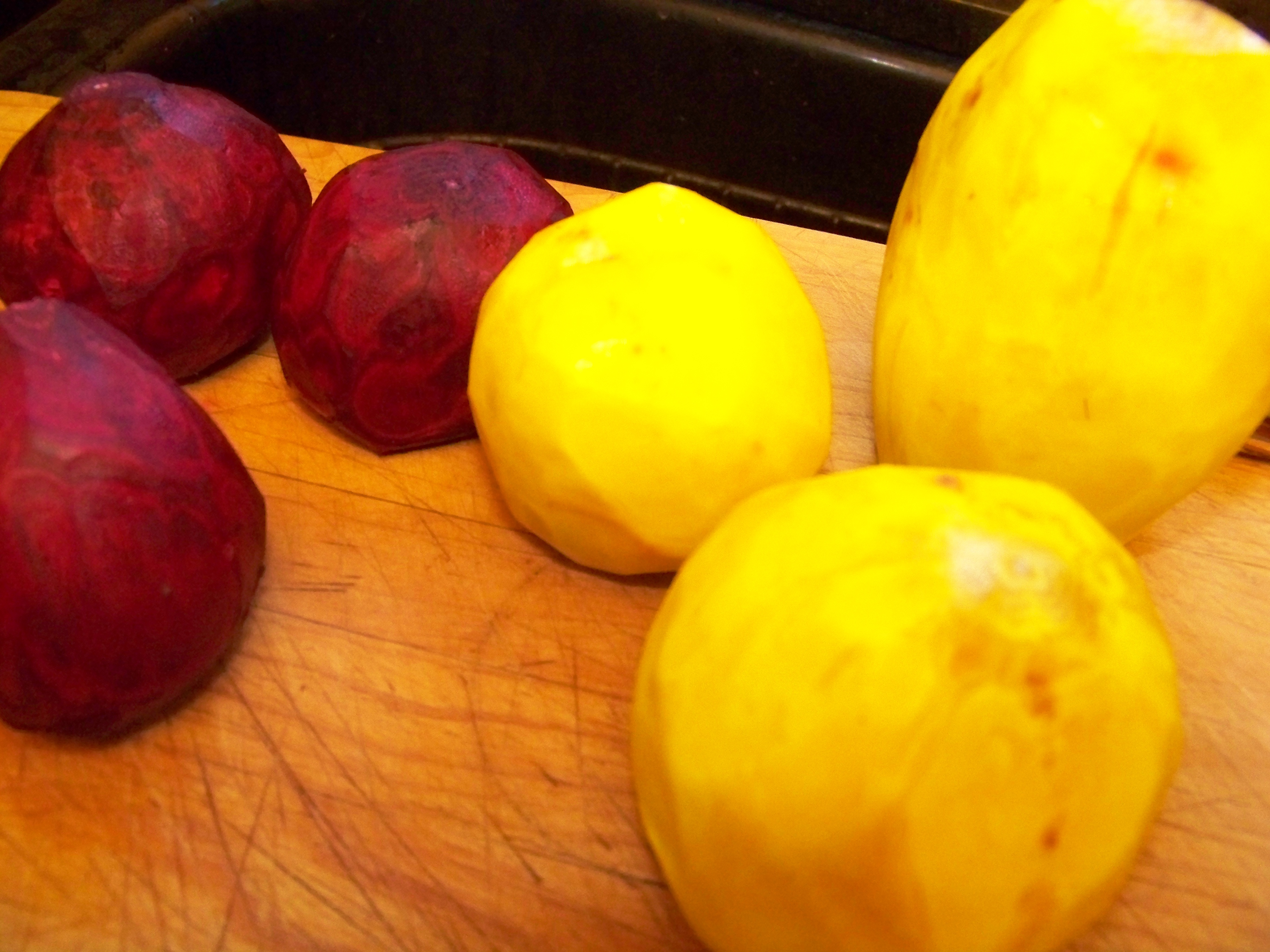
A bunch of beets.

A bunch of beets.

After the beets have been cut or grated, season them with a little salt and pepper and set them aside while you prepare the dressing. [I put them in the refrigerator to give them a slight chill-down.]

Great grated beets!

Great grated beets!

From the shallot to the cornichons on the ingredients list, everything is diced and/or measured and/or whatever as appropriate and gets mixed in a bowl. [Please consider buying the book; while this recipe isn’t complicated, it will do your karma good to support writers and chefs such as Tanis. And it’s a really terrific book.] The finished dressing will look something like the picture below, except that I took the shot before adding the parsley. Idiot me. So imagine some chopped flat-leaf parsley. Pour the dressing over the salad, mix, and let it marinate for at least 10 minutes. [Again, I put it in the fridge for this step.]
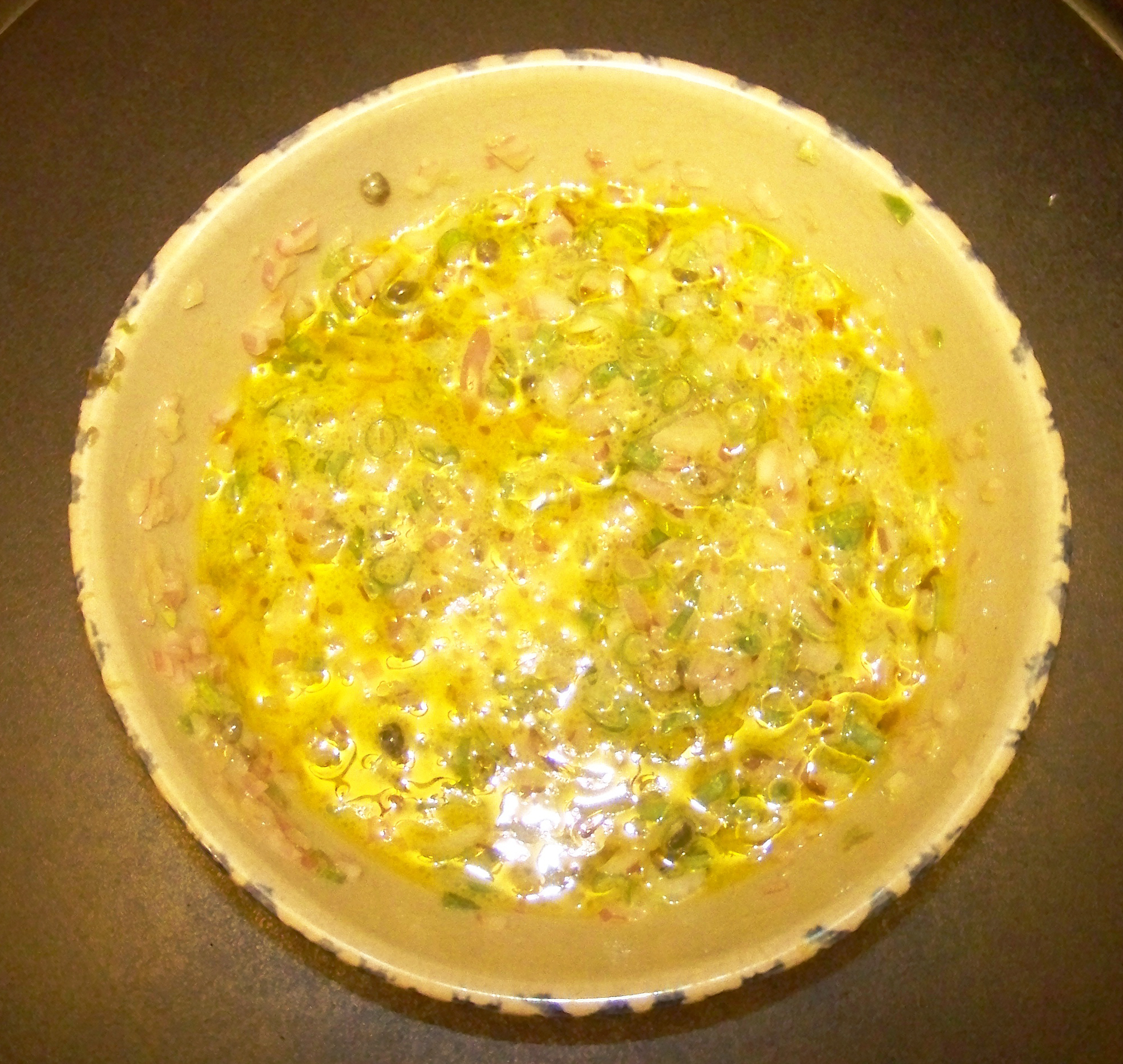
Yummy dressing for yummy salad.

Yummy dressing for yummy salad.

Serve, eat, and eat some more.

The second-best part about this salad is that it still tastes terrific the day after.
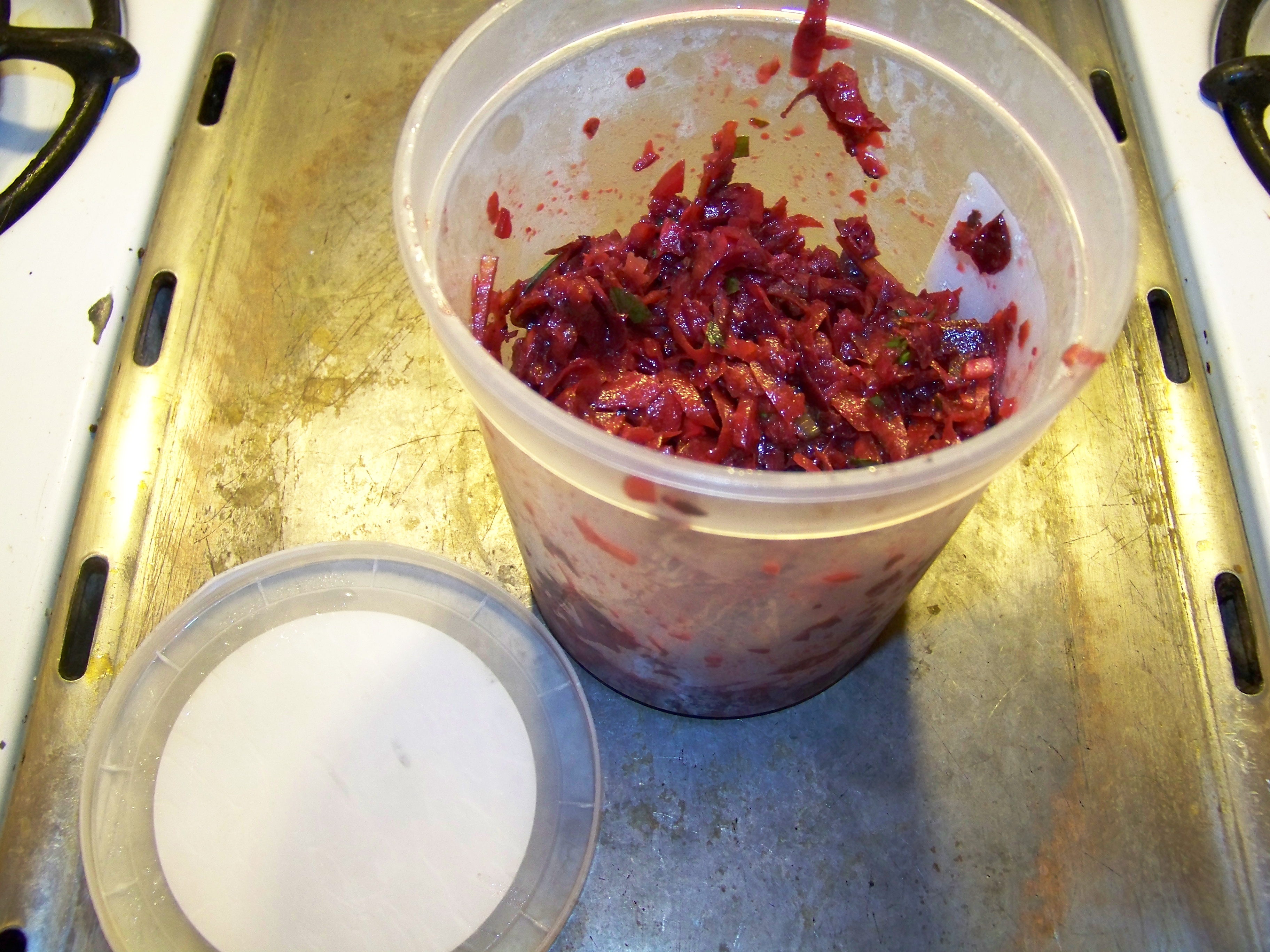
Mmmmm. Still good the next day.

Mmmmm. Still good the next day.

The recipe claims to serve four to six people, but don’t be surprised if your guests (or yourself!) are keen on seconds.

Vegan Tomato-Dill Soup

0
It's soup!

It’s soup!

Despite the widely-held belief that “it never rains in southern California,” it does, albeit not often enough. Tonight, for instance, was a prime example of the occasionally intemperate nature of SoCal weather; a much-needed downpour, most of which would wind up in storm drains on a quick trip to the Pacific Ocean, rather than into the aquifers and reservoirs that could make the best use of it. Rain, for me, signals an opportunity to make soup, which matches inclement weather the way pearls go with Sophia Loren’s exquisite neck.

In my youth, tomato soup meant a can of Campbell’s, made famous by Andy Warhol. My late and much beloved mom used to prepare it in high style, diluting it with milk rather than water for an instant “cream of tomato” concoction, which remained the gold standard for tomato soup in my estimation until well into my adulthood. One weekend in my thirties, though, on a trip to Lake Tahoe, I tasted freshly prepared tomato soup for the first time, and it was nothing short of revelatory. I’ve been spoiled ever since.

INGREDIENTS:

2 tbsp.olive oil
1 medium onion, finely chopped
2 tbsp. Cup4Cup gluten-free flour
2 cloves garlic, minced
1 can (28 oz.) San Marzano diced tomatoes
4 tbsp. stemmed and chopped fresh dill + 4 fronds for garnish
28 oz. vegetable broth (or chicken broth, if the vegan version isn’t sufficiently compelling)
1 bay leaf
salt
ground black pepper
dollop of cashew cream (for vegan version) or sour cream or yogurt (non-vegan version)

The humble onion.

The humble onion.

DIRECTIONS:
First, heat the olive oil in a soup pot, then add the diced onion at medium heat. Sweat the onion, allowing it to release its liquids, but don’t brown it. Add the Cup4Cup gluten-free flour, and stir, making sure to break up any lumps that might ensue (a whisk is good at doing this). Add the garlic and cook for about two minutes, stirring occasionally. Then add the tomatoes, broth (a simple way to measure this is to fill up the empty tomato can), chopped fresh dill, bay leaf, salt, and pepper.

Adding the flour.

Adding the flour.

Cook over medium low heat, stirring occasionally, for about 30 minutes, but you needn’t be particularly fussy about the timing; it’s just enough to let the flavours blend.

Spices added; stirring ensues.

Spices added; stirring ensues.

From here, you have a couple of options. 1) Allow the soup to cool overnight in the refrigerator, and serve it the following day as a rustic cold soup, garnished with a dill sprig (and remember to remove the bay leaf!).

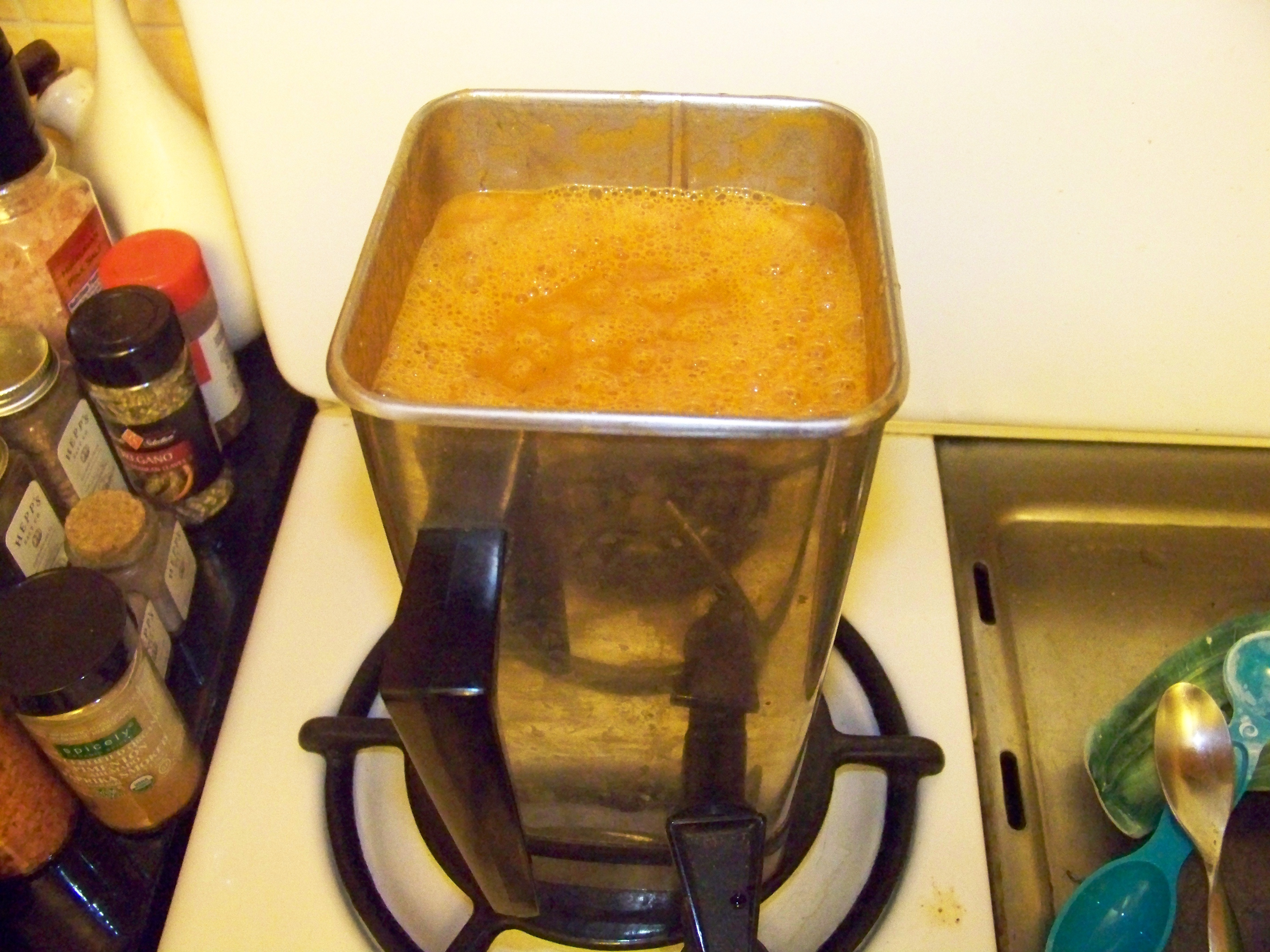
A quick trip to the Vita-Mix.

A quick trip to the Vita-Mix.

2) Alternatively, you can remove the bay leaf, toss it in the food processor and purée it. Be sure to work in small batches, and DON’T plug the feeding tube unless you’d like your kitchen walls redecorated with a fine spray of tomato soup. [The steam needs somewhere to go; best bet is to drape a kitchen towel LOOSELY over the top of the feeding tube.]

You can add a delightfully silky texture by stirring a dollop of cashew cream into each bowl (or cup). Garnish with a dill sprig, and serve.

Serves 4-6

Sriracha + Salt = Success

0
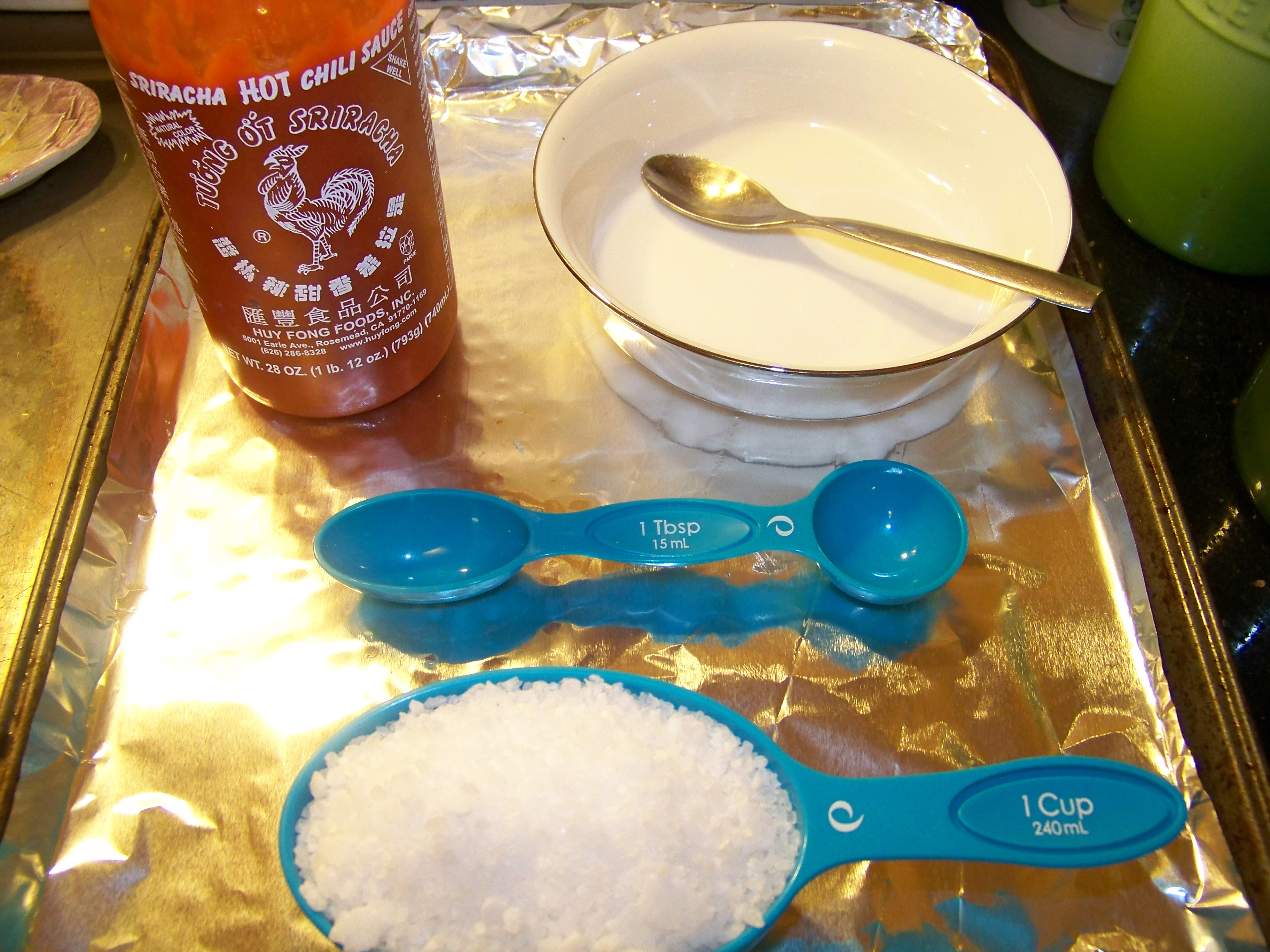
Everything you need to make this recipe. Seriously. Including the oven.

Everything you need to make this recipe. Seriously. Including the oven.

I love flavoured salts. Smoked salts, herbed salts, lemon, garlic, chili pepper, whatever. And I’ve happily been paying sums for them that my late pal John Wayne would call [and I should alert you to salty language here] “rigoddamndiculous.” Particularly in this case, when making it yourself is ridiculously simple.

It’s been my experience that no recipe is foolproof, because just as I find one that might fill the bill, along lumbers a bigger fool. But if you are incapable of getting this one for Sriracha salt right, you may as well convert your kitchen into a darkroom or a tool shed or a walk-in closet, because you have no business cooking in it.

Before I get into the particulars, I owe a shout-out to Let’s Give Peas a Chance, from whom I got the recipe, and Radical Possibility, from whom they got the recipe.

Salz, sel, salt, sal, tuz, gatza... whichever you prefer.

Salz, sel, salt, sal, tuz, gatza… whichever you prefer.

INGREDIENTS:
1 cup sea salt (or kosher salt, or fleur de sel)
4 tbsp./60 ml Sriracha sauce (or, as my Canadian homies call it, “Cock sauce” — because of the rooster on the label)

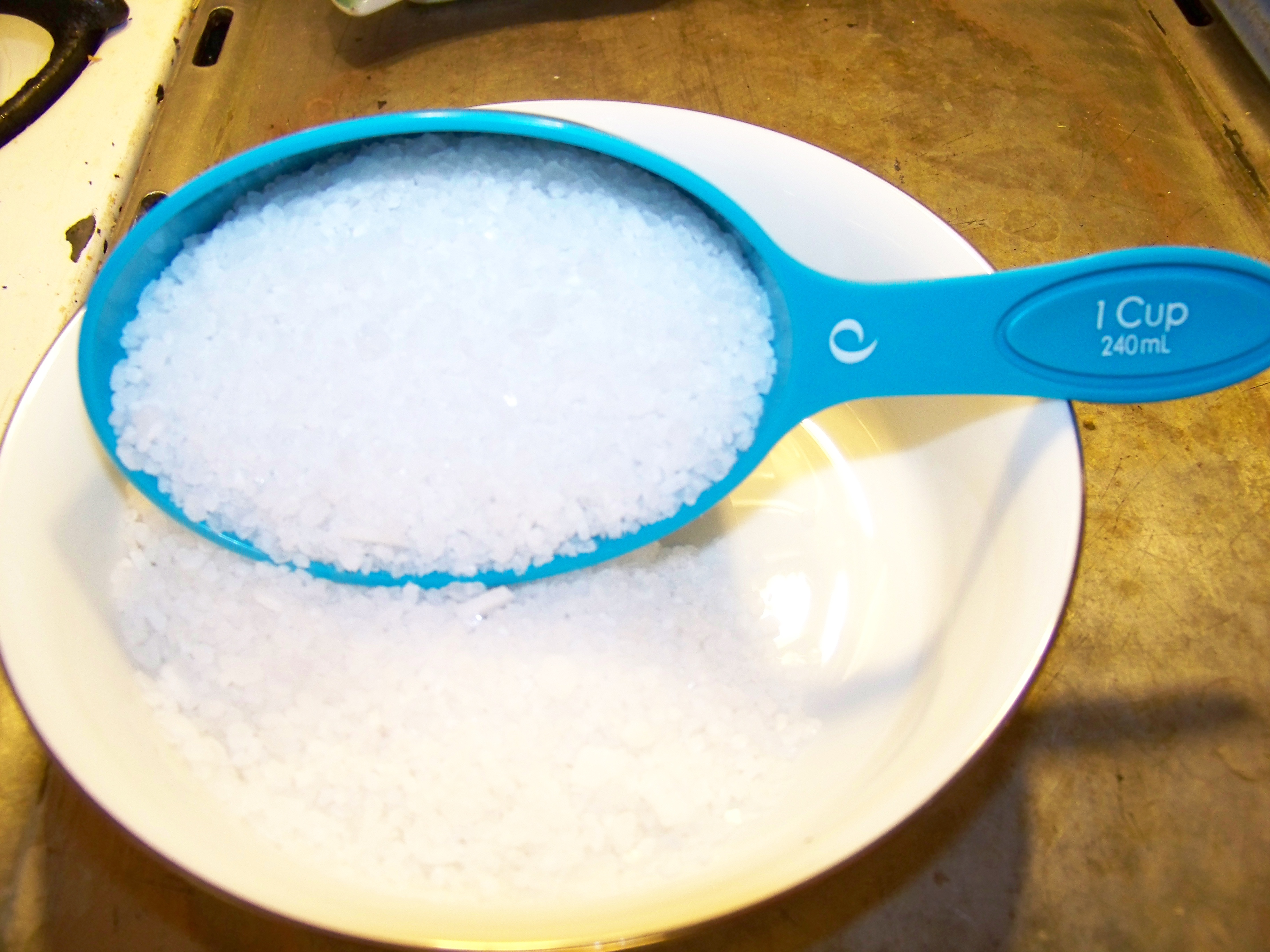
Add the sauce to the salt

Add the sauce to the salt.

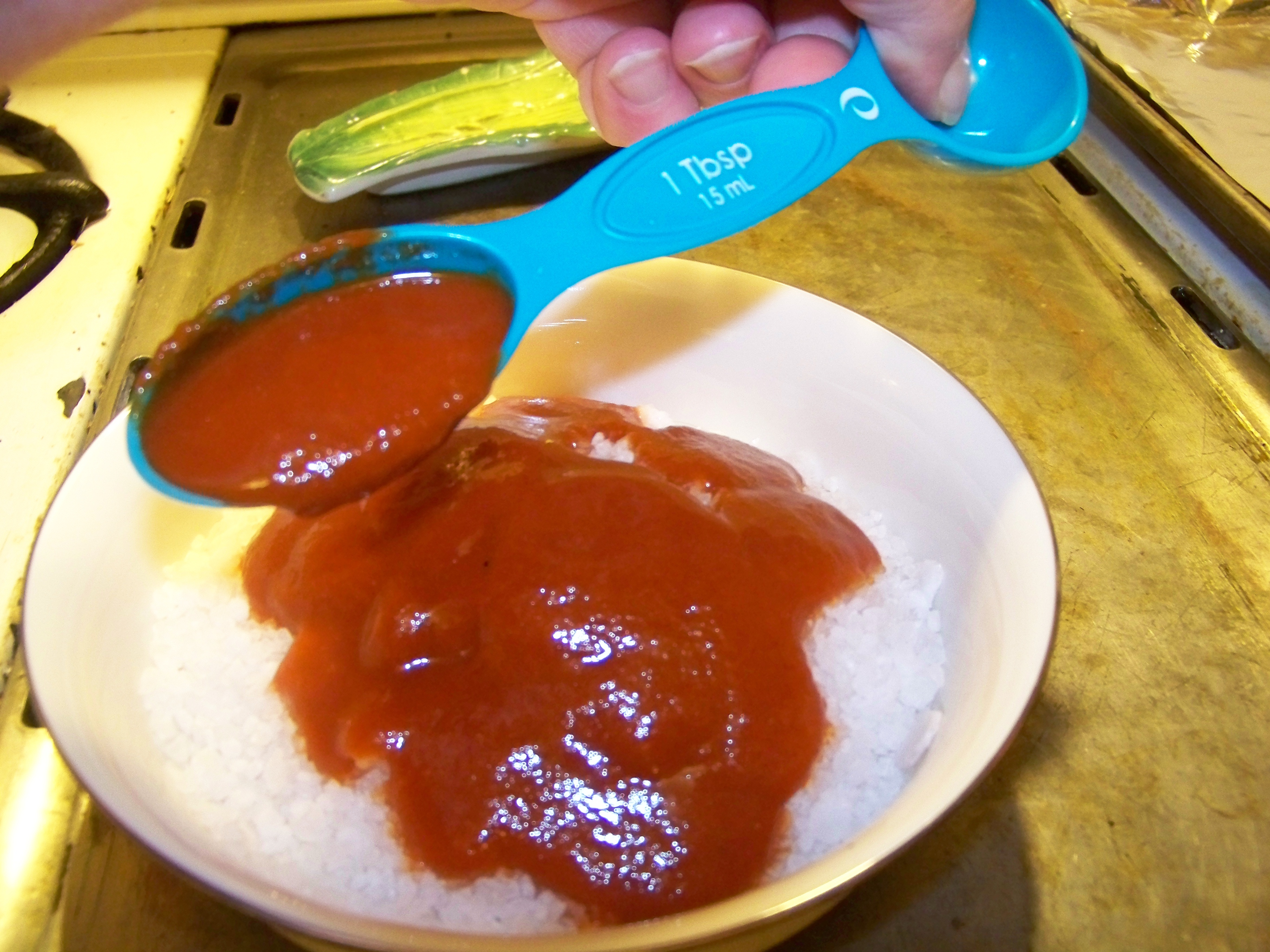
Coated.

Coated.

DIRECTIONS:
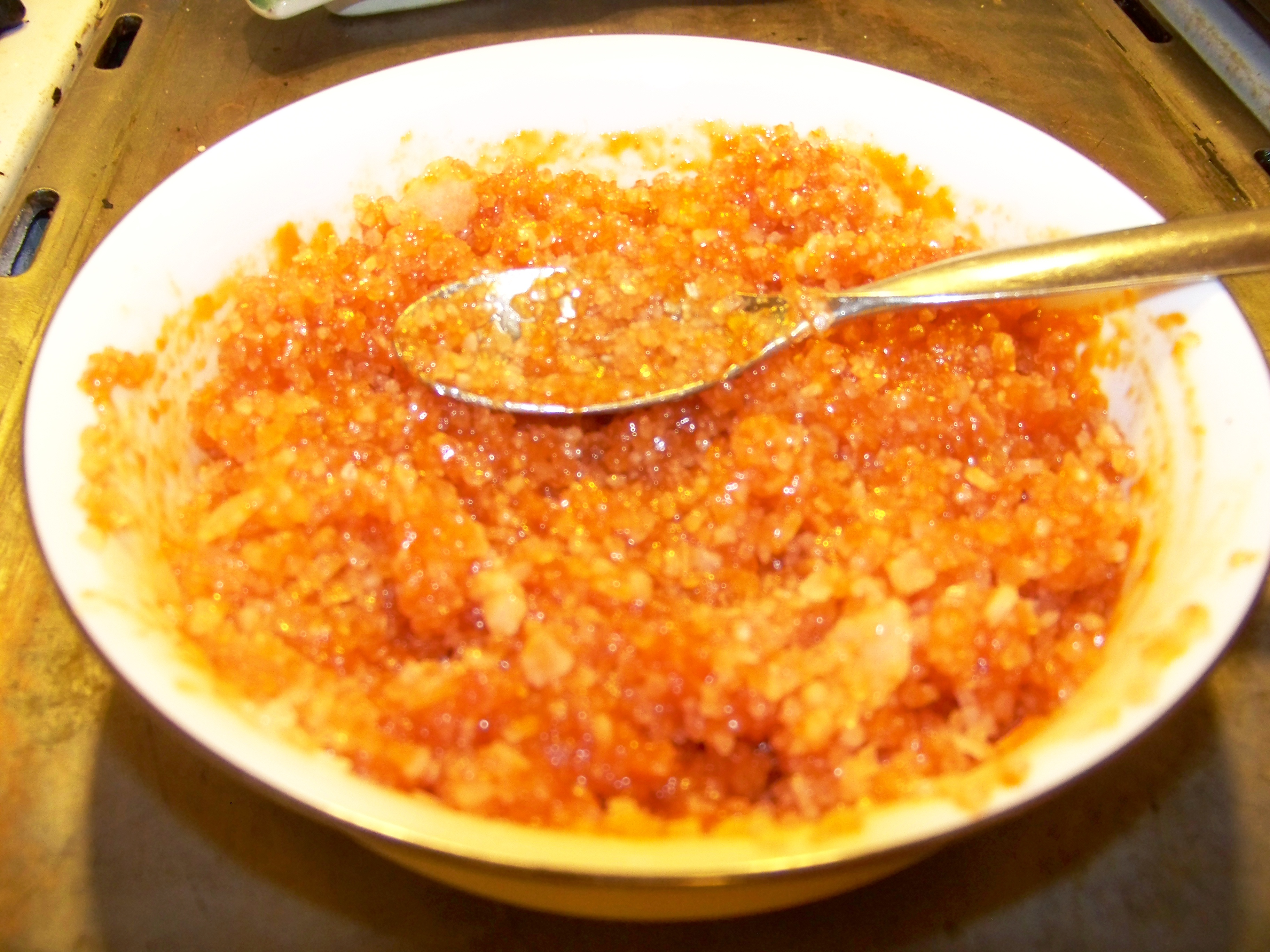
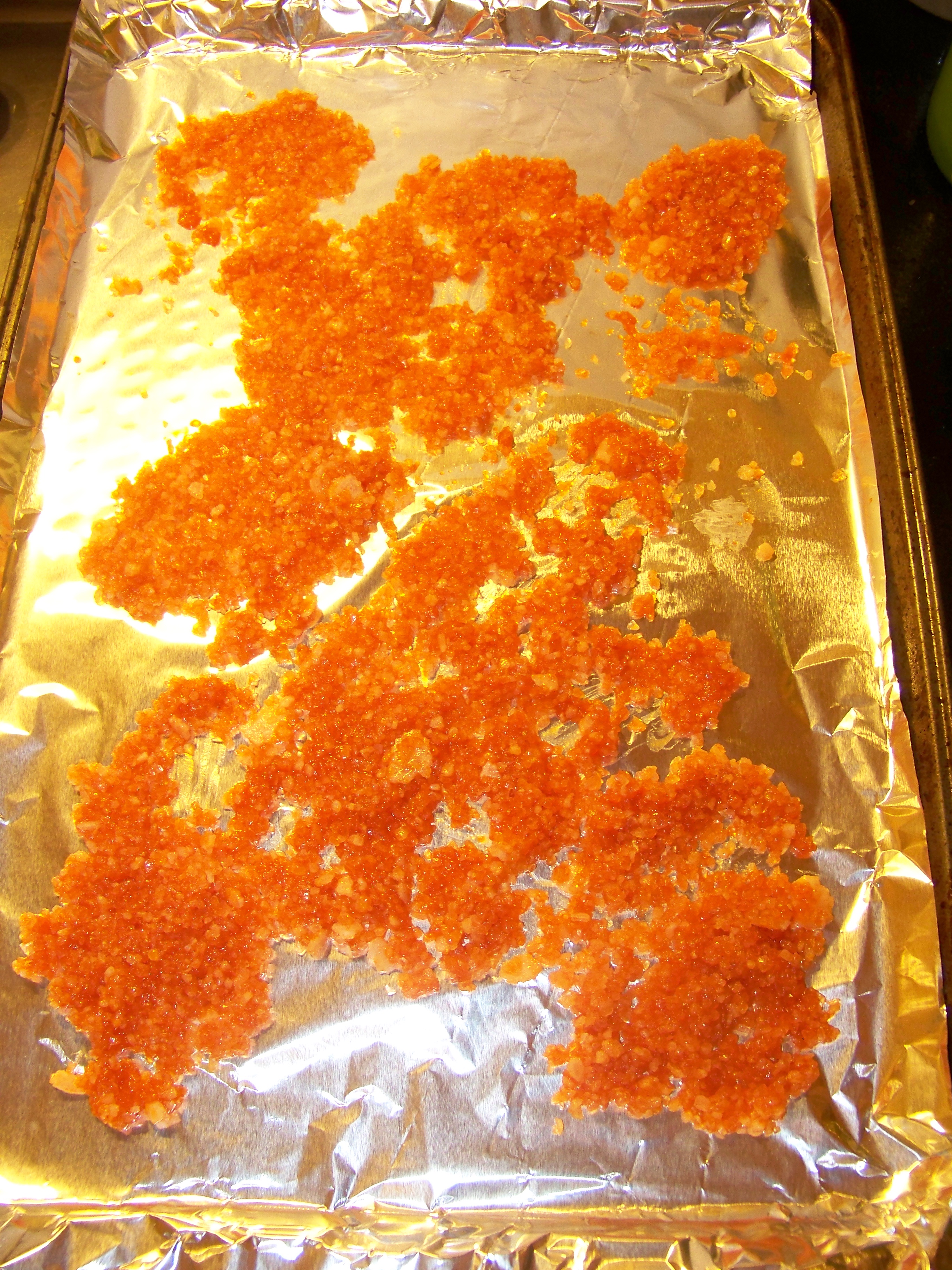
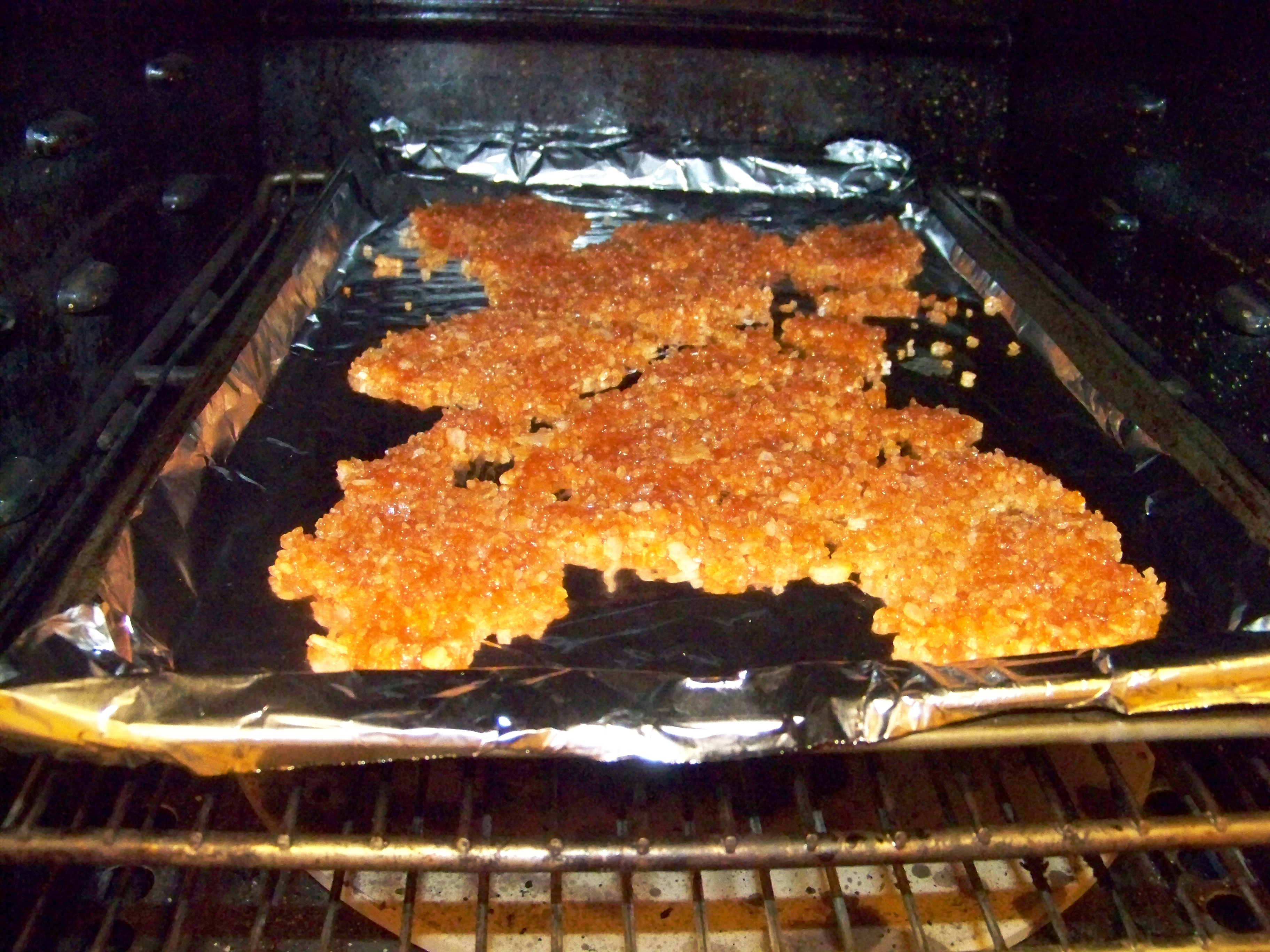
Preheat oven to 350ºF / 175 (actually 176.67)ºC. Mix salt and sriracha in bowl. Transfer from bowl to aluminum foil-lined cookie sheet. Spread out with spoon or spatula to thin layer. Turn off heat in oven. Place tray in oven and allow to dry, about 2 hours, but it’s fine to leave it in overnight. You’ll want to give it a stir and a scrape every 20 minutes or so for the first hour, just to help prevent excess clumping and promote drying. Any crystals that remain clumpy can be broken up by shaking vigorously in a covered container, or separated mechanically, either with a fork in a bowl or in a small spice grinder/food processor (just a few quick pulses will do the trick — you don’t want to pulverize the salt!). [Of course, you could also spread your salt mix on the fine-mesh screen of your dehydrator as well, but I’m guessing that for every kitchen equipped with a dehydrator, there are about half a million that are not.]

Spread the salt on the cookie sheet.

Spread the salt on the cookie sheet.

Put it in the oven.

Put it in the oven.

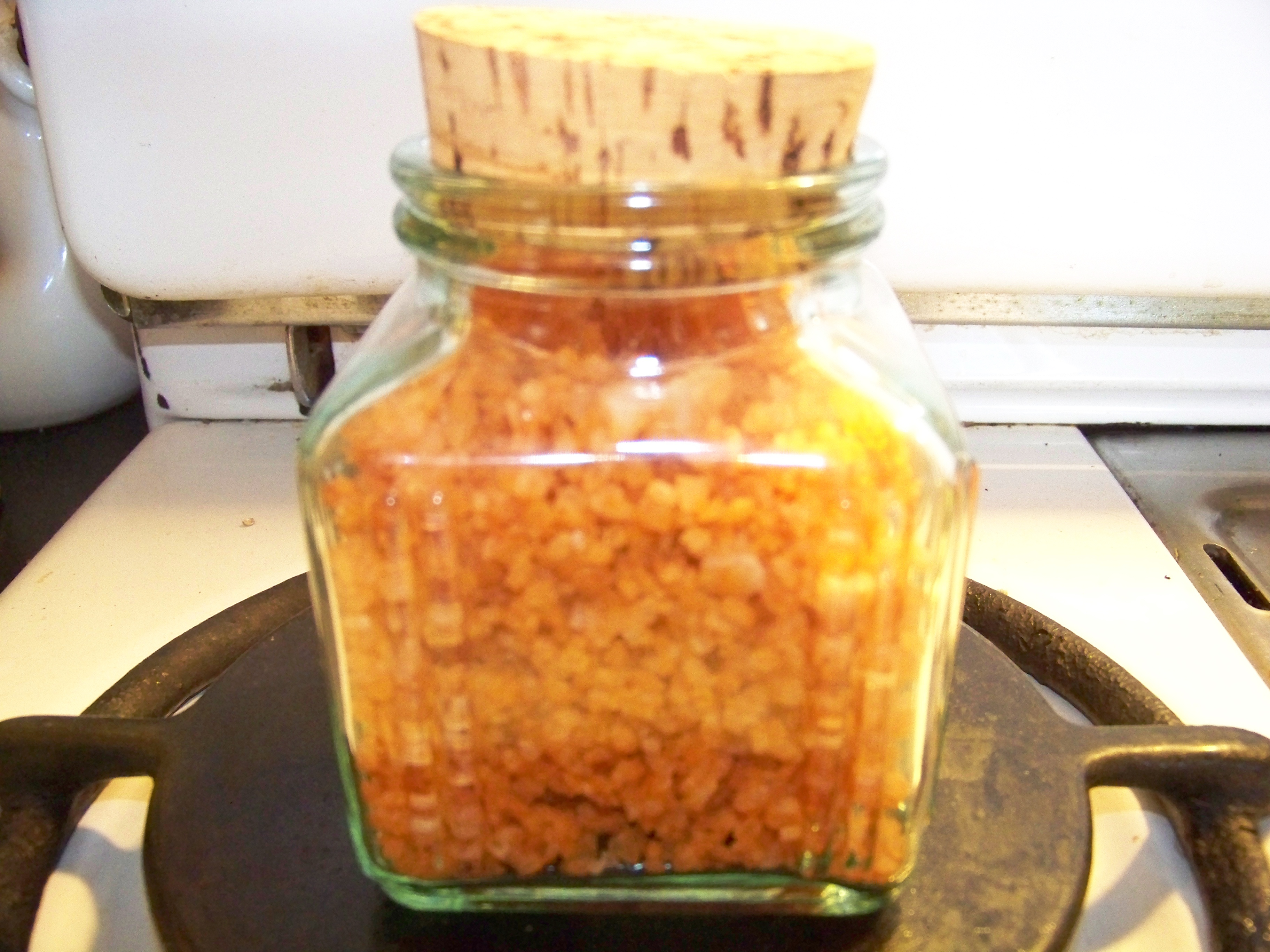
After a couple of hours, it will look like this.

After a couple of hours, it will look like this.

Works great for dry rubs, or as a finishing salt for salad, or probably a hundred billion other things I haven’t thought of. But it’s simple, and inexpensive, and it makes a great gift. Heck, everybody uses salt. And any friend who receives a little container of this as a present will think you’re some sort of kitchen wizard, possessed of superhuman culinary powers. Don’t ruin it for them. Let’s just keep this our secret, okay?

Ready to rock.

Ready to rock.

Saffron Risotto with Peas and Langoustine

2
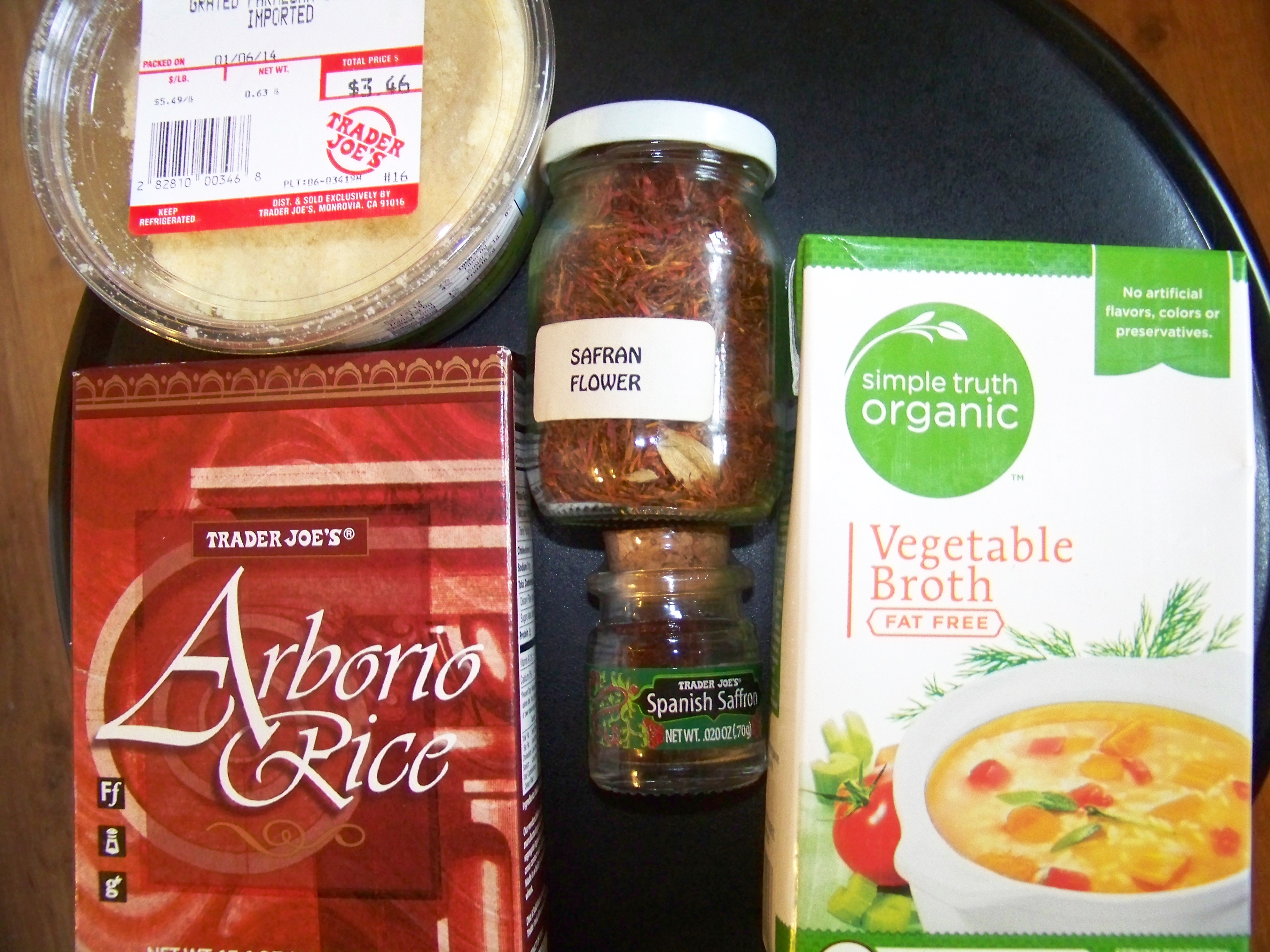
No, I didn't make my own stock or grate my own cheese this time; please don't judge

No, I didn’t make my own stock or grate my own cheese this time; please don’t judge

In what passes for winter in Southern California, one may on occasion wish for a wintry dish, and nothing fills that bill quite like risotto. There are a million ways to make it, but I had a hankering for some peas, and I had gotten a great deal on some frozen (and pre-cooked) langoustine, so I cogitated on what spice might work well with the two of them; I settled on saffron. I had some that my brother had brought back from Turkey, and a little (slightly fresher, if not as exotic) Spanish saffron from Trader Joe’s, each of which made it into the final mix.

Risotto (or “little rice”) can be traced back to 16th century Milan, though rice’s role in Italian cooking predates that considerably, having likely been introduced by the Arabs who conquered Sicily in the 9th century. By many accounts, saffron arrived in Italy in the 13th century, though it’s not clear who brought it in. Why it took the Italians three centuries to marry saffron and rice in this dish is something of a mystery, but it just bears out the thesis that risotto is the great-granddaddy of the slow cooking movement. Arborio rice, which is central to the dish, is a short-grain rice named after the town of Arborio in the Po Valley, where it is grown. [Some areas in Italy use other varieties of rice; Milanese chefs are said to prefer Carnaroli rice, while Vialone nano is more popular around Venice. Neither are as widely available in America as Arborio, though both can be found at Italian specialty markets or through Amazon.]

Two things about risotto: First, don’t be intimidated. It’s time consuming, no doubt, but once you get your head around that, it’s really not hard to make a very tasty, elegant dish that will wow your friends (or, in this case, endear me to The Bride). Second: There is no speed round when it comes to risotto making. Commit to stirring constantly for the better part of 45 minutes. Think of it as a kitchen meditation, where all the world’s cares drop away and you can focus on the gastronomical, physical, and spiritual union of stock and rice.

INGREDIENTS:

• 1 liter (4 cups) vegetable stock, maybe a bit more
• 75g (5 tbsp) unsalted butter
• 30ml (2 tbsp) olive oil
• 1/2 medium brown onion, finely chopped
• 1/2 celery stick, finely chopped
• 2 garlic cloves, crushed and chopped
• 375g (1 3/4 cups) Arborio rice
• 190g (1 1/4 cups) frozen peas
• 500g (1 lb) frozen cooked and shelled langoustine
• Pinch of saffron threads
• 125g (1 cup) finely grated Parmesan
• Salt & freshly ground black pepper
[Remember, grams are a measure of weight, and cups are a measure of volume, so there’s a little room for movement here. We’re not in a science lab.]

Stock warming nicely

Stock warming nicely

DIRECTIONS:
First, bring the stock just barely to a boil, then set it back to a simmer. If you have not yet defrosted the langoustine (they often to tell you to do it the night before by moving them from the freezer to the fridge, but I rarely plan that far ahead), take them from the freezer, put them in a sealed plastic bag, and set the bag in warm water. Since they will only be at this warming temp for about 40 minutes or so, you don’t need to panic about bacterial bloom or other fishy evils.

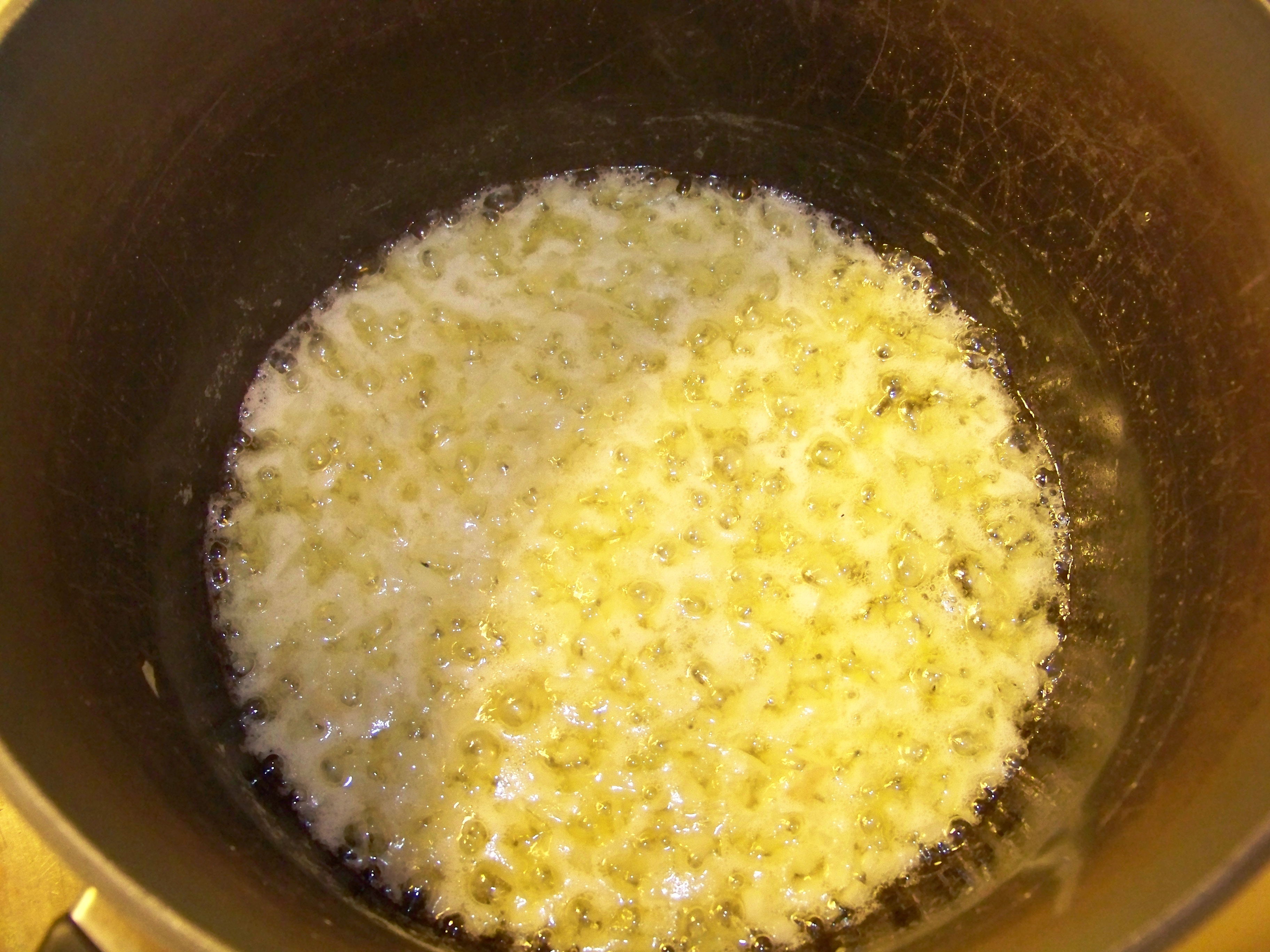
Butter and allium products bubbling

Butter and allium products bubbling

Next, heat the butter and oil in a large saucepan over low heat until foaming. Add the onion, celery and garlic, and cook, stirring, for 5 minutes or until onion softens. Add the rice and cook, stirring, over medium heat for 1-2 minutes or until the grains appear slightly glassy.

Stir until the rice is coated with butter and begins to turn glassy

Stir until the rice is coated and begins to turn glassy

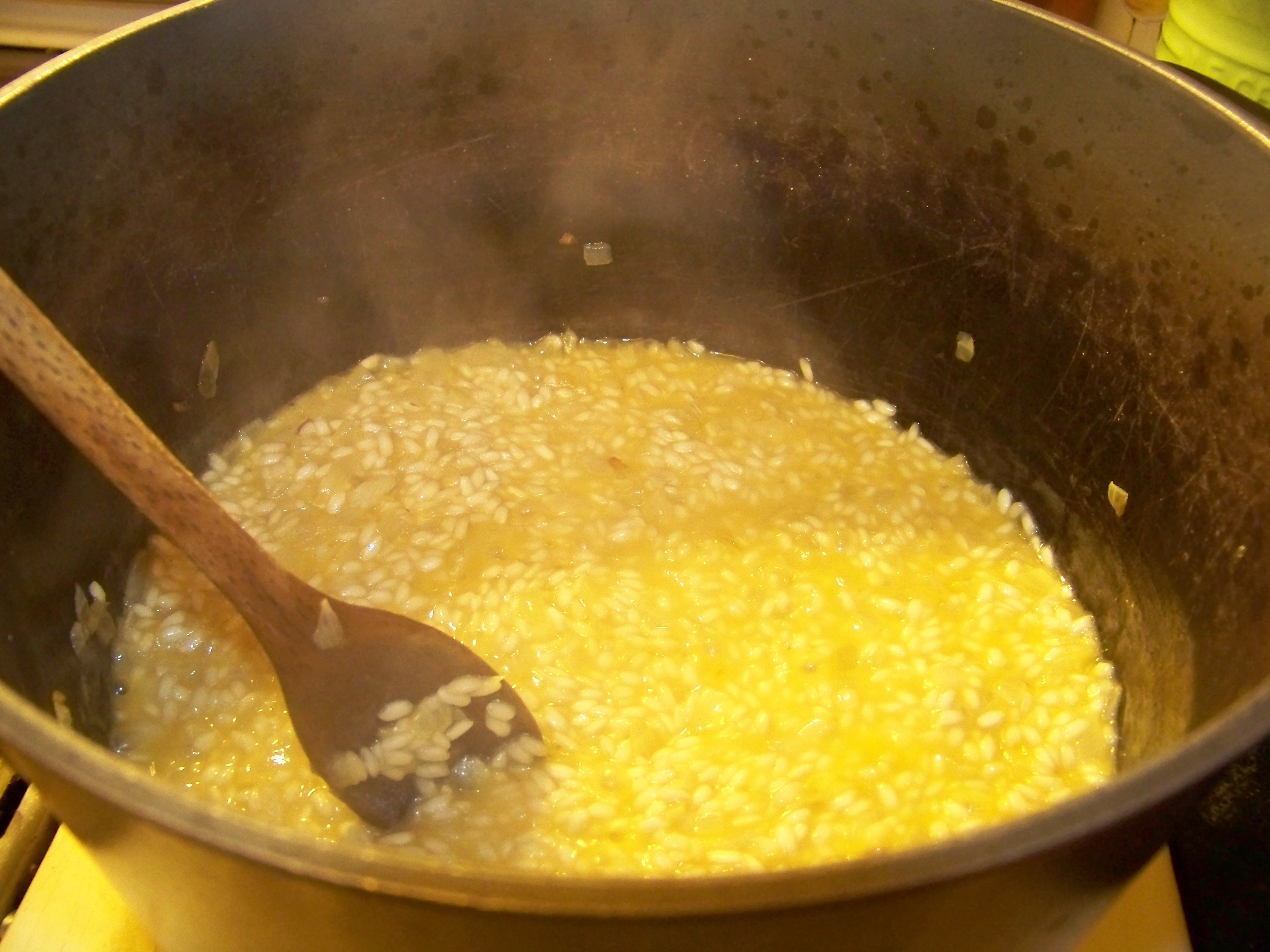
Add a ladle (about 125ml / 1/2 cup) of the heated stock to the rice mixture and use a wooden spoon to stir until the liquid is completely absorbed. Why wood? It’s so much nicer than plastic, isn’t it?

Adding some stock, then stirring, and stirring, and stirring...

Adding some stock, then stirring, and stirring, and stirring…

Continue to add the stock, one ladle at a time, stirring constantly and allowing the liquid to be absorbed before adding the next.

As the rice absorbs the stock, it gets creamier

As the rice absorbs the stock, it gets creamier

Cook until the rice is just tender and the risotto is creamy (this will take at least 25 minutes — DON’T RUSH).

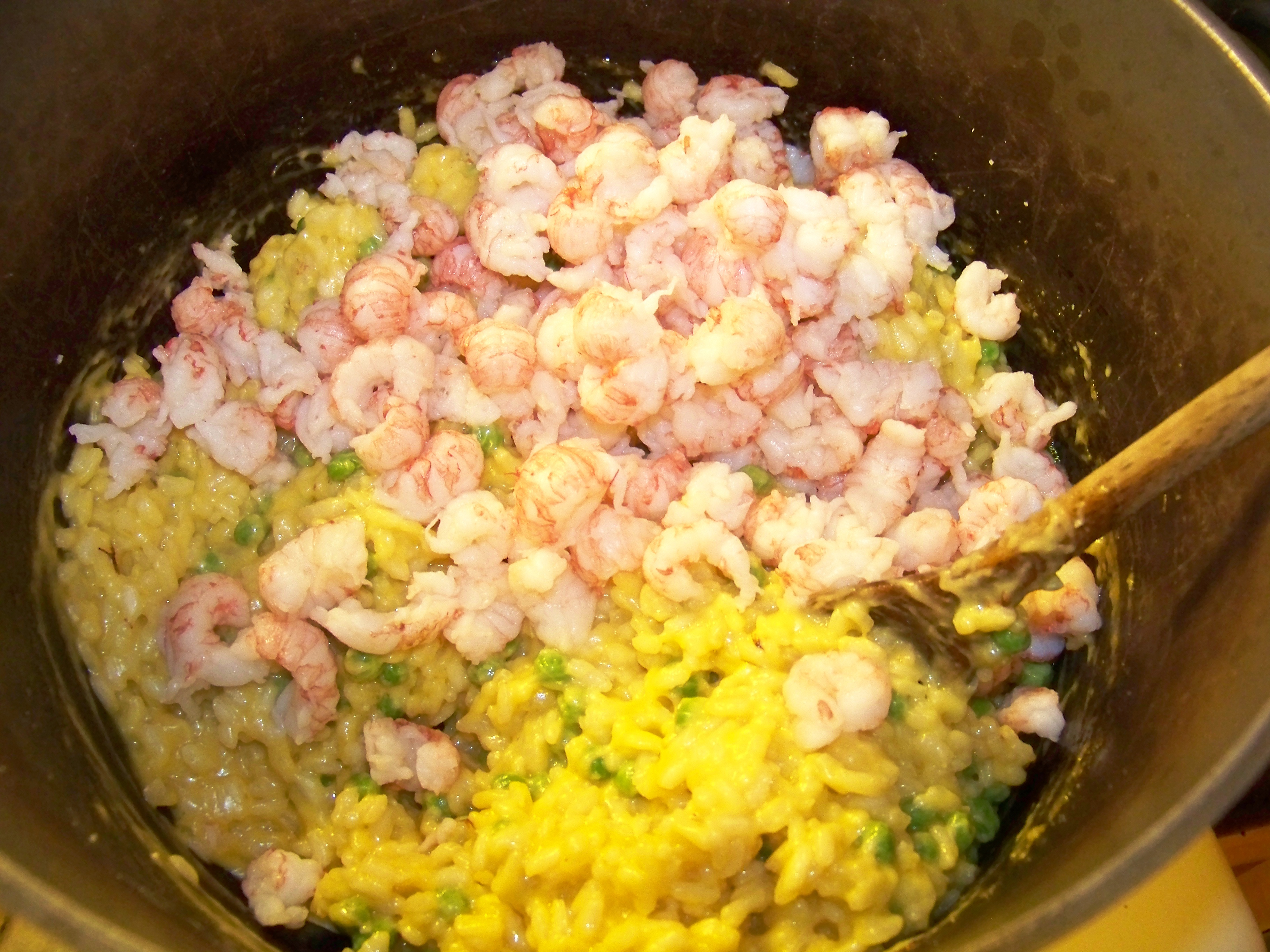
Ready for the last little mix; langoustines, peas, and cheese all added

Ready for the last little mix; langoustines, peas, and cheese

Add the langoustine, peas, and saffron, and cook, stirring, for 3 minutes or until well combined and heated through. Remove from heat and stir in the Parmesan. Taste and season with salt and pepper. Remember: the Parmesan brings its own saltiness, so have a light hand with the NaCl! You can always add more salt — even at the table — but you can’t take it away.

C'est fini! Or, more appropriately, è finito.

C’est fini! Or, more appropriately, è finito.

Spoon the risotto into bowls and serve immediately. Try not to consume it like a just-uncaged wolverine.

Building a Greater Grater

2
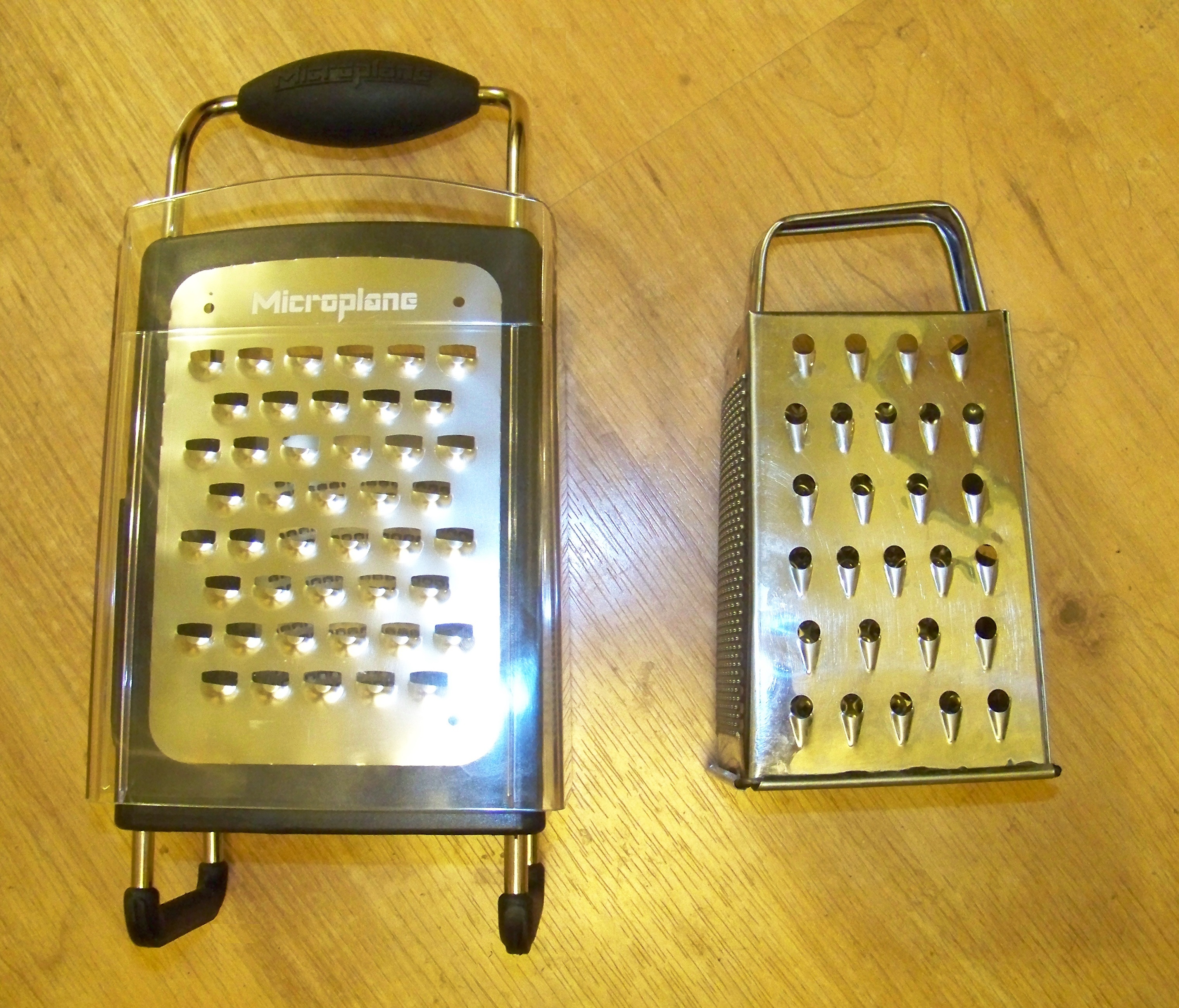
Grating my nerves, mostly

Grating my nerves, mostly

I’ve never had a happy relationship with any box grater, ever. For the most part, they are designed for a child’s hand, are honed about as sharp as Carrot Top’s wit, and embody the confidence-inspiring sturdiness of single-ply bathroom tissue. Basically, they feature one marginally useful side (pictured), while the other three are for clogging, juicing, and… I never quite figured out what that fourth side was for. On occasion, I might be able to shred cheddar, provided it nailed the precise thermal sweet spot where it neither crumbled nor smeared, which, to the best of my ability to determine it, is 2.5˚C (36.5˚ F), or just slightly colder than the interior of my fridge. Accordingly, the potential gratee usually detoured briefly to the freezer while I tried to triangulate the stay required to arrive at la température idéale. Upon its removal, I had roughly 41 nanoseconds to complete my task before the warmth of my hand and the ambient temp turned le fromage into un blob gluant. Back to the freezer, 41 more nanoseconds, again and again and again.

During the holidays, I decided to buy a new grater for The Bride as a stocking stuffer, and I was determined not to repeat the same mistake I had been making for the better part of 40 years. Enter the Microplane 4-Sided Box Grater.

Size isn't everything, but it does count

Size isn’t everything, but it does count

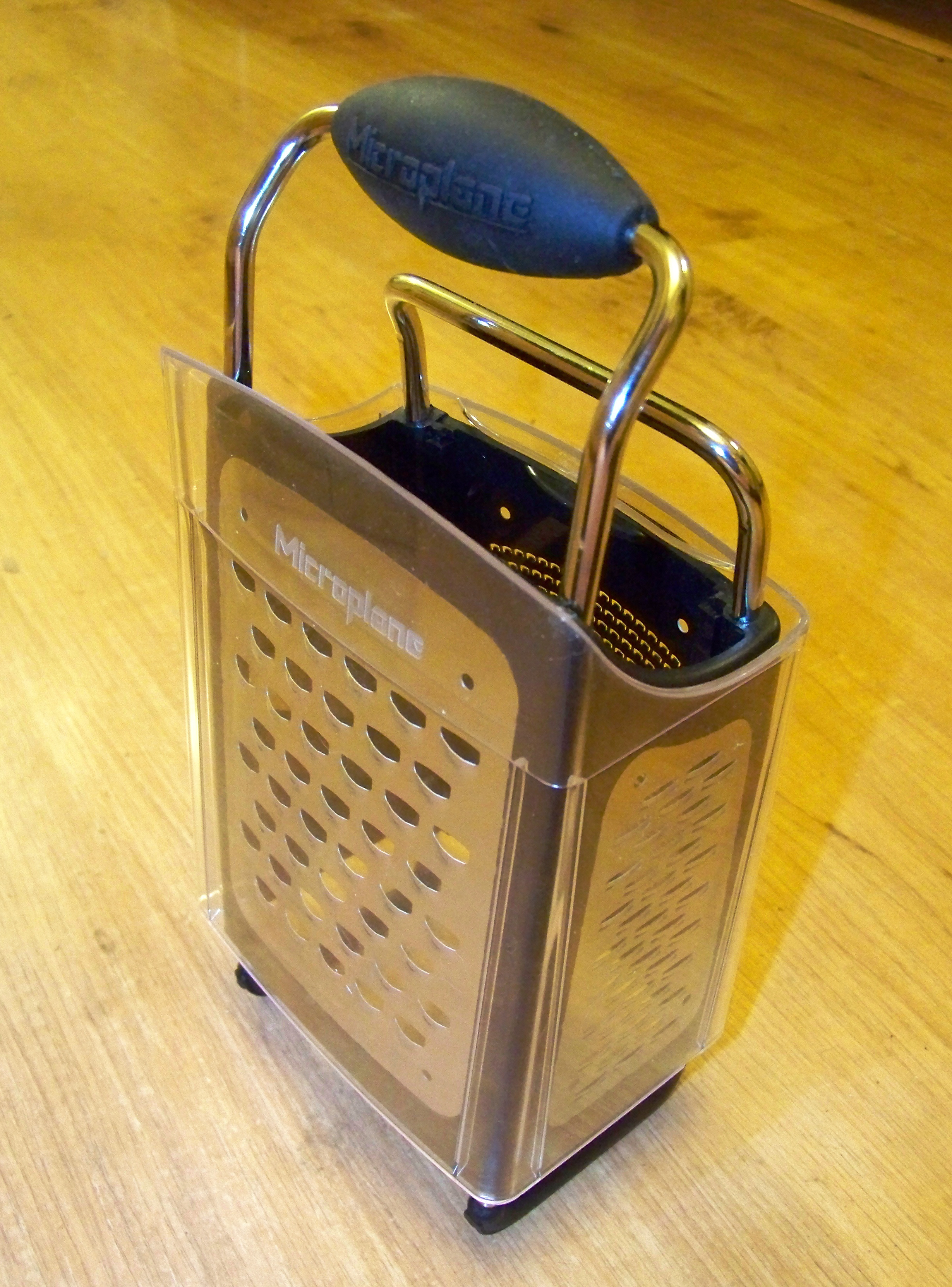
If there is such a thing as the Maybach Landaulet of box graters, this is it. Strike that — they don’t make Maybachs anymore, and new Rolls-Royces are just plain fugly, which this isn’t. Call it the Bentley Flying Spur of box graters; not flashy, but meticulously engineered. To extend the metaphor, if the price of the average box grater in Target’s or Tesco’s housewares section were indexed to, say, a Kia, the Microplane is gonna cost you like a Cadillac. [I think I paid $35 USD + tax for mine at Sur la Table.] But oh, what luxuries it affords.

Who's the greatest of them all?

Who’s the greatest of them all?

Let’s start with the dual handle; nicely contoured for the palm of the hand, with an additional finger grip for added stability. The plasticised feet set the tool’s base about an inch above the cutting board/pan/plate surface, so you can actually see how much you’ve grated (used to be, one had to lift up the grater to peek, which meant carrot or parsnip or cheese shreds tumbled out, thereby making it impossible to set it level again without a pile of fuss). The blades, which are hella sharp, come in ultra coarse, fine, medium ribbon, and slicer sides, the latter of which provides a sort of mini-mandoline for cucumbers and carrots and the like. One of the sides even slides off so you can comfortably (and thoroughly) clean the grater’s interior. And maybe best of all, it comes with a protective plastic shield for storage, which keeps the blades sharp and your fingers safe (when reaching in the drawer for it, anyway; the usual safety cautions apply during use). No wonder it took the gold medal in the Kitchen Hand Tools category of the 2009 Housewares Design Awards.

This may not be the last box grater you’ll ever need, but it’s probably the first one you won’t regret having bought.

Such a Tool

2
Everything put together can be taken apart

Everything put together can be taken apart

No cook or chef I know — myself included — ever seems to have enough storage space. The recently acquired Piment d’Espelette doesn’t fit into the spice rack, the deal you got on parchment paper at Costco means you’ll be keeping it in the garage (or worse, the back seat of your car), and measuring spoons often exhibit a sock-like knack for going missing unexpectedly, particularly at a mission-critical juncture. The folks at Progressive International have more or less solved this last dilemma with four sets of measuring spoons that have mastered the art of spooning, in that they nest — and remain — together in the drawer. No more hanging spoons off a ring like a jailer’s keys. No more trying to eyeball 7.5 mL’s worth of baking soda in a 15 mL spoon.

From a design standpoint, they are elegant and really thought through. First, they have measuring bowls at both ends, one narrow for digging spices out of small-necked jars, one round and well suited to liquids. How many times have you had to wash or dry your measuring spoon because you were moving from wet to dry ingredients? Problem solved. Second, they are flat on the bottom, so they sit perfectly on the counter or stovetop, making it easy to drizzle in a little liquid from the jug of olive oil or vinegar. Third, because the stems and bowls are flush, it’s easy to scrape across the top to level off dry ingredients. Fourth, they display both metric measurements and their archaic counterparts. And finally, they lock together, keeping them beautifully compact and always at the ready in the storage drawer. As a special bonus, any spoons superfluous to your current project can remain locked together, presuming you arrange them from smallest to largest.

Measuring spoons spooning

Measuring spoons spooning

The set I have (pictured above) are made of stainless steel and snap together mechanically at the mid-section, but you can also get a snap-fit set made from plastic, and both plastic and stainless versions with embedded magnets to wed them.

Brilliant. Simple. How ever did I get along without them?

Next up for this kitchen: Progressive International has adapted the genius bit to measuring cups. Gotta get those without doubt.

[NOTE: While many of these links send you to Amazon.com, Progressive International products are available through a variety of retail channels, both brick-and-mortar and online.]

*********

Special kudos to iheartorganizing.blogspot.com for their photo of kitchen drawer chaos. Makes me feel like I’m right at home. And to theoatmeal.com for the first coherent explanation on why socks can’t live together in peace and harmony. [They’ve also neatly outlined the difference between mayonnaise and Miracle Whip in an R-rated strip.]

Shepherdless Pie — or — Don’t Kvetch About Guvech

0

Gyuvech: It's not only the container... it's what's inside.

Gyuvech: It’s not only the container… it’s what’s inside.


One-paragraph history and etymology lesson rolled into one: In Bulgaria (and throughout the Balkans), meat and vegetable casseroles are often made in beautifully decorated earthenware pots known by a staggering variety of names, including guvech, gyuvech, đuveč, ѓувеч, гювеч, ђувеч, and others. The word has become not only synonymous, but indeed coterminous, with the meal prepared within it. [In that sense, it’s kind of the opposite of the word restaurant, which, back in the mid-18th century, was the name of a bouillon, later morphing into its modern definition of where that bouillon is served (when bouillon is served there at all, rarely the case these days).] By the time the word reached Turkey, it had become güveç, which more or less transliterates into guvech or guvetch, which is how we know it in North America.

Just like my great-grandma didn't used to make. But someone else's did.

Just like my great-grandma didn’t used to make. But someone else’s did.

As with any casserole/stew/hotchpotch, there are something approaching an infinite number of recipes for guvetch, but I’m quite fond of this meatless commercial variety, produced in Bulgaria by Konex Foods and marketed In America by Indo-European Foods under the label ZerGüt. It may be my favourite guvetch because it’s the only kind I’ve ever had (which is true), but it’s quite delicious on its own terms. According to a spokesperson for Konex, the commercial recipe is derived from one handed down by one of the company founder’s ancestors. The vegetarian guvetch they market (pictured above) is a simple mélange of aubergines, peppers, potatoes, carrots, water, sunflower oil, green beans, tomato paste, peas, salt, okra, onion, sugar, and parsley, with no preservatives, artificial flavours, or colours. At 250 calories per 19 oz. bottle, it’s easy on the diet, too.

A potful of potatoes.

A potful of potatoes.

Flash forward to earlier this evening. I’d had a hankering for shepherd’s pie, but there wasn’t any ground lamb to hand, and I decided to take a whack at a vegan version.

SHEPHERDLESS PIE

Ingredients
2 large Russet potatoes
4 smallish yams (about a pound or so)
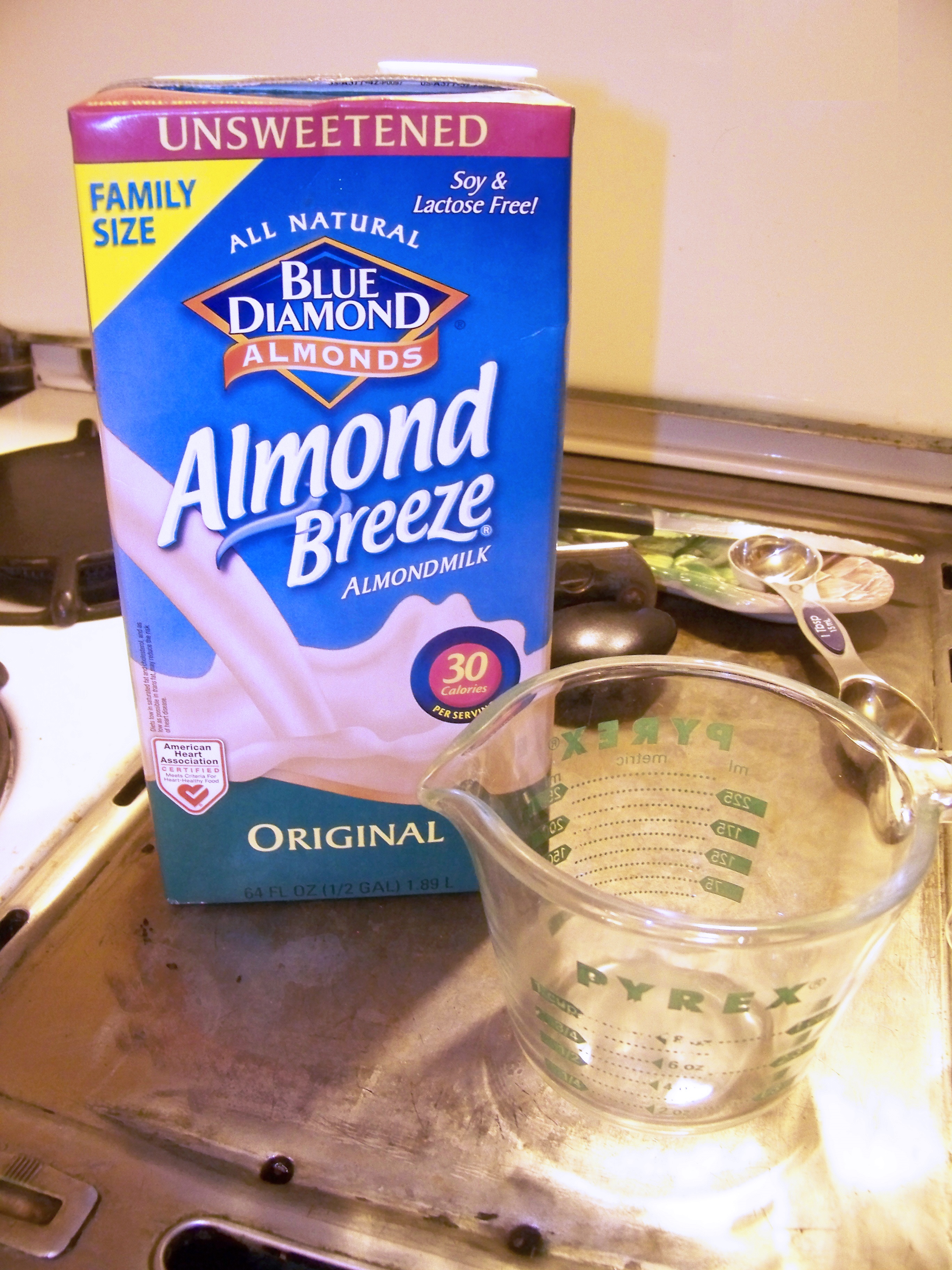
3/4 cup unsweetened almond milk
2 tsp salt
1 jar ZerGüt guvetch

Directions
Set a pot of salted water on to boil. Peel potatoes and yams; cook in boiling water for about 20 minutes, or until soft. Drain. Return to pot and mash with almond milk and salt; set aside to cool slightly.

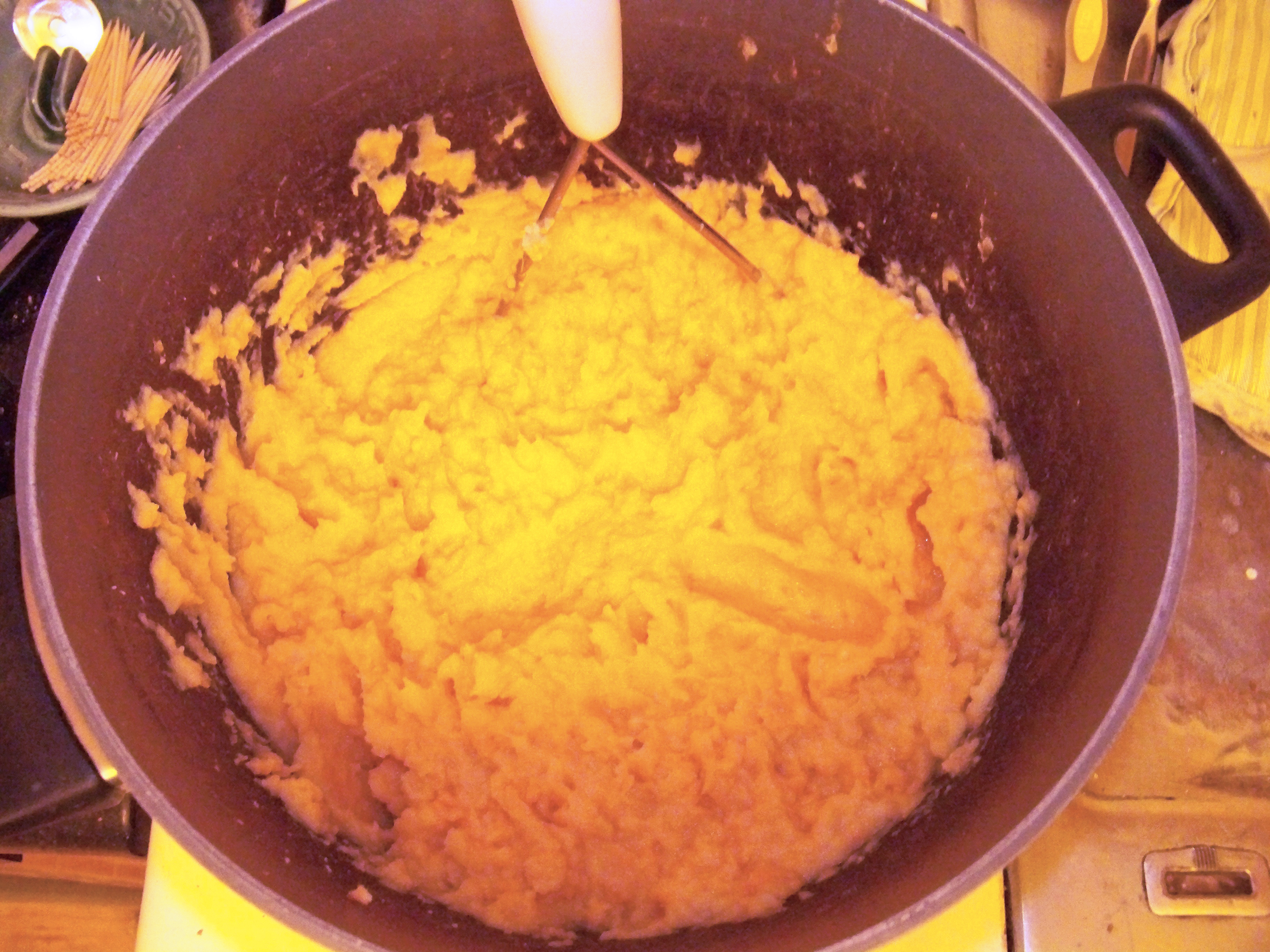
Mashed potatoes, yeah.

Mashed potatoes, yeah.

Divide guvetch evenly into six ramekins. Microwave on high for about 2 minutes to warm.

Microwave me, baby!

Microwave me, baby!

Here’s where I got silly. The simple thing to do would have been to spoon the mashed yam-and-potato mixture on top, fluffing it with a fork to create those peaks that would brown underneath the broiler (about 8 minutes, and rotate the tray at 4 minutes). Instead, I pulled out a pastry bag and a star tip, and piped the potatoes in over the guvetch. Totally unnecessary, totally fun.

Sack o' spuds.

Sack o’ spuds.

If you decide to do it that way, work in a circular motion from the edge toward the center, finishing with a little peak on top.

Piped, but not yet piping hot.

Piped, but not yet piping hot.

Place the ramekins on a foil-lined baking sheet. Eight minutes under the broiler (or you can use a kitchen torch, if you wanna get fancy about it). Rotate the pan at four minutes, and have a care, because some broilers are more efficient than the one in my sixty-year-old O’Keefe & Merritt.

Good to go, after they've cooled a tad.

Good to go, after they’ve cooled a tad.

Allow the ramekins to cool sufficiently that you can handle them — albeit gingerly — with your bare hands. Serve while warm. Makes six.
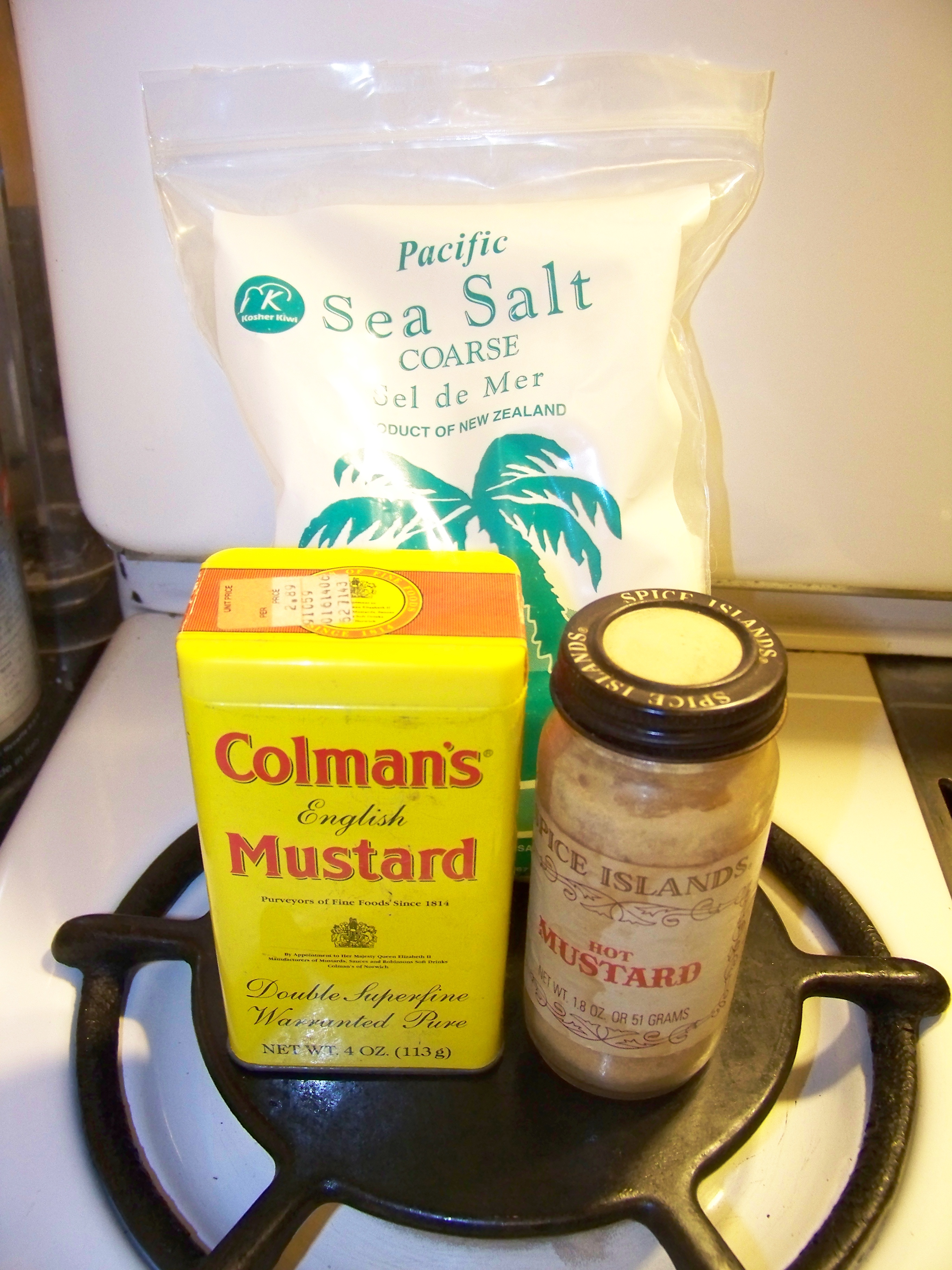
[NOTE: Bottled guvetch is available at markets that cater to an Eastern European clientele, but it can also be purchased online. The big issue here is the shipping cost, which makes it kinda prohibitive to buy a single jar. If you are willing to purchase a six-pack, you can bring your cost down to about $6.50-$8 per jar (depending on where you live), which is about twice what you’ll pay for it in an ethnic market. It can be ordered online from Salonika Imports in Pittsburgh, so the closer you are to them, the less you’ll pay to have it shipped. Alternatively, you could chop and heat your own vegetable mélange; Google “guvech recipe” for ideas, or just go for it as the vegetable bin provides and the spirit moves.]

Potatoes au Gratin sans Fromage (Vegan-style)

3
It's plane to see.

It’s plane to see.

We’ve been doing Meatless Mondays around the pad for years now, and that frequently means one of several standbys, often involving potatoes. [What can I say, I’m Irish.] My original intent had been to take a whack at Chef Thomas Keller’s Potato Pavé recipe, but time and energy conspired against me, so I opted for Potatoes au Gratin. As luck would have it, The Bride and I dined a few days ago at Crossroads, an excellent vegan restaurant in Los Angeles, and that inspired me to retool the cheese-oozing, cream-dripping, diet-busting fave of my youth.

Generally speaking, I’m not much of a fan of ersatz food products (diet sodas largely excepted). I’d much rather have a beautifully grilled portobello mushroom served like a burger than any sort of the Frankenmeats that often try to pass themselves off as beef patties. As a consequence, my first order of business was to strike off most of the over-the-counter vegan cheese substitutes available, as they more often taste like Firma-Grip paste with a side of FD&C Yellow No. 6 than anything resembling fromage. What I wasn’t willing to sacrifice, though, was the creamy, viscous, umami-laden mouthfeel of the real deal. Fortunately, I didn’t have to.

Gotta give some props here to Tori Avey’s blog, The Shiksa in the Kitchen, which published a recipe for Dairy-Free Saffron Scalloped Potatoes that launched me in the right direction. Basically, there are two parts to the recipe: The potatoes and onions, and the sauce. Here’s a list of ingredients:

100_4774100_4770100_4768

DAIRY-FREE, GLUTEN-FREE, VEGAN POTATOES AU GRATIN

For the Sauce:
2 tbsp non-hydrogenated butter substitute (I used Earth Balance)
3 1/2 tbsp flour (I used Cup4Cup gluten-free flour)
1 can (13.5 or 15 oz) coconut milk* — NOT THE NON-FAT OR LOW-FAT VERSION!
1 cup Almond Breeze almond milk, unsweetened
1 tsp sea salt
1 tsp finely minced garlic (or 1/2 tsp garlic powder)
½ tsp tamari sauce (gluten-free soy sauce)
1 ½ tsp mustard powder
¼ tsp Piment d’Espelette (or hot paprika or cayenne powder)
1 tsp celery flakes or parsley flakes (optional)

For the Taters:
4-5 lbs Russet potatoes (you could use Yukon Gold as well, but Russets are way cheaper)
1 large onion
several dashes paprika for colour and presentation, optional

You have a couple of choices here (more if you are not acting as your own sous chef, which I was). Either make the sauce first (which I did), or slice the potatoes and onions first. If you are slicing the veggies first, please feel free to skip ahead. [Do remember to put your potato slices in a bowl of cold water to keep them from going brown while you’re working on other stuff.]

Making the Sauce:

Making the roux.

Roux the day.

Melt the butter substitute (or margarine, even if it’s not called that) over medium heat in a saucepan or pot, and whisk in the flour a tablespoon at a time, stirring more or less constantly to make a roux. Let it brown a bit, maybe two minutes or so, and then begin adding the coconut milk, about 1/3 of a can at a time. [The full fat variety of coconut milk will probably have a big fatty plug at the top of the can; this is a good thing. Smooth it as you whisk.] Then add the almond milk and spices, continuing to whisk all the while (nothing says “M-m-m-m, tasty!” quite like a thumbnail-sized lump of mustard powder in your finished dish). The reason I used tamari rather than regular soy sauce was to keep the recipe gluten-free; if you don’t care about that, your basic Kikkoman will work just fine. All that need be done from here on is to keep it at a simmer; it only has to be warm (and liquid) enough to pour over the potatoes. Cover it (to keep it from reducing) and turn the heat down low while you focus on the next task: preparing the potatoes.

Preparing the Vegetables:

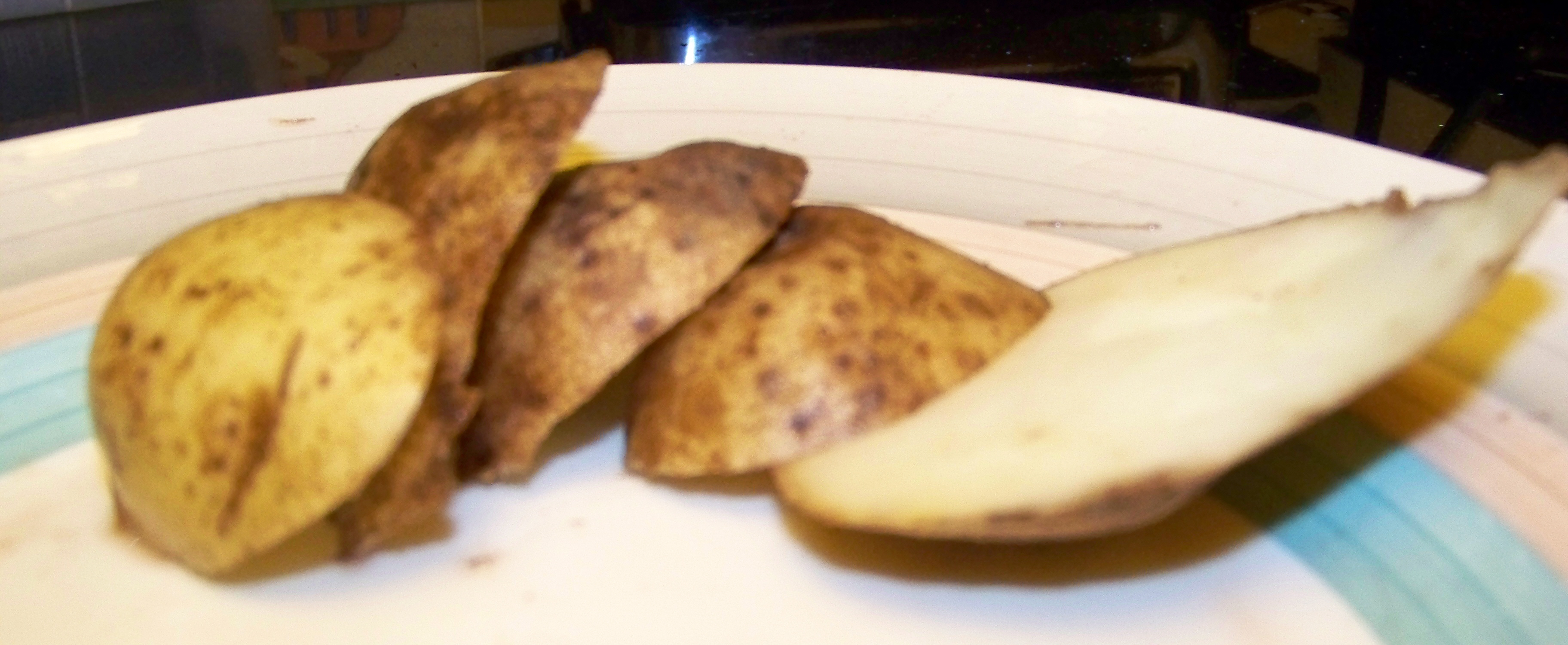
Spud ends.
Spud ends.

First, preheat your oven to 350ºF / 175 (actually 176.67)ºC

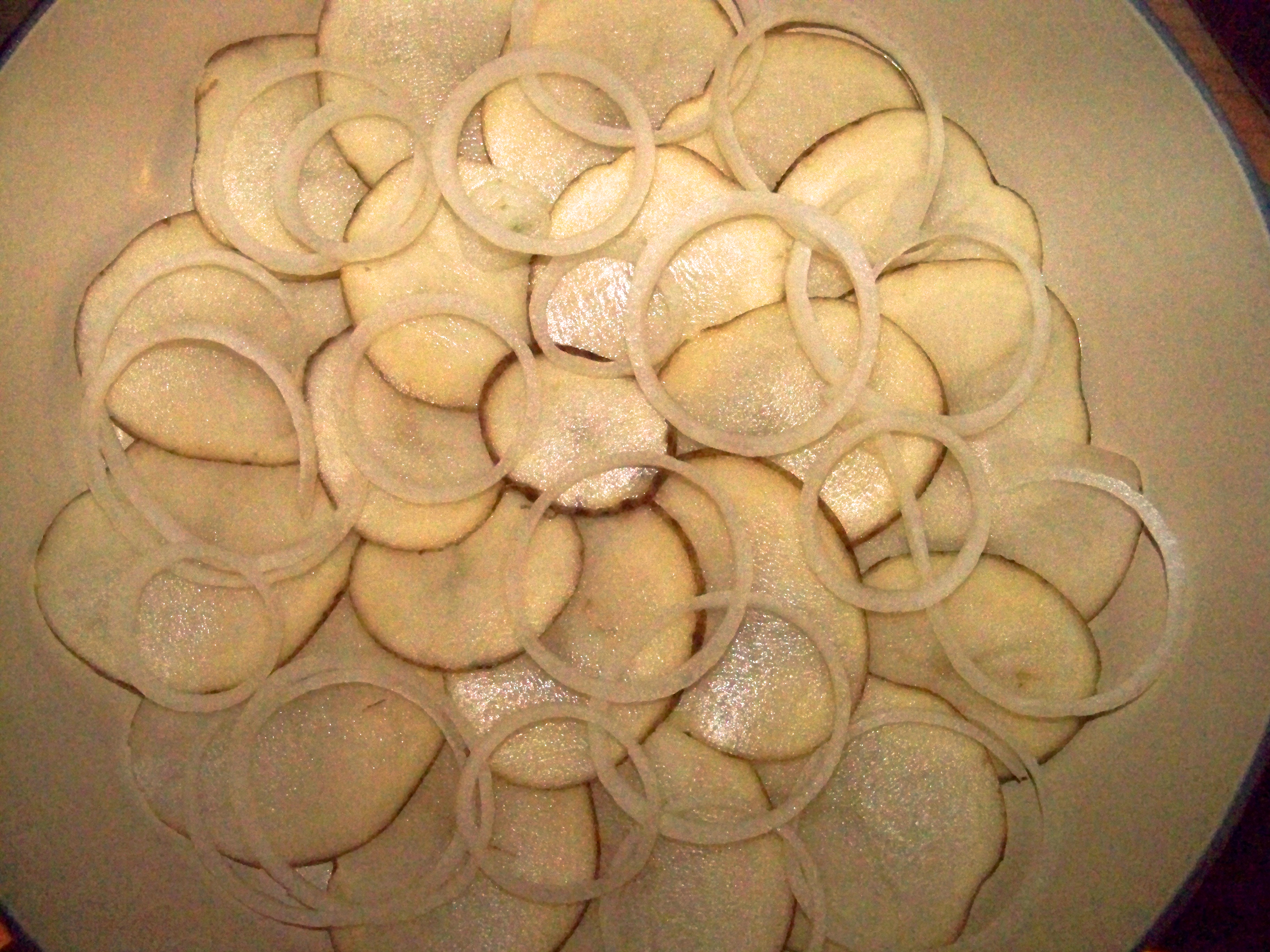
The potatoes (peeled or unpeeled, according to the chef’s whim) should be sliced to a thickness of about 1/8″ or so. More skilled craftsmen than I can perform this task handily with nothing more than a knife, but I use a mandoline (as you can see at the top of the post), and because I am a manly and foolhardy man, I use it without the safety guard. [THIS IS NOT RECOMMENDED!] Should you find the safety guard oppressive, one alternative is to wear a steel mesh or Kevlar glove. But in the true Anthony Bourdain spirit of recklessness, well, I don’t do either of those things. That being said, not only is slicing off your fingertips or shaving your palm — a real possibility! — painful and disfiguring, it also invalidates the recipe’s claim to being vegan. (Blood, even accidentally spilled, is an animal product.) When all the potatoes are sliced (and put in a bowl of water to prevent their discolouring), repeat the process with the onion.

Potatoes and onions, ring the bells of St. Bunion's.

Potatoes and onions, ring the bells of St. Bunion’s.

Layer the potatoes and onions into a greased large baking dish or Dutch oven (I used a 5 qt. Le Creuset Braiser, which worked magnificently). First set down a layer of overlapping potato slices, then scatter some onions on it, then ladle some of the sauce over. Lather, rinse, repeat, until the dish is full (I had about 1/2 lb of sliced potatoes left, which I put in the fridge, and will roast or fry later). Sprinkle some paprika on the top, if you so desire.

Ready for some ovenizing.

Ready for some ovenizing.

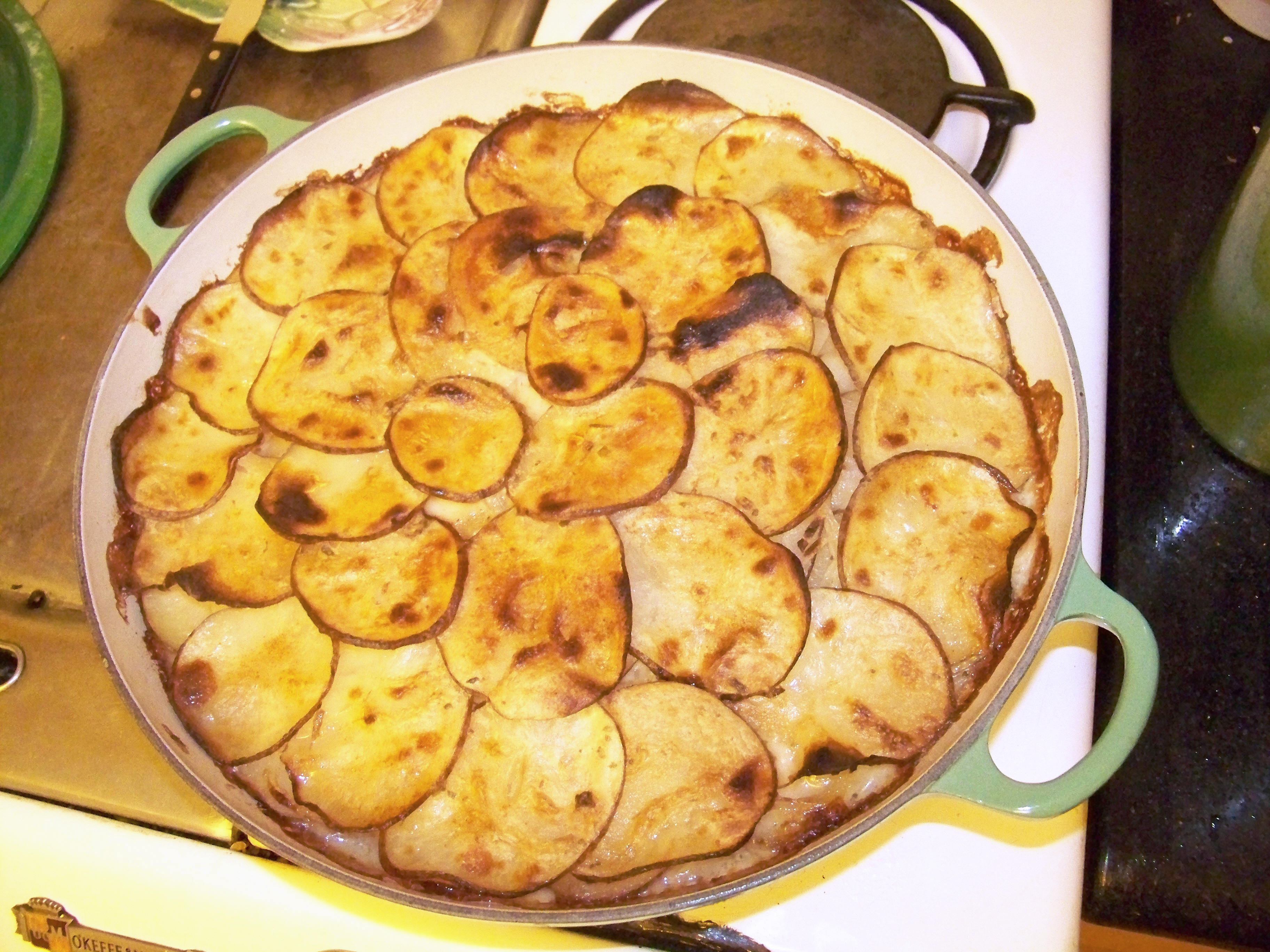
Cover with foil (or put on the lid), and pop it into the oven for 60 minutes at the aforementioned 350ºF / 175ºC. By then, the potatoes should be soft and yield easily to a fork. Give them another 10 minutes in the oven uncovered, and finish them off with about 5 minutes under the broiler to brown the top (be watchful during this process, because it can go pretty fast, depending on the distance between the dish and the flame).

Remove from oven, and allow them to cool for about 10 minutes.

Brown is beautiful.

Brown is beautiful.

Coda: I realized (a little too late) that some diced green chiles would be a terrific addition to the sauce; I heated some up and spooned them over top, but it didn’t have quite the same effect. Also, you may want to add some salt (or allow your diners to) at the table, as it was a tiny bit shy on the NaCl for my taste. And a little fresh ground pepper is also nice.

*The full-fat variety of coconut milk runs about 700 calories a can, which is a not inconsiderable amount, but don’t be tempted by low- or non-fat substitutions, because they won’t provide the same mouthfeel. And when you consider how many fewer calories it has than cream (52 per ounce vs. 103), it’s totally worth the “splurge.” [Also, the almond milk is only 7.5 calories per ounce, and given that you’ve also left out all the cheese, there’s a pretty dramatic reduction in calories compared to the standard au gratin recipe.]

At Home with Sous Vide: A New Cookbook You Can Help Make Happen

0

30839_560_366

An Aussie sous vide pioneer is crowdsourcing a new cookbook. At the time of this post, he only needed a couple of hundred dollars to meet his goal. It’s definitely worth checking out, and if you feel so moved, helping him hit his target.

The aforementioned pioneer, Dale Prentice, has written the text for the book, with lots of insight in to sous vide cooking and tricks for best results. The recipes are by Dale and contributions from chefs and bloggers from around the world. They have some amazing contributors and a truly diverse set of recipes for sous vide cooks of every level.

Photo by author Dale Prentice.

Photo by author Dale Prentice.

Contributing chefs: Bruno Goussalt, Nathan Myhrvold, Wylie Dufresne, Shannon Bennett, Phillipe Mouchel, Stefan Cosser, Brad Farmerie, Spencer Patrick, Jarrod Hudson, Martin Boetz, Shane Delia, Anthony Fullerton, Mark Ebbels, James Blight, Patrick Dang, George Diamond, Dallas Cuddy, Kirby Craig, Adam Draper, Pablo Tordesilla, Ryan Clift, Michael Ryan, Jason Logsdon, J.Kenji Lopez-Alt, Harold and Christine Fleming, Raymond Capaldi, Christine Manfield, Florent Gerardin, Joe Strybel, Wayne Smith, Garen Maskal, Roberto Cortez, Andrew Dargue, Tom Randalph, Darren Purchase, Madalene Bonvini-Hamel and David Roberts.

Support Cooking – At Home with Sous Vide.

UPDATE: 30 September — The project hit its initial funding goal yesterday, but you still have a few days to contribute if you’d like one of the available donor perks.

I’ve got a date with Blondie!

1
Blondies on the stem. Or is it stalk?

Blondies on the stem. Or is it stalk?

I’ve never been a huge fan of dates (either the social or the foodstuff variety), but for a couple or three weeks every year, I go date crazy. Forget everything you think you know about dates. These little darlings have the crunch of an apple, the astringency of quince (at least at first), and the sweetness of honey at the back of the palate. For about one more week this season, depending on where you live, you may have access to these lovely little gems, and I most heartily recommend picking a few up, if only for the experience of tasting something you likely have never tasted before. According to a couple of the local growers (and this thesis was supported by a manager at Hadley’s, a date mecca on the road to Palm Springs), these not-quite-fully-ripe dates are known as “blondies,” and most of them are shipped off to Japan, where they fetch top dollar… or top yen. If you leave them to hang around, their sugar content increases, their skin softens, and they turn into the dates you know and love (or don’t depending on your taste).

Blondies in a bottle

Blondies in a bottle

I pickled a bunch of them a couple of weeks ago, and I’m curious as to how they will taste when they are ready. Stay tuned. In the interim, go and find your own blondie.

The Incredible Hulk in a glass

0

incrediblehulkstylinonline_2270_78360219

The Bride and I were dining at Paiche, an excellent (and highly recommended) new restaurant in Marina del Rey, whose menu offers several intriguing non-alcoholic concoctions. As designated driver that evening, I recused myself from their wonderful wine list, but I wouldn’t settle for fizzy water as my sole potable, so I selected a drink they call The Incredible Hulk. [Cue the ever-litigious Disney (who now owns Marvel Entertainment), likely into its third draft of a cease-and-desist order; by the time you get to the restaurant, it may be called The Bruce (or David) Banner, or something else entirely.]

The Incredible Hulk consists of five simple ingredients: parsley, cactus, orange juice, pineapple juice, and celery. [Here’s a mnemonic for the ingredient list: CC POP.] Living as I do in the Los Angeles area, rounding up some cactus (known at the Mexican grocery store as nopales) was no big deal, and the rest of the items are available anywhere. I kinda cheated and bought pineapple juice and orange juice, rather than making them myself from fresh fruit, as I suspect the restaurant does. I revved up the old Vita-Mixer and ground up six large celery stalks, a pound of chopped nopales (do NOT buy the pickled version or the ones packed in brine for this!), and a bunch of curly parsley with the bottom inch of the stems removed.

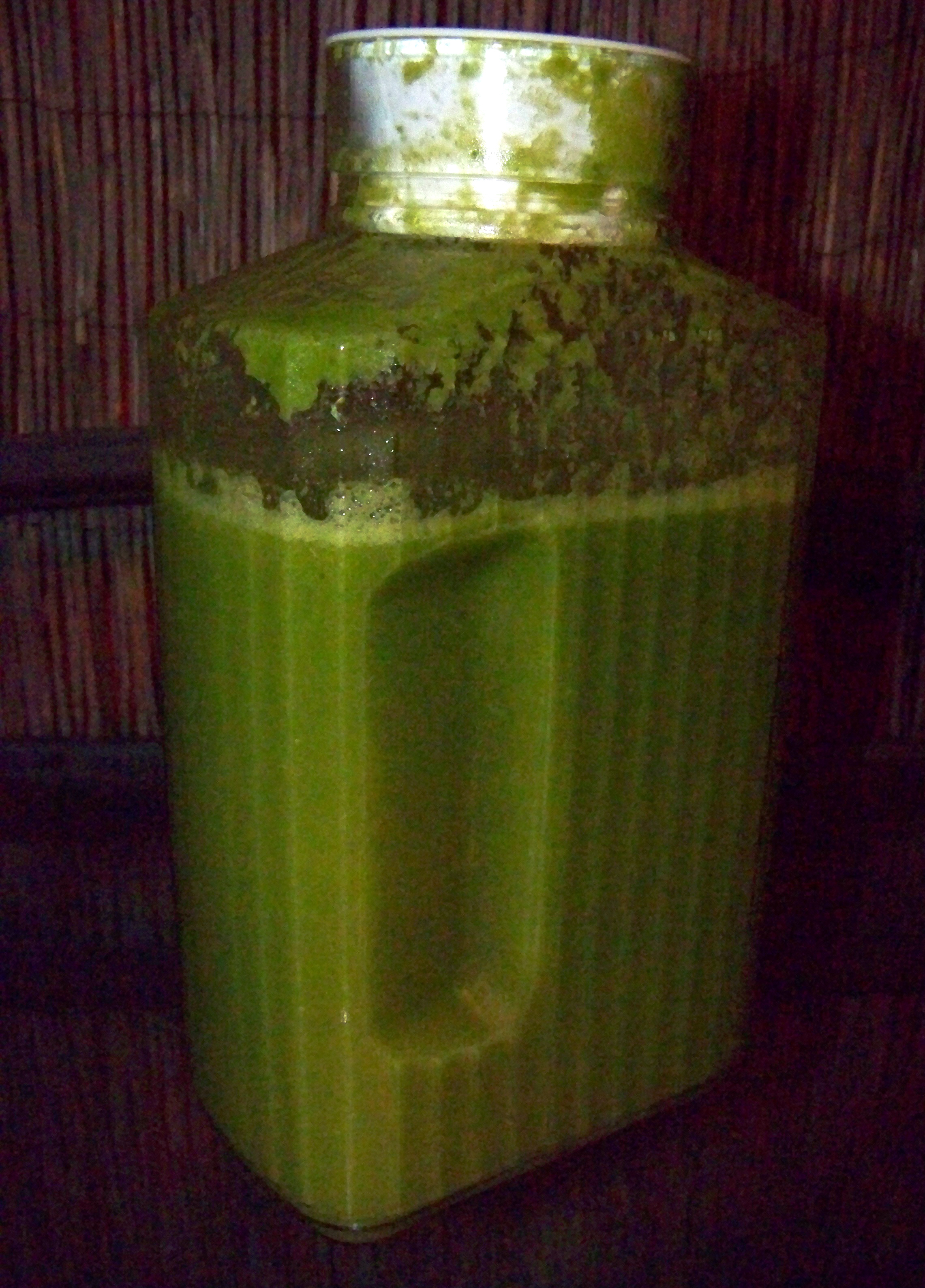
Incredible Hulk sits on stove top without fear

Incredible Hulk sits on stove top without fear

I’ve discovered that adding a citrus juice (or any acidic juice) to cactus juice causes foam to rise more or less immediately, so don’t worry if that happens; you can skim it off or discard it. I just mixed it back in. I prefer my juice a little “greener” than the one Paiche serves, so I used less of the orange-pineapple juice blend than they do, but you can experiment to find your sweet (or not-so-sweet) spot.

Looking for vodka in all the wrong places

Looking for vodka in all the wrong places

THE INCREDIBLE HULK
1 bunch parsley
1 pound nopales (cactus), chopped
6 large celery stalks
32 oz. orange juice
32 oz. pineapple juice

Blend greens and a little bit of the orange and pineapple juices (mixed 50-50) in a Vita-Mixer (you’ll need a pretty powerful blender or food processor to deal with the pulpiness of the celery and nopales) until smooth. [You will likely have to do this in two or three batches.] Strain if you wish (I didn’t). Pour half a glass of the greens mixture into a glass with an equal amount of orange-pineapple juice. Stir and serve over ice. Go on rampage. “Hulk smash!”

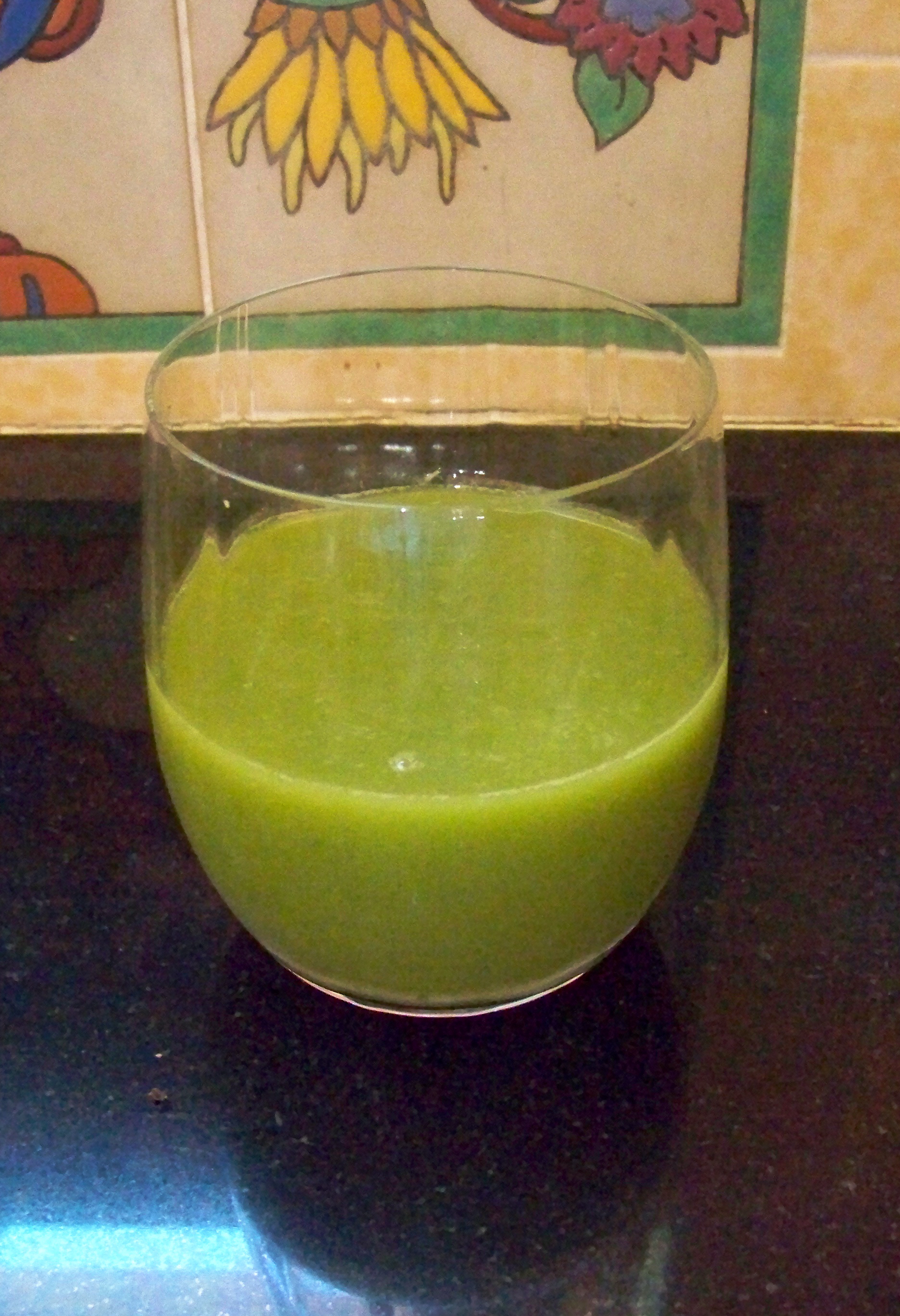
A refreshing glass of the delicious beverage

A refreshing glass of the delicious beverage

Thai One On, or Larb is Just a Four-Letter Word

1
A somewhat inauthentic take on a great Thai salad

A somewhat inauthentic take on a great Thai salad

As truth would have it, despite its being on pretty much every Thai restaurant menu in North America, the salad known as larb actually originated in Laos, though versions can be found throughout Thailand, particularly in the northern part of the country, as well as in Myanmar and China’s Yunnan province (where there is a significant Lao community). The recipes from which I concocted my version come from highly authentic sources, Bon Appetit magazine and Giada De Laurentiis. Fortunately, I’ve had it a about a gazillion restaurants, so I knew the flavour profile. Also, being in the greater Los Angeles area, I had access to ingredients that may be more difficult to obtain in Dubuque, Des Moines, or Denton.

Rather than the traditional ground beef or chicken, I opted for lamb both because I wanted a break from beef and chicken, and also because the market was having a ground lamb sale. [Incidentally, fish and duck are popular protein options for larb as well, so feel free to try your hand with whatever’s at hand. I may yet take a whack at escargot larb if I ever get the wind up.]

Prep consists of a bunch of chopping, followed by a little sizzle in the pan, followed by dumping said protein on either the trad lettuce (or radicchio or endive) leaf, or piling it on some mixed greens, as I did earlier this evening. It’s a mere 30 minutes from concept to plate, making it a perfect alternative to a rabbit food salad with a burger patty sitting forlornly alongside, and simple to prepare after a long day’s work, presuming you have all the ingredients to hand. For those who don’t have immediate access to fresh whole lemongrass (or who don’t want to work at cutting it into bits so small they don’t appear as wood chips in the salad), many supers in the US (including Kroger and its subsidiaries) carry lemongrass paste in the produce section. It’s a bit pricey, but one tube will take you a long way.

Ground lamb and spices being browned

Ground lamb and spices being browned

Larb with Ground Lamb
INGREDIENTS
Dressing
1/3 cup fresh lime juice
2 tablespoons fish sauce (such as nam pla or nuoc nam)
2 tablespoons honey
1 tablespoon Sriracha sauce

Lamb (or other protein)
1 1/2 pounds ground lamb (chicken, turkey, beef, or pork may be substituted)
1/2 cup coarsely chopped shallots
2 tablespoons thinly sliced lemongrass
2 kaffir lime leaves, finely chopped (you can find these at Asian, Middle Eastern, and some Indian markets)
2-3 tablespoons fresh mint leaves, finely chopped
1 small red Thai chile (such as prik kee noo), thinly sliced
1 garlic clove, thinly sliced
2 teaspoons fish sauce (such as nam pla or nuoc nam)
1 teaspoon kosher salt

Greens
1 head iceberg lettuce, or 16 oz. mesclun mix (4 oz. per serving)
1 small bunch cilantro (optional)

PREPARATION
Dressing
Stir all ingredients in a small bowl to blend; set aside.

Lamb (or other protein)
Combine ingredients 2-8 in a food processor, or just chop on cutting board. Season ground meat with salt and place it in a large heavy nonstick skillet over medium–high heat. Add spice mixture and sauté, breaking up meat into small pieces with the back of a spoon, until it begins to turn golden brown and is cooked through, about 6 minutes.
Place mesclun (or a couple of iceberg lettuce leaves) on each plate. Top leaves with meat mixture, dividing evenly. Garnish with cilantro (if desired) and spoon reserved dressing over.

Shameless repurposing, part three: Wolf at the Door, or The Puck Stops Here

0
Wolfgang and Oscar, together again

Wolfgang and Oscar, together again

Yeah, I know I’m going to hell for the puns. I think it was the endless hours of watching Rocky & Bullwinkle as a kid, in which upcoming episodes would be teased with titles such as “The Midnight Chew-Chew, or Stick To Your Gums” and “Fuels Rush In, or Star Spangled Boner.” In 2012, I had the opportunity to interview Wolfgang Puck, who was as charming on the telephone as he is on the television (and, presumably, in person). I realize that one doesn’t climb to the Elysian heights that Puck has ascended without a healthy double dollop of ego, but I found him to be surprisingly modest. Much like Emeril Lagasse, Puck has built a loyal cadre around him, many of whom have been in his employ for upwards of 20 years, which is no mean feat in the remarkably transient business of hospitality.

And, like virtually everyone who has achieved justifiable fame in the cooking profession (I’m pointedly leaving out many — though by no means all — of TV’s instant celebu-chefs, who maintain a virtual chokehold on the Cooking Channel and the Food Network “reality” shows these days), he laboured for years before ever penetrating the public consciousness, leaving home at 14 to work as an apprentice at a bakery. His first major gig in America was in Indianapolis, of all places.

Fine Dining at the now-shuttered La Tour, Indianapolis, circa Wolfgang's era

Fine Dining at the now-shuttered La Tour, Indianapolis, circa Wolfgang’s era

It was all glamour and glitz from there, Oscar parties and multi-million dollar deals, but his passion for food still comes through in conversation. In fact, here’s a recipe he gave me for Savory Squash Soup that can be served warm or cold, making it an excellent year-round dish.

Savory Squash Soup in situ

Savory Squash Soup in situ

Savory Squash Soup (serves 6)

Ingredients
4 butternut squash (about 3 3/4 pounds)
2 acorn squash (about 1 3/4 pounds)
8 tablespoons (1 stick) unsalted butter
2 white onions (about 4 ounces), peeled, trimmed, and finely diced
1 teaspoon kosher salt
1/4 teaspoon freshly ground white pepper
1/2 teaspoon ground nutmeg
1/2 teaspoon ground ginger
1/4 teaspoon ground cardamom
8 cups chicken stock or vegetable stock, heated
2 cups heavy cream
2 sprigs of fresh rosemary

Garnish
Cranberry Relish*
Cardamom Cream**
Spiced Caramelized Pecans***
8 tablespoons pumpkin seed oil

Preheat the oven to 350° F/ 175° C.

Cut each squash in half and discard the seeds. Brush cut sides with 2 tablespoons of melted butter. Season with salt, pepper, and nutmeg. Arrange the squash cut side down in a roasting pan and bake until tender, about 1 hour. Cool, scoop out the insides of the squash, and purée the flesh in a food processor. Reserve. (You should have about 6 cups of puréed squash.)
In a medium stockpot, melt the remaining 4 tablespoons of butter. Over low heat, sauté the onion. Do not allow it to brown. Add the puréed squash and cook over very low heat until heated through, stirring occasionally. Do not allow it to bubble up. Season with the salt, pepper, ginger, and cardamom.

Pour in the stock and bring to a boil, still over low heat, stirring often. Cook about 20 minutes.

In a small saucepan, heat the cream with the rosemary sprig. Remove the rosemary and pour the cream into the soup. Transfer to a blender or food processor and process, in batches, for 2 or 3 minutes. Adjust the seasoning to taste.

To serve, ladle the soup into heated bowls. Place a tablespoon of Cranberry Relish in the center, top with a dollop of Cardamom Cream, then sprinkle with chopped pecans. Drizzle pumpkin seed oil over soup.

Note: If desired, bake small squash until tender, scoop out, and use as individual serving bowls.
Note #2: You don’t need to make the full recipe for the Cranberry Relish if you’re using it only for the soup.

***************

Cranberry Relish - photo courtesy wolfgangpuck.com

Cranberry Relish – photo courtesy wolfgangpuck.com

*Instructions for Cranberry Relish (serves 6)

3 cups cranberries, fresh
3/4 cup sugar
3/4 cup verjus or 4 tablespoons lemon juice

In a small saucepan, combine all the ingredients. Bring to a boil, then lower to a simmer. Continue to cook until the mixture is thick and the berries are glazed. Allow to cool. Transfer to a covered container and refrigerate until needed.

**Instructions for Cardamom Cream

2 cups heavy cream
1 tablespoon black cardamom seeds

In a small saucepan, bring 1 cup of heavy cream and the cardamom seeds to a boil. Reduce until only 1/4 cup remains. Strain through a wire sieve and allow to cool.
Add flavored cream to the remaining 1 cup of heavy cream and whip until stiff peaks form. Chill until ready to serve.

Spiced Caramelized Pecans

Spiced Caramelized Pecans

***Instructions for Spiced Caramelized Pecans

1 1/2 cups peanut oil
1 cup pecan halves
1 teaspoon kosher salt
1/4 teaspoon cayenne pepper
1/2 cup confectioners’ sugar

Add pecans to a pot of boiling water in two batches, boiling for two minutes. Drain and shake off all excess water.
Sprinkle salt and cayenne over nuts. Coat with sugar, allowing the sugar to melt into the pecans.
Toss the nuts in the strainer, slowly adding all sugar. [NOTE: Do not use utensil to toss.]
Carefully add nuts to hot oil. Cook until golden brown, about 3 minutes, stirring occasionally.
Remove with slotted spoon and allow to cool on cookie sheet.

Beware the chicken heart! Not.

1
The Deadly Chicken Heart!

The Deadly Chicken Heart!

Seventy-six years ago, the brilliant radio dramatist Arch Oboler wrote a radio play for the NBC series Lights Out called, simply, “Chicken Heart.” The main thrust of the story was that a science experiment had gone terribly, terribly wrong, and what once was a harmless, knuckle-sized, garden variety chicken heart had grown to gargantuan proportions, and was — LUB-DUB, LUB-DUB, LUB-DUB — threatening to take over the world. Good times.

As intended, the story terrified a very young and impressionable Bill Cosby, as well as many others, enough so that the story was repeated the following year and again in 1942. It is still regarded as one of the finest examples of radio drama’s darker side.

I wasn’t around seventy-six years ago, but I was around in 1966, when Cosby described the depth of his dread on the album Wonderfulness. Like most kids in North America, I wasn’t predisposed to eating organ meats anyway, and the now-disgraced comedian’s riff on Oboler’s play gave me one more reason to avoid the deadly chicken heart.

Inside Mitsuwa

Inside Mitsuwa

Jump forward forty-seven years or so, to August of 2013. I happened to be shopping in Mitsuwa Marketplace, an Asian grocery store complex that’s one of my favourite local haunts. Other folks, when they go overseas, visit temples or museums or strip clubs. I visit grocery stores. [Yeah, and temples and museums as well. Strip clubs, not so much.] In between travel jaunts, I try to find the most “foreign” grocery stores I can, preferably ones that don’t have English-speaking help. Mitsuwa is as close as I can get to Japan without going into the Little Tokyo section of downtown LA.

While there, I came across a bottle of yuzu honey. Yuzu, for those of you unfamiliar with it, is an Asian citrus fruit not seen much in the United States except in extracted form, and that generally only in Asian markets. It tastes something like a cross between a lemon, a grapefruit, and a tangerine. It’s really quite a fetching fruit, so I picked up the bottle of “honey” (at $12.99 for 33.86 oz./980g) and tried to figure out what I might do with it. [I put quotes around the word “honey” because its main ingredient is high fructose corn syrup.]

Yuzu Honey

Yuzu Honey

Perhaps because I’d been hankering to visit a (now shuttered) local restaurant called Corazón y Miel (Spanish for “Heart and Honey”), I flashed on the idea of glazing chicken hearts with the yuzu honey. Heck, if the name was good enough to carry a restaurant, it certainly should be able to carry a meal.

This may come as a shock to you, but the Interwebs are not exactly chock-full of chicken heart recipes; nor were any of the cookbooks that were immediately at hand. The best piece of advice I got was that chicken hearts should be cooked either very quickly or very slowly; anywhere in between is likely to result in a tough heart, and who wants that? I did stumble across a blog called Cooking in Sens, which had an interesting recipe for a Chicken Heart and Pepper Stir Fry, and I took some inspiration, if not a recipe, from them.

Yuzu-Glazed Grilled Chicken Hearts

Ingredients
2 dozen or so chicken hearts
1 cup soy sauce (or tamari sauce)
4 cloves garlic, minced
1/2 cup yuzu honey (or honey with a blast of 2-3 tbsp. of some citrus juice, with zest from one lemon or orange)
Kosher salt

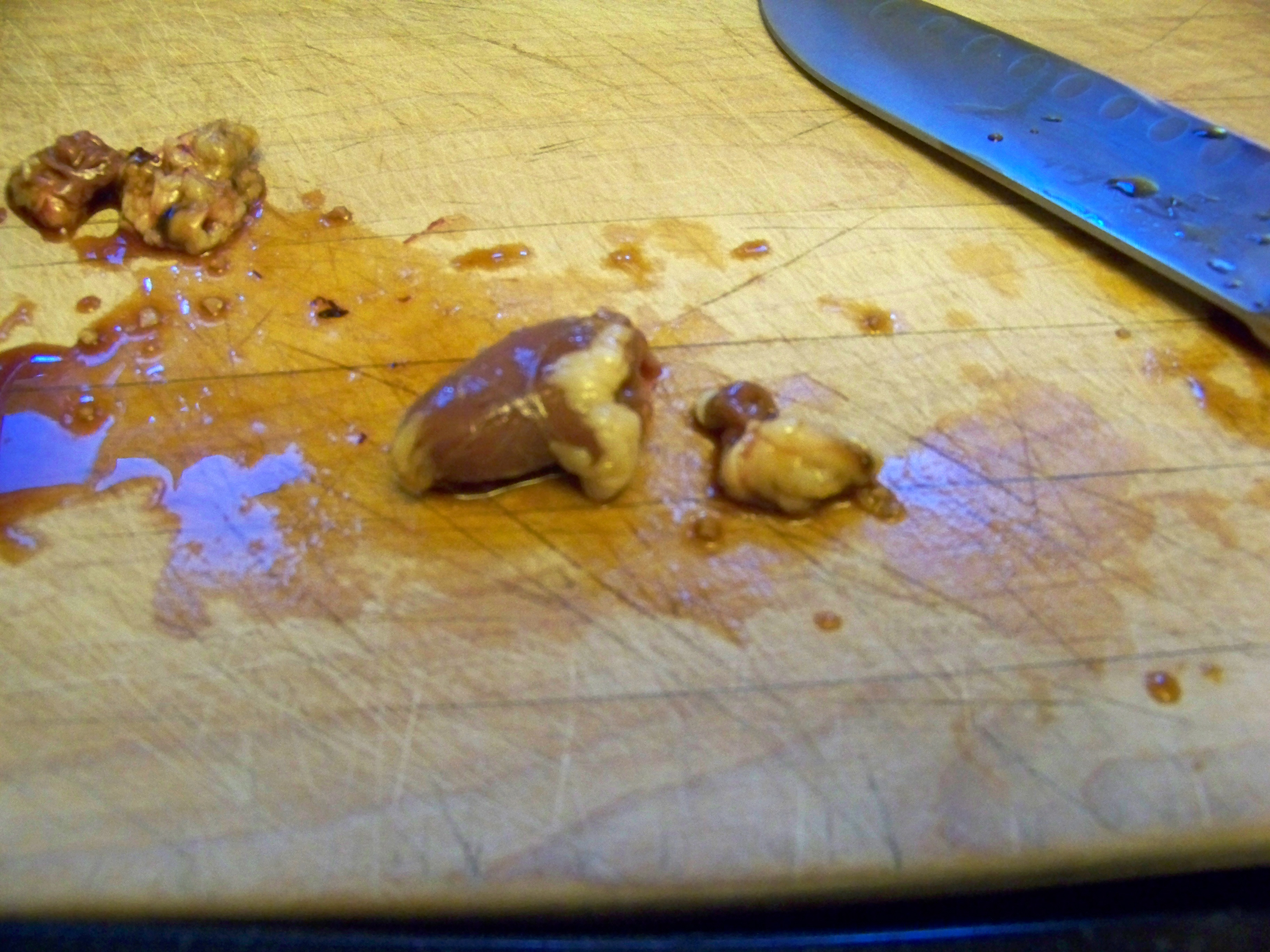
Wash chicken hearts, removing as much blood as possible (it is a heart after all). Then trim off the gristle-y bit of connective tissue at the top of the heart (you should NOT remove all the fat). [See picture below.]

Heart with connective tissue separated. More connective tissue from a previous heart at left.

Heart with connective tissue separated. More connective tissue from a previous heart at left.

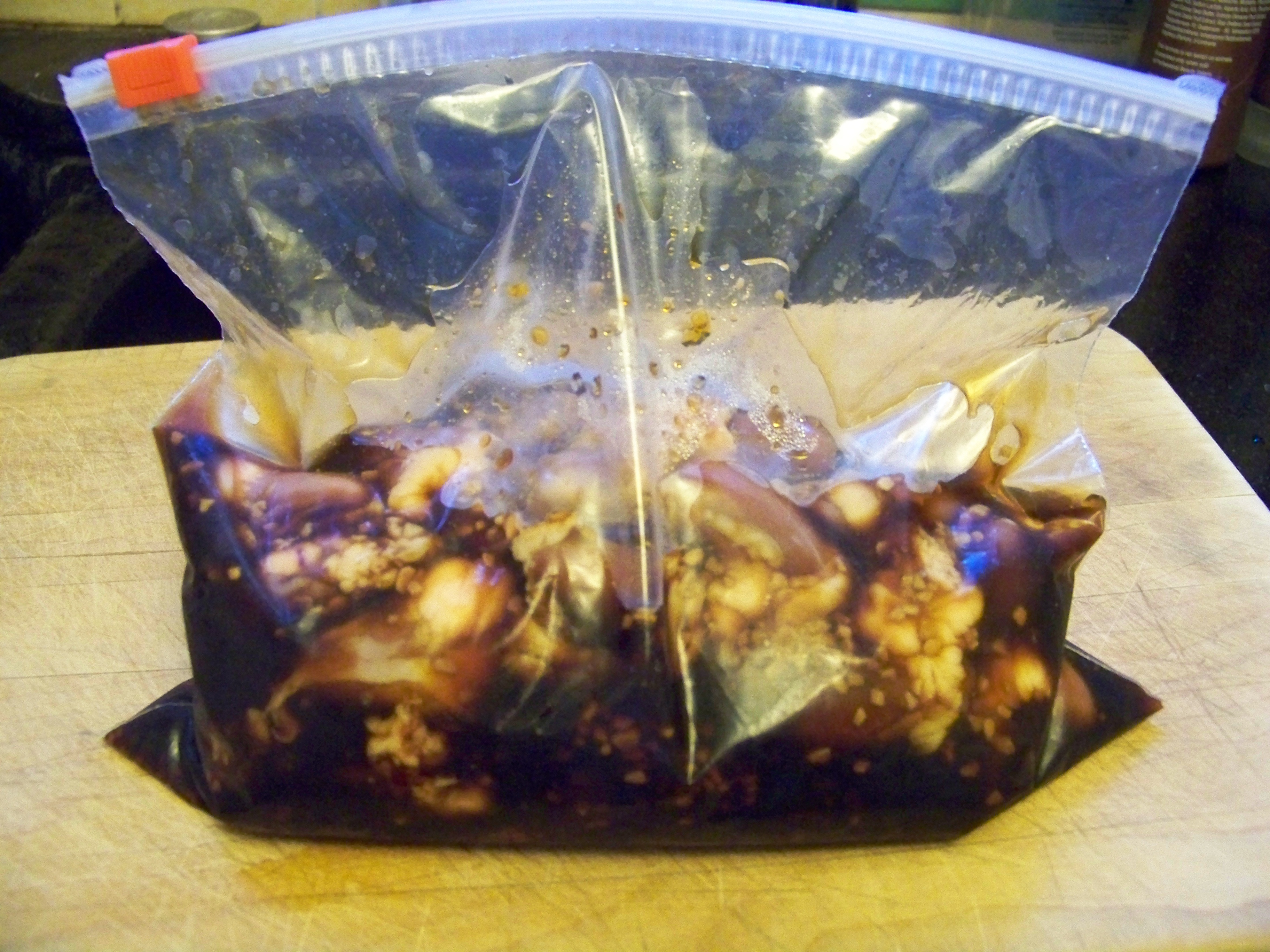
Place cleaned chicken hearts, minced garlic, and soy (or tamari) sauce in plastic bag. Seal, and marinate in refrigerator for 30 minutes to 2 hours, depending on the degree to which time is a factor in getting the meal to table.

Marinating hearts.

Marinating hearts.

After marinating the hearts, you have a couple of options; you can either pan fry them, or grill them. I chose the grill because my stove top was taken up with rice and stir-fry veggies, so it was an easy choice. Just season them with a little kosher salt and skewer them on either a metal skewer or a pre-soaked bamboo skewer (don’t want it catching fire or turning to ash on the grill). In either event, you’ll want to pre-heat the grill or the oil in the pan.

A quick grill means a tender heart.

A quick grill means a tender heart.

Cook them about two minutes per side, or just as soon as they can be lifted from the grill without sticking. When you first lay them down, brush half the honey on the top side of the hearts; when you turn them over, brush the remaining honey on the now-browned side. After 4-5 minutes (TOTAL!), you can take them off, and they’ll be perfect.

Hearts a-plenty.

Hearts a-plenty.

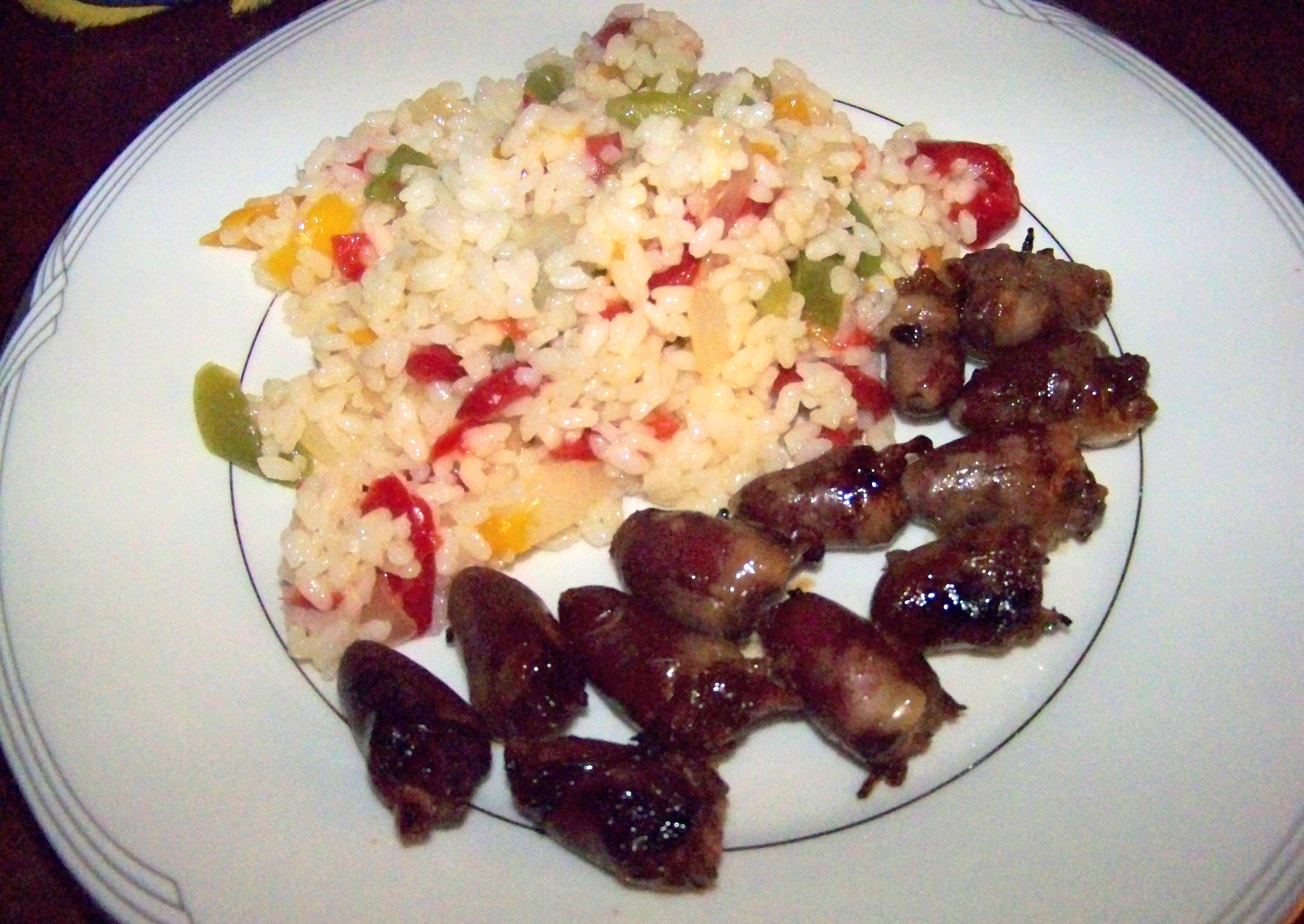
Because my sous chef was me, I placed the hearts into a 200°F/95°C oven just to keep them warm while I finished off the stir-fry veg and rice. They were in the oven for about 15 minutes or so, to no ill effect. When combined with the rice and veg (which themselves had been augmented by a yuzu seasoning base), they made a — ahem — hearty meal.

A different way of approaching chicken and rice.

A different way of approaching chicken and rice.

[NOTE: The price on the yuzu seasoning base in the link is confiscatory, and I only put the link in to show you the bottle. It (or something very close) should be available at your local Asian market for something in the neighborhood of three to four dollars or so, if memory serves. For goodness sake, don’t spend $20 on a tiny bottle of yuzu seasoning base. Its ingredients are water, yuzu juice, vinegar, citric acid, orange juice concentrate, evaporated cane juice, yuzu oil, and the ubiquitous “natural flavour.” A little lime juice, vinegar, sugar, and water (with some lime zest, if it’s handy) will work perfectly fine as a substitute.]

Bite-Sized Bit — Chickens in Literature

0
Image: © Stephanie Metz, Chicken Legs, 2004. Felted wool, wood 17”H x 12”W x 15”D

Image: © Stephanie Metz, Chicken Legs, 2004. Felted wool, wood 17”H x 12”W x 15”D

My pal Lisa Jane Persky, in addition to being a fine actress, writer, and artist, numbers among her quirks a semi-obsessive desire to document the role of the humble Gallus gallus domesticus in the world of literature. From Proust to Palahniuk, she captures the cluck in word and image, honouring our fine feathered friends with an expert curatorial eye.

While I usually tend to find my chickens in the fridge, roasting pan, or fryer, I have to admit I’m partial to her recipe for a little brain food.

On the other hand, if you would prefer to put your brain in park for a moment, you might want to check out comedian Bruce Mahler’s ingenious use of a store-bought fryer as a prop for a skit on the ABC series Fridays.

And if you would like to find out more about Stephanie Metz, the artist who created the overbred fowl featured at the top of the post, her art can be found here.

Balkanizing My Kitchen, Part two — Ajvar and Pinjur

3
Oops. That's not Ajvar and Pinjur, it's Akbar and Jeff from Life in Hell, with apologies to creator Matt Groening.

Oops. That’s not Ajvar and Pinjur, it’s Akbar and Jeff from Life in Hell, with apologies to creator Matt Groening.

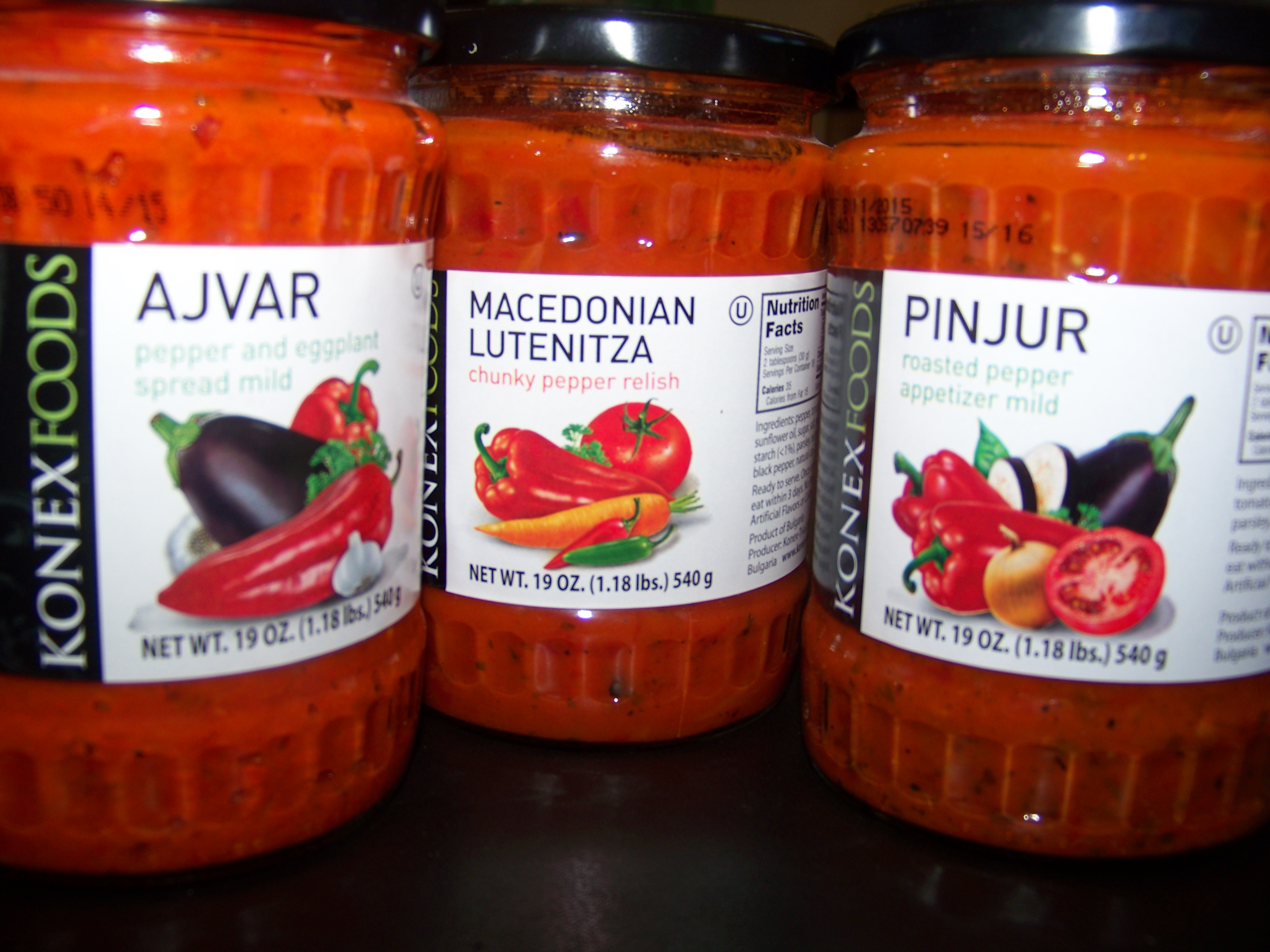
If you happened to see my earlier post on lutenitza, you’ll recall that I promised to return with a further exam of its kissing cousins, ajvar and pinjur. First, let’s have a look at the real deal.

The REAL Ajvar and Pinjur.

The REAL Ajvar and Pinjur.

Although thought to be Serbian in origin, ajvar (pronounced “EYE-var”) is said to have derived its name from the Turkish word havyar, which shares an etymology with “caviar.” [In Russian as well, the word ikra (or икра), can mean both traditional caviar and also a vegetable purée or paté.] It’s made from red peppers, aubergines, garlic, oil, and spices. Both lutenitza and pinjur, which share many ingredients with ajvar, generally include tomatoes, while ajvar does not. Perhaps the most striking difference between ajvar and the other two, though, is its consistency; you can turn a room temperature jar of ajvar upside down without spilling its contents. Pinjur and lutenitza, not so much. Depending on the recipe, ajvar may be made with smoked or roasted peppers or not; in this bottled version, the peppers are not roasted, giving it a lighter, brighter flavour than either the pinjur or the lutenitza.

The FatFree Vegan Kitchen blog has an excellent (and quite healthy) recipe for homemade ajvar, as does the Kitchen Window blog at NPR (where they dub the dish “Serbian Salsa“). In both cases, these recipes opt for roasting the red peppers.

Pinjur (also known as pindur, pindjur, pindzur, and pinđur) is widely available throughout Serbia, Bosnia, Herzegovina, Bulgaria, and Macedonia. Just in case you’re unclear on just where all these places are, here’s a map.

For the geographically challenged, this is where ajvar and pinjur come from. Photo courtesy Univ. of Texas Library.

For the geographically challenged, this is where ajvar and pinjur come from. Photo courtesy Univ. of Texas Library.

Unlike ajvar, which is more of a spread, pinjur (pronounced “PEEN-jur”) resembles a salsa or sauce. And, like salsas and sauces, it comes in a fairly wide variety of styles. It’s generally characterized as being an aubergine (eggplant)-based sauce/relish, rather than a roasted pepper sauce/relish, even though lutenitza generally contains aubergines, and pinjur generally contains roasted peppers. Confusing, ain’t it? In my limited experience so far, lutenitza is a little spicier than pinjur, but there are so many variants on the recipes, it would be impossible to make a generalization that really sticks. Dealer’s choice here.

Both pinjur and lutenitza are terrific mixed in with rice, ladled over vegetables or meat, or as a dip for chips; they can be served either warm or at room temperature. Both are gluten-free and vegan (as is ajvar), and they’re all a great way of dealing with the overabundance of vegetables from the summer garden, offering a tasty treat for home canning enthusiasts well into the winter months… provided you can wait that long to break into those jars.

The Food Network’s UK website has a tomato and pepper-free recipe for pinjur that relies heavily on aubergine for its base, but if you want something closer to the commercially available versions, you can opt for this recipe from the Healthy Food Base blog.

As the Macedonians would say, “Cреќен јадење!” [transliteration: “Sreḱen Jadenje!”] [translation: “Happy eating!”]

Balkanizing My Kitchen, Part one — Lutenitza

2
Three tasty pepper-derived foodstuffs.

Three tasty pepper-derived foodstuffs.

Not to worry: my kitchen has not split into warring factions. I just happened to be at Big Lots! [or, as some stores’ signage reads, Big! Lots (formerly Pic ‘N’ Save)] earlier today, poking around to see if they had any more jars of Macedonian Lutenitza, as one often does on a Tuesday. And that’s when it happened.

Let me back up a minute. Back in the ’50s, in Culver City, California (not far from where I live), a guy named William Zimmerman put together a chain of stores that specialized in overruns and closeouts, and called it Pic ‘N’ Save. Later, as the chain expanded — overexpanded, as it turns out — they redubbed themselves MacFrugal’s, and were purchased in 2002 by Consolidated Stores Corp., who converted the locations they kept open to their pre-existing brand, Big Lots! (and ultimately renamed the entire business Big Lots, Inc., which currently trades on the NYSE with the symbol BIG). While most of the merchandise in these stores is off-brand or otherwise out of favour (see picture below), they occasionally bring in weird little items that magically appear — and then just as magically disappear. So it was with my introduction to Macedonian Lutenitza.

Get 'em while they're not hot.

Get ’em while they’re not hot.

Lutenitza (also known variously as ljutenica, lyutenitsa, or lutenica, plus a dazzling variety of Cyrillic-alphabet spellings) is a type of salsa/sauce/relish widely made throughout Bulgaria, Serbia, and Macedonia. Its basic ingredients are tomatoes, red peppers, aubergines (eggplant), vegetable oil, sugar, and salt, though variants also contain onions, carrots, garlic, and black pepper, among other things. Like salsa, everybody’s grandmother makes “the best,” and family recipes are handed down as prized possessions. I’m sure my Bulgarian friends — if I had any — would blanch at the idea of buying commercial lutenitza, but heck, I didn’t even know about it until a week ago. [Note to self: Make some Bulgarian friends.]

For the geographically challenged, this is where lutenitza comes from. Photo courtesy Univ. of Texas Library.

For the geographically challenged, this is where lutenitza comes from. Photo courtesy Univ. of Texas Library.

While lutenitza itself is entirely vegan, it’s served on meats, fish, breads, roasted vegetables, French fries, and pretty much anything that doesn’t move. Some versions are apparently hotter than others, but if you make your own — which I’m guessing you’ll probably have to do, unless you have a Balkan grocery (or Big Lots!) in your area — you can adjust spices to taste. This recipe, courtesy of rhubarbfool.co.uk, looks like it would match up pretty closely to the one in the bottle I have, except it would seem that this commercial version has upped the pepper and carrot content in favour of using aubergine, and he uses olive oil rather than a more neutral one such as canola.

Lutenitza Serving Suggestion, courtesy http://www.mucizelezzetler.com

Lutenitza Serving Suggestion, courtesy http://www.mucizelezzetler.com

Lutenitza –- Bulgarian Vegetable Relish

Ingredients

2 medium carrots, peeled and diced
1 onion, diced
1 medium aubergine, diced
2 tablespoons olive oil
3 large roasted red peppers, skin and seeds removed and then diced
1 400g (14 oz.) can chopped tomatoes
1 tablespoon sweet paprika
1 teaspoon dried thyme (or summer savory if you have it)
2 tablespoons sugar
salt and pepper to taste

Take a medium sized saucepan and fry the onions, carrots and aubergines in the olive oil until soft. Add the red peppers and fry for a further 2-3 minutes. Add the tomatoes and seasoning, bring to the boil and simmer for 10 minutes. Add a little water if the mixture seems too dry. Mash some of the mixture using a potato masher. You are aiming for a thick ratatouille type texture. Spoon into a clean preserving jar, cool, seal and refrigerate. Makes about 1 kg/2 lb.

If, however, you plan on making it the old fashioned way — which is to say in bulk to put up for winter — this video, which calls for an astonishing 8kg (nearly 18 lbs.) of tomatoes, might serve you better, as might this video, featuring the “Sexy Chef,” Liz Todorova.

More on lutenitza’s cousins, ajvar and pinjur, in a later post. Do come back.

The Tournament of Rosés

0

100_4261

Dan, our gracious co-host (pictured at far right below), laid out the ground rules simply in his email:

100_4268

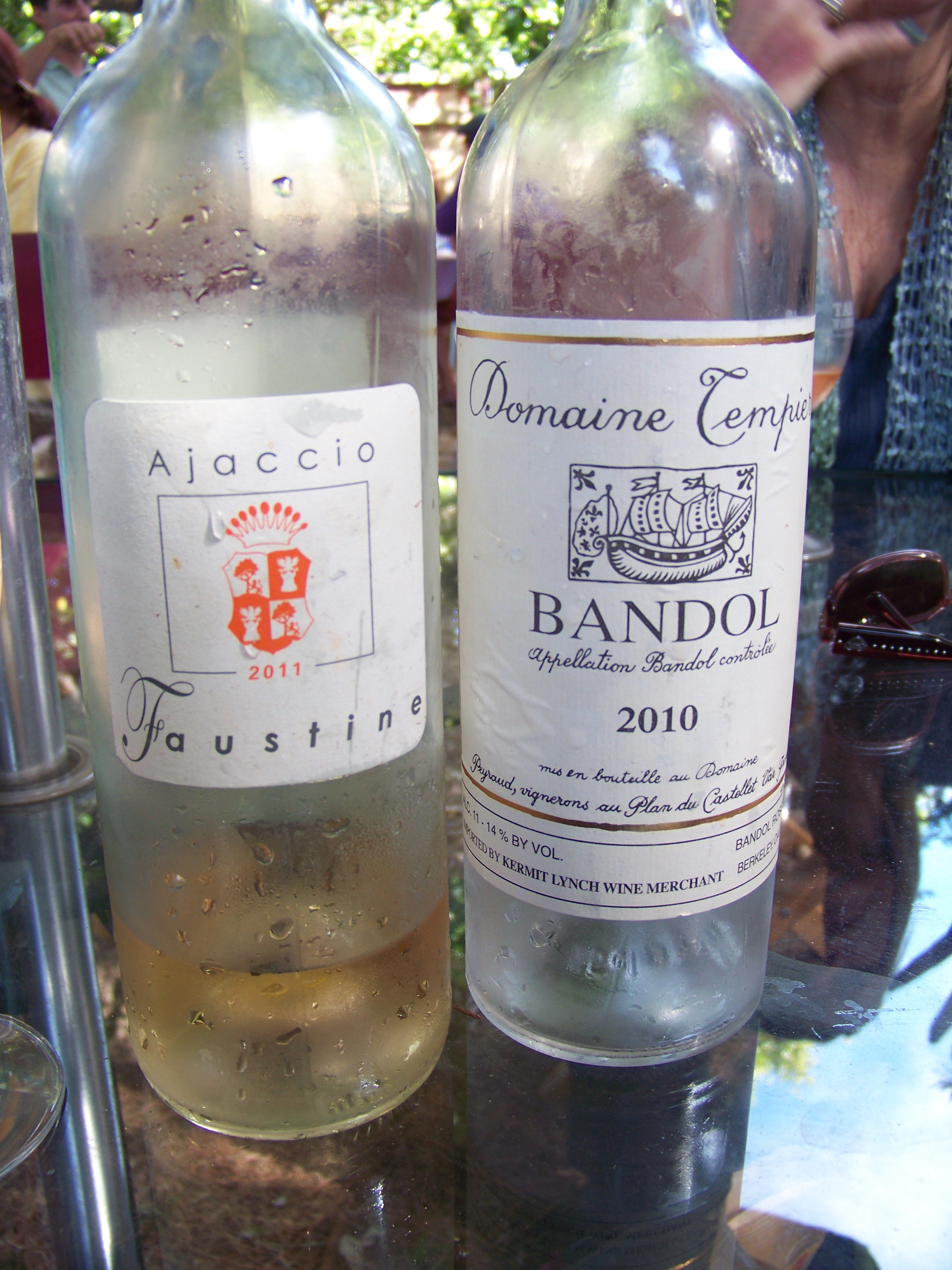
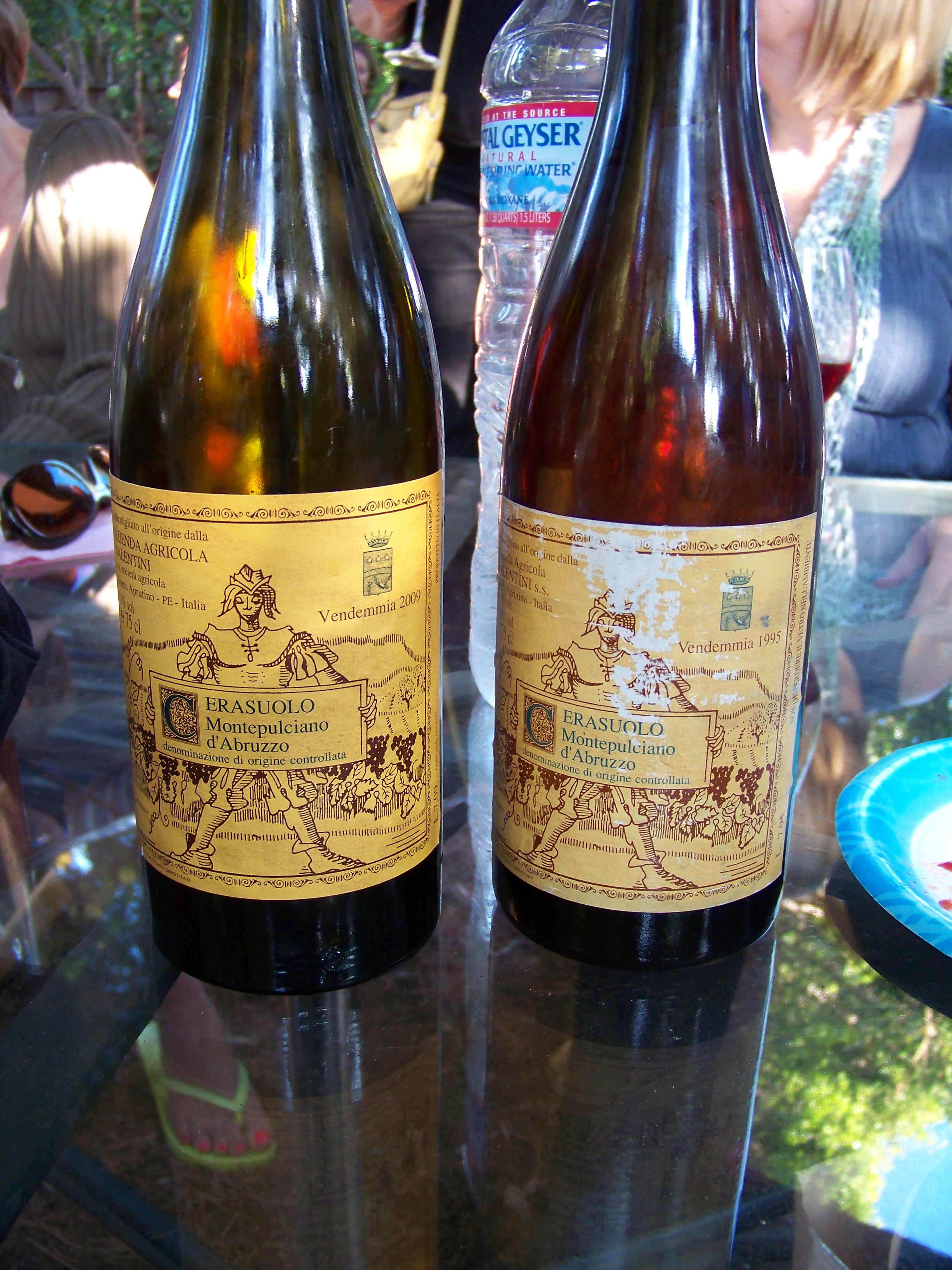
Bring a favorite bottle of rosé to share. Heck, feel free to bring more than a bottle if you’re the magnanimous sort. We love diversity, so no bring no more than one bottle of any one rosé, unless of course it’s Tempier or Valentini. Note-taking, reviewing or rating of the wines is heartily discouraged, and anyone overtly pimping bottles they don’t make themselves will be asked to leave (but we’re happy to send a note to your boss telling them that you did an admirable job representing the brand).

For eleventeen years or so, Dan has co-hosted a pagan summer event dedicated to the celebration of that most summer-y of beverages, rosé wines. The Tournament started on the deck outside his second-storey Malibu townhome with just a dozen or two people, and has grown geometrically in the years since, relocating to his friend Françoise’s back yard in Santa Monica. At first, it seemed something of a quirky kind of wine to revere. Much like the Jews, rosés wandered for years in the wilderness, having been given a bad name in America by the likes of Mateus and Lancers and (more recently) Sutter Home White Zinfandel. In fact, that one wildly popular White Zin was so poorly received by the cognoscenti that — despite being an economic juggernaut — it nearly tanked the reputation of the Zinfandel grape, and red Zinfandel (or just Zinfandel) is as far from white Zinfandel as red pepper is from white pepper. [That said, my pal Van Williamson makes a delightful rosé of Zinfandel (he calls it Rosato), so it is possible to make a “white Zin” that’s palatable.]

“So what,” I hear you ask, “is the key takeaway here? After all, I wasn’t invited to the party, and even if I had been, I missed it.”

100_4280

First of all: Don’t be afraid of rosés! They’re the perfect anti-wine-snob wines, mostly inexpensive, and the obvious bridge between people who claim not to like red wines and people who maintain they’re not interested in whites. They go great with food, from grilled meats to seafood to veggies. They’re widely available; most major grocery stores usually have one or two really tasty ones for under $20 (unless you happen to live in one of those unfortunate states where the liquor sales are controlled by the government, and even the state stores in places such as Pennsylvania and New Hampshire frequently carry an acceptable selection). If your local wine store clerk gives you attitude over your selection, give him — trust me, if it happens, it will always be a him — a clout upside his snooty pate and proceed proudly to the checkout counter. After all, the French, who know a thing or two about wine, consumed an average of 11.8 liters per capita in 2010.

One of several well-stocked coolers at the 2013 Tournament.

One of several well-stocked coolers at the 2013 Tournament.

Twenty years ago, red wines constituted 73.4% of wines sales in supermarkets in France; in 2011 (the most recent year for which I could find figures), they had declined to 56%. Over that same period, rosé’s market share had grown from 13.1% to 27.3%. As per usual, we’re a little behind the curve, trend-wise, but experts in the American wine business are saying that rosé sales are expected to continue to rise here as well. Maybe Brangelina’s recent foray into rosé territory will jump-start the movement here; the first 500 cases of their Miraval rosé sold out in six hours.

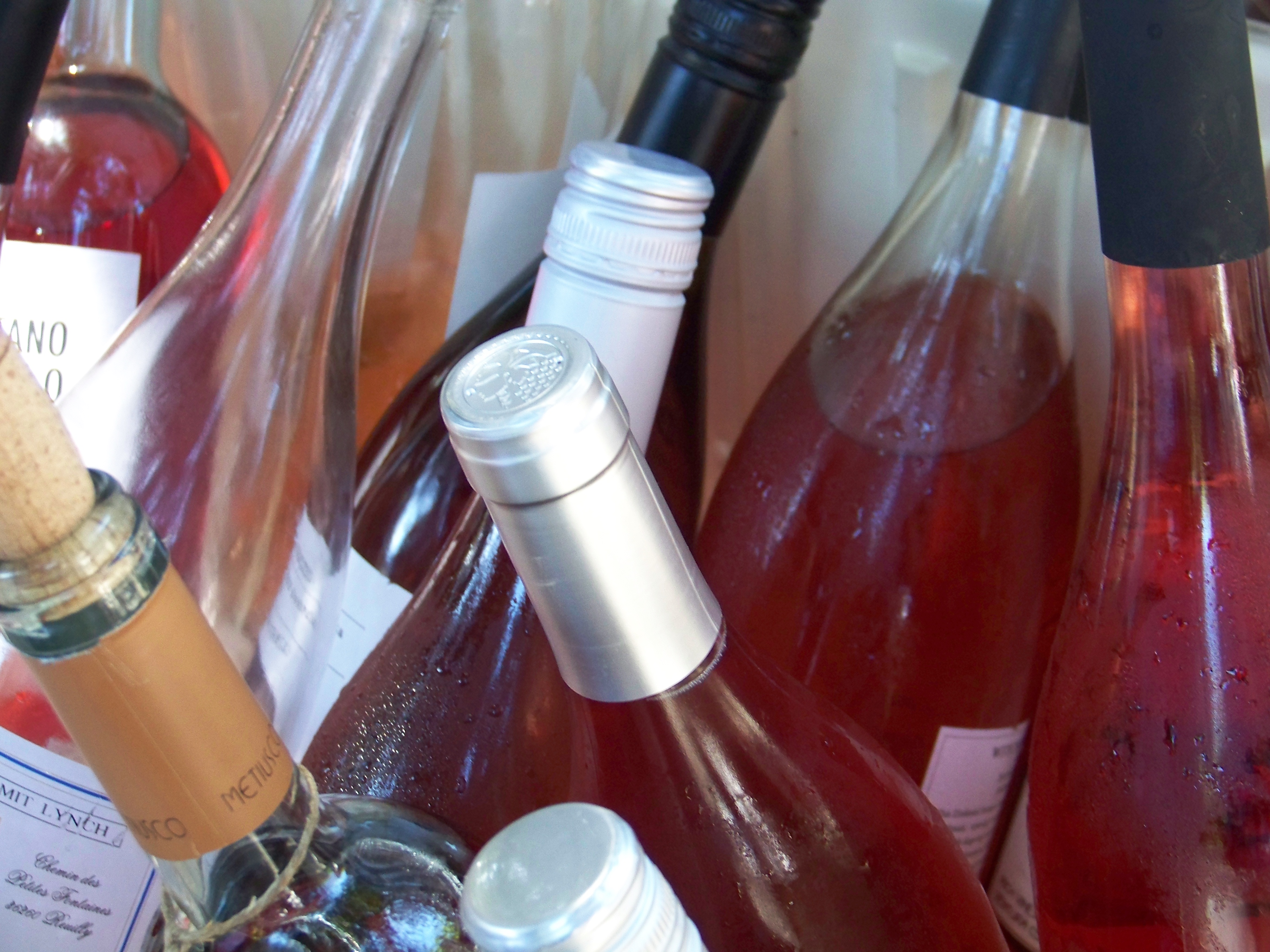
A few of the 84 bottles that were consumed at the 2013 Tournament of Rosés.

A few of the 84 bottles that were consumed at the 2013 Tournament of Rosés.

In addition to being a great hang, parties such as this are a terrific way to get exposed to wines you otherwise might never know about. And clearly, having friends who are in the wine business (and who have outstanding cellars) are a positive boon such a gathering. But even without that, getting friends together to share and compare can be both entertaining and educational. [It’s real easy to forget about the educational part after the first few glasses, so I just take pictures of bottles I like.]

A picture of bottles I liked.

A picture of bottles I liked.

I don’t recall who first introduced me to the two-point wine scale, but it’s served me well: ultimately, it’s either “yum” or “yuck.” While far from being an expert, I’ve spent a fair amount of time tasting, reading, and making notes about wine myself, so the last thing I would want to do is disparage others who analyze wine the way people of a certain age used to pore over the cover of Abbey Road for clues that Paul was dead. But the final question for me always boils down to whether or not I would want to consume some particular wine again, ratings be damned. And today, I was richly rewarded.

Rosés, much like roses, come in many colours.

Rosés, much like roses, come in many colours.

Here are a few faves (in no special order) that are widely available, all under $20 and many a good deal less:
2012 Charles and Charles, Columbia Valley, WA
2012 Caves d’Esclans ‘Whispering Angel’ Rosé, Côtes de Provence, FR
2012 Domaine de Triennes Rosé, Vin de Pays du Var, FR
2012 Marqués de Cáceres Rioja Rosado, SP
2010 Château Bonnet Merlot/Cabernet Sauvignon Rosé, FR
2010 Falesco Vitiano Rosato, Umbria, IT
2012 Château de Campuget Costières de Nîmes Tradition de Campuget Rosé, FR
2012 Ameztoi “Rubentis” Rosado Getariako Txakolina, SP
2012 Château de Lancyre Rosé, Pic Saint Loup, FR
2012 Chateau de Lascaux Rosé, Coteaux du Languedoc, FR
2012 Domaine M. Chapoutier Belleruche Rosé, Côtes-du-Rhône, FR

And here are a couple that you probably won’t ever get to taste, and which I will likely never taste again, thanks to the generosity of one of our wine collecting friends, who pulled a couple of special bottles for the Tournament.

From our pal John's cellar. Magnificent.

From our pal John’s cellar. Magnificent.

Une fleur pour le dîner

1
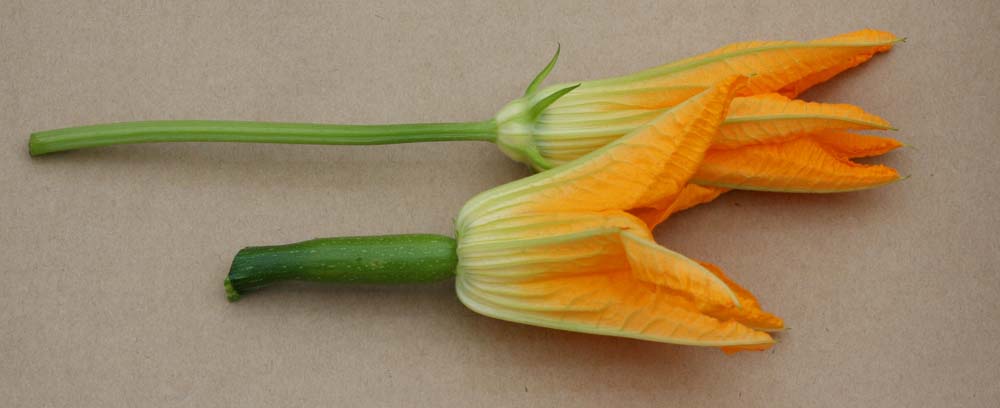
Male and Female Squash Blossoms -- photo courtesy http://www.gardenwisdom.ca

Male and Female Squash Blossoms — photo courtesy http://www.gardenwisdom.ca

Yesterday, while The Bride was having an excess piece of bone excised from her foot, I whiled away the time by visiting the Santa Monica Farmers Market. Lured by the siren song of fresh aubergines and oh-so-ripe peaches, I stumbled upon a couple of stalls that featured squash blossoms, a short-season summer treat. Normally, I stuff them with goat cheese, batter them, and pan fry them; I was keen to try the Cup4Cup gluten-free flour on my longtime fave. As it turned out, The Bride offered up an equally enticing competitive idea. Guided by Mae West’s belief that “between two evils, I always pick the one I never tried before,” I opted for the new recipe (not that either recipe is evil).

Ricotta-Stuffed Squash Blossoms with Tomato Vinaigrette
Recipe adapted from Chi Spacca, Los Angeles, Calif. and reblogged from www.purewow.com

Makes 10 squash blossoms (plus about 3/4 cup vinaigrette)
Start to Finish: 25 minutes

Ingredients

Tomato Vinaigrette

Tomato vinaigrette.

Tomato vinaigrette.


¼ cup cherry tomatoes, halved
¼ cup red wine vinegar (I used white Champagne vinegar, which worked fine)
½ cup extra-virgin olive oil
Kosher salt

Ricotta-Stuffed Squash Blossoms

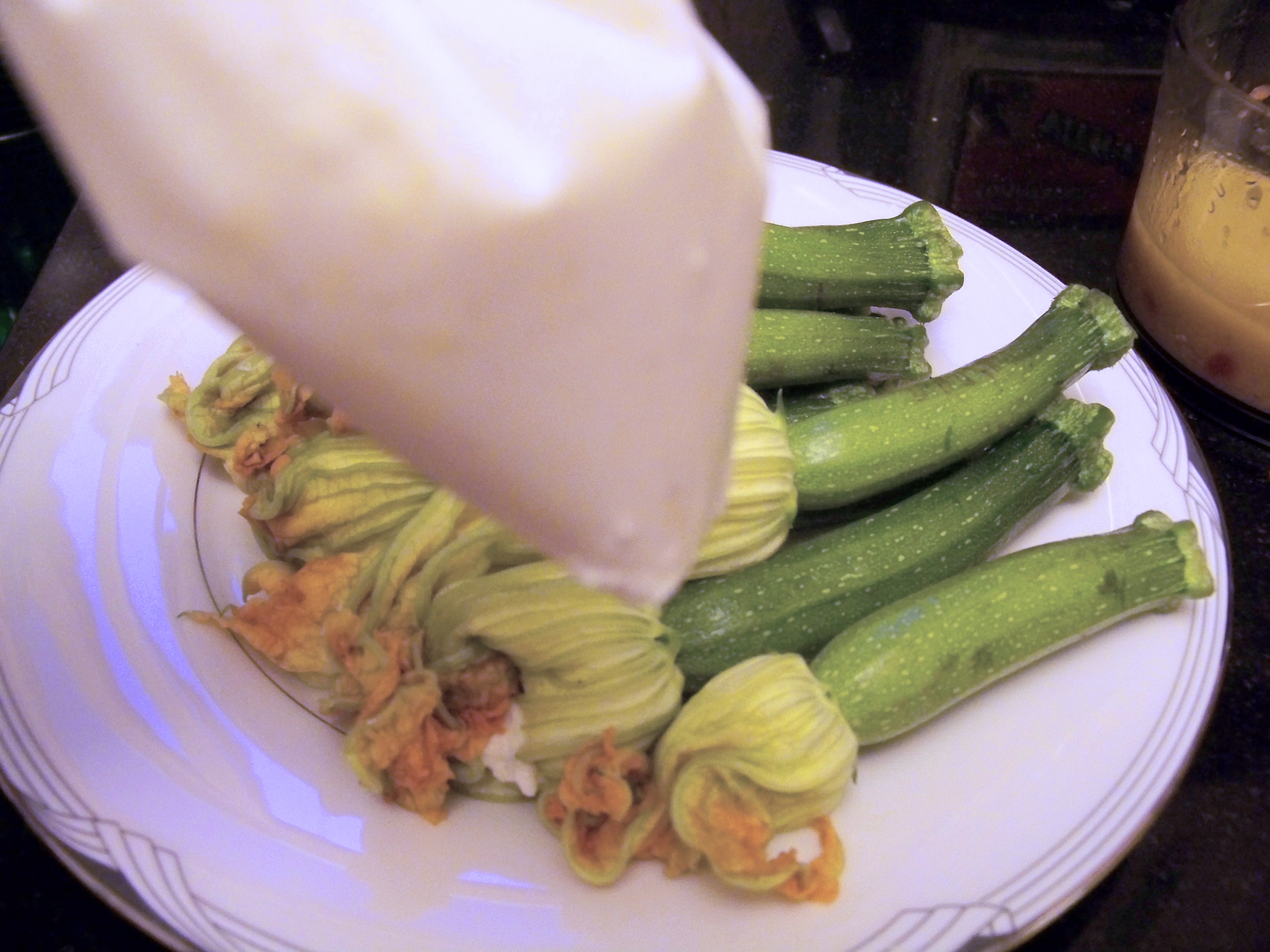
Piping bag and squash blossoms.

Piping bag and squash blossoms.


½ cup ricotta
1 tablespoon finely grated Parmesan cheese (I went with about 3 tbsp., which is more to my taste)
2 tablespoons heavy cream (I substituted sour cream and a splash of water; maybe a teaspoon)
Kosher salt
10 large squash blossoms, stems trimmed and stamens removed
Extra-virgin olive oil, for drizzling
Freshly ground black pepper
Basil leaves, for garnish

Directions

1. Make the vinaigrette: In the bowl of a food processor, combine the tomatoes with the vinegar and pulse to combine. With the motor running, slowly drizzle in the olive oil until combined. Season to taste with salt and set aside. [TOTT note: I just put it all in together and pulsed until I got it where I wanted it to be; because I was using a stick blender and bowl attachment, the “drizzling in” bit wasn’t really an option. Worked superbly, and it meant I didn’t have to assemble and clean the big honking Cuisinart.]

2. Make the squash blossoms: Preheat the oven to 350˚. In a medium bowl, mix the ricotta with the Parmesan and cream until just combined. Season the mixture to taste with salt. Transfer the mixture to a piping bag or large Ziplock bag with a small piece of the corner cut off.

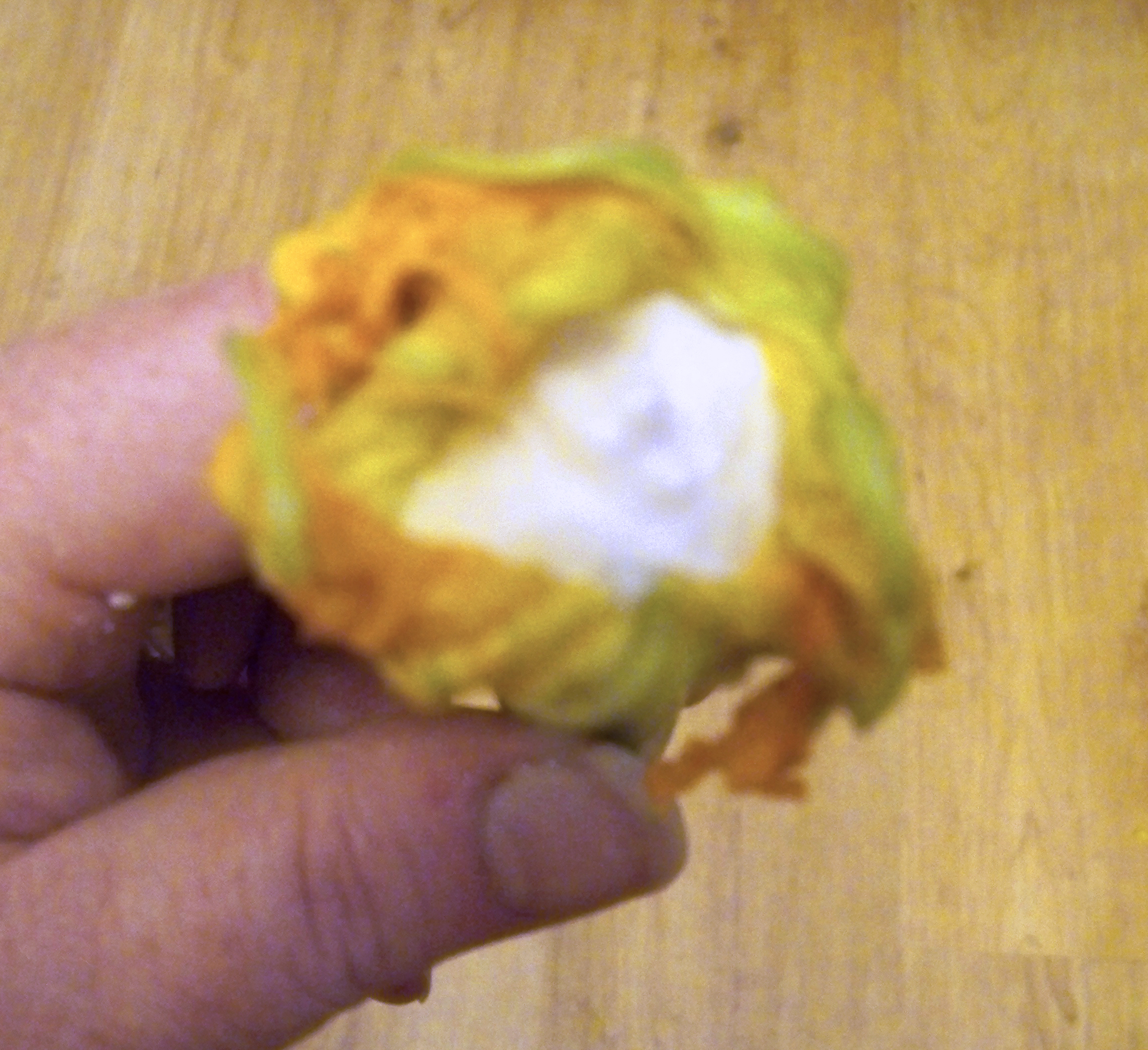
Stuffed blossom, not yet tied.

Stuffed blossom, not yet tied.

Stuffed blossom, tied.

Stuffed blossom, tied.

3. Working with one squash blossom at a time, fill the interior cavity of the blossoms with the ricotta mixture until three-quarters full. Twist the petals gently to seal. (Depending on the size of your blossoms, you may have leftover filling.) Arrange the filled blossoms on a small baking sheet, drizzle with extra-virgin olive oil and season with salt and pepper. Bake the squash blossoms for 2 minutes [TOTT Note: Because I was using the female blossoms, I left them in for about 5-6 minutes.] or until just warmed through.

Ready for the oven.

Ready for the oven.

4. Meanwhile, in a small saucepan set over medium heat, simmer the reserved vinaigrette until warmed through, about 3 minutes, and remove from the heat. [TOTT Note: I thought this was too much of a pain in the ass, so I just transferred the vinaigrette to a microwave-safe bowl and zapped it for 30 seconds on high.]

5. Cover the bottom of a large platter [or your serving plate] with a thin layer of the vinaigrette. (Reserve the remaining vinaigrette for another use.) Arrange the squash blossoms on top of the vinaigrette and garnish with the basil leaves. Serve immediately.

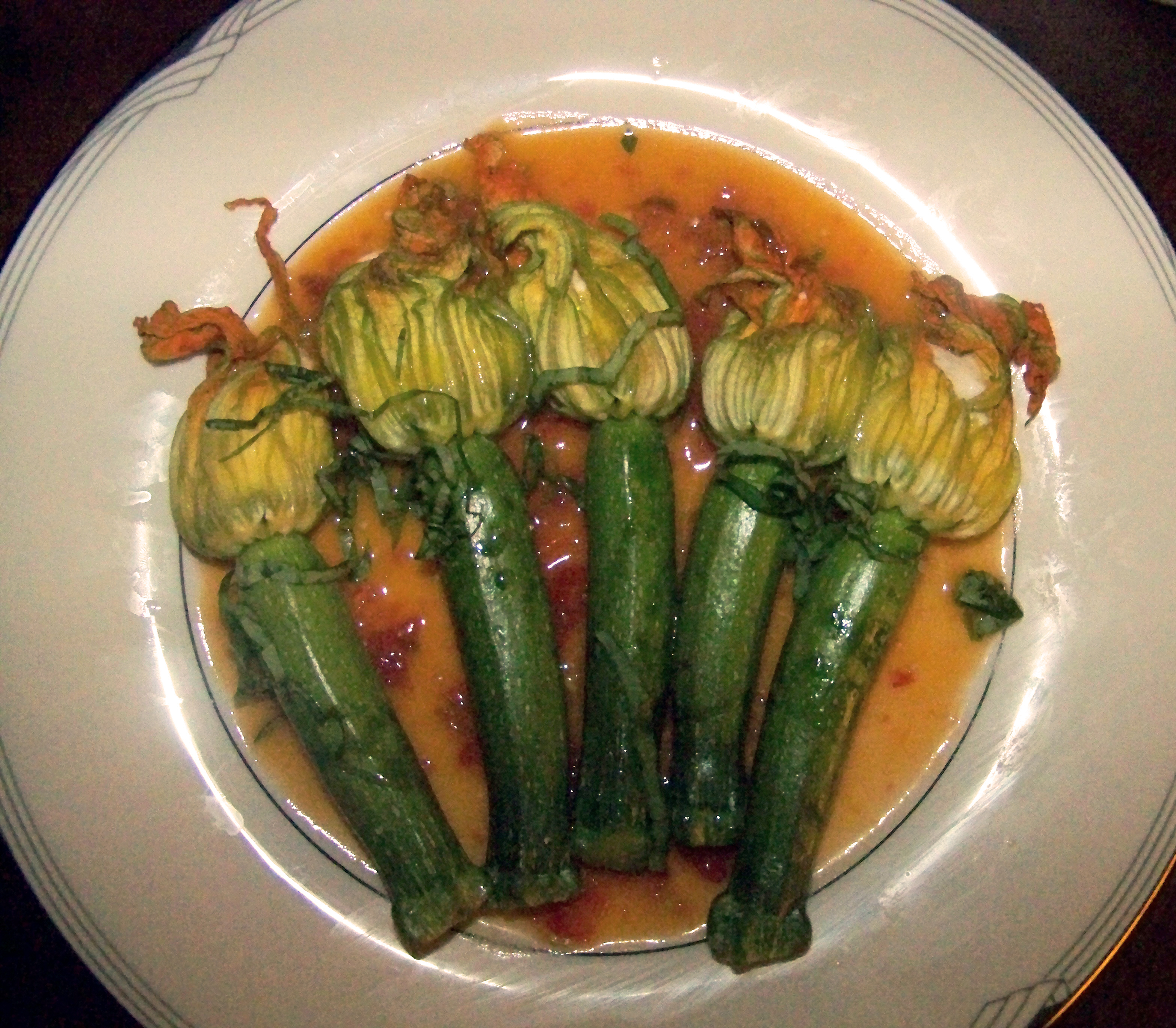
Dinner is served.

Dinner is served.

He Blinded Me — And Darn Near Crushed Me, Too — With Science

1
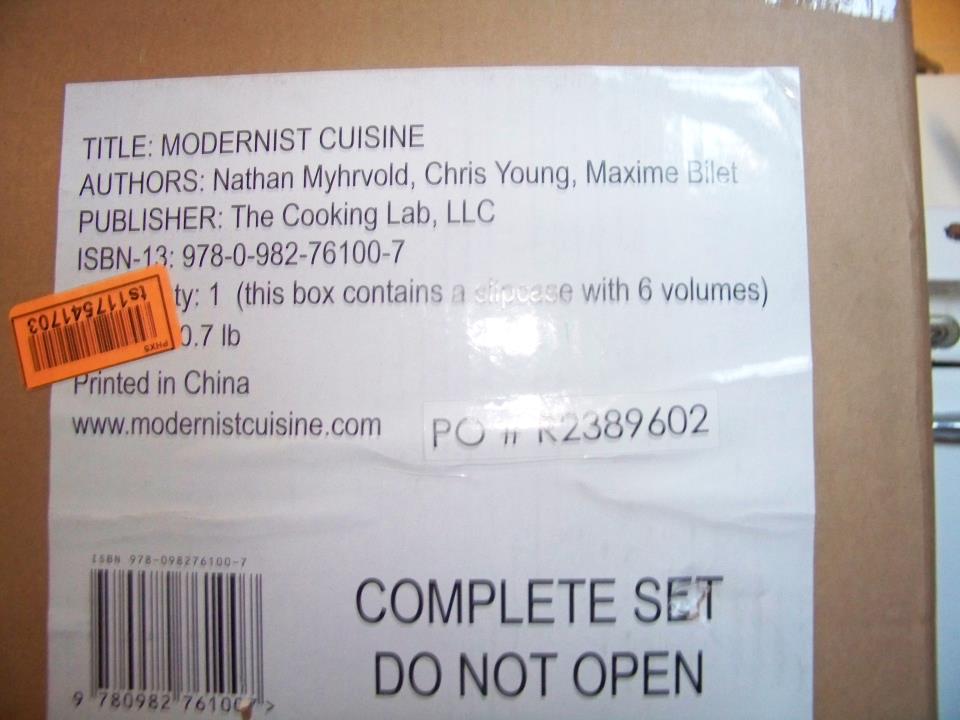
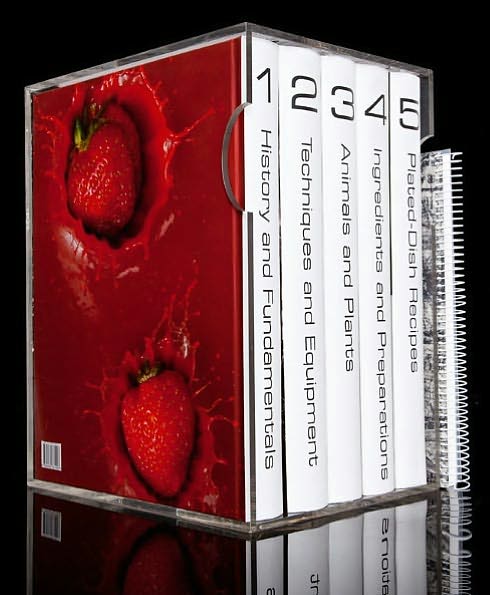
A 50 Pound Box of Books

A 50 Pound Box of Books

You say “po-tay-to,” I say “po-tah-to.” You say “hard-boiled egg,” I say “denatured proteins encased in an ovoid container composed largely of calcium carbonate.” Let’s call the whole thing off. Or rather, let’s not, just for the moment.

Many years ago, when I foolishly (and incorrectly, as it turned out) believed I could balance a Chem major with a second one in Political Science, managing the campus radio station, editing the Editorial page of the campus newspaper, and engineering an entirely unsatisfactory love life, I had a moment of epiphany. Most of the lab experiments we undertook were colloquially referred to as “recipes,” and it occurred to me that “recipes” — the ones I had gathered from family and friends for use in the kitchen — were little science experiments. I know, friggin’ duh. Next I’ll be telling you about water being wet.

When people say “a lot of love went into that recipe,” it usually means, “the cook spent a whole mess of time getting it right, and she can reproduce through sheer muscle memory processes that I (a newbie trying to imitate the outcome) am unable to replicate.” In our mashed-potato-bud-flakes culture, any skill that cannot be mastered in the time it takes to microwave a bag of popcorn is just too darn hard, so we might as well ascribe some mystical attribute to the perfectly cloudlike soufflé rather than admit that your grandma, or Wolfgang Puck, or Eddie down the block, is just better at following directions than you are.

After all, when we prepare food, we generally do one or more of three things: We heat it. We cool it. We mix things with other things. And in performing some combination of those processes, we change the chemical composition of the ingredients at the molecular level. Voilà! Science.

Enter Nathan Myhrvold.

1322

If that picture isn’t the archetypal image of a Scientist Doing Serious Science, I don’t know what is. Oh, wait — he isn’t wearing a lab coat. Nonetheless, he’s something of a polymath, having started college at 14, and breezed through a master’s degree in mathematical economics and a Ph.D in theoretical and mathematical physics from Princeton and a post-doc fellowship with Stephen Hawking at Cambridge before being named Chief Technology Officer at Microsoft. He has also competed on a team that won first place in multiple categories (as well as being named best team overall) at the 1991 World Championship of Barbecue. And here we have that moment of interfacial polymerization, where the two seemingly disjoint circles in the Venn diagram overlap, and magic happens.

Modernist Cuisine

Modernist Cuisine

After having left Microsoft, Myhrvold had enough time to pursue his passion for cooking. Setting aside for a moment the fact that he haunted kitchens like some Phantom of the Spatula, turning up in local Seattle joints as well as Michelin-starred outfits abroad, Myhrvold brought a special piece to the puzzle: money. Much as when Walt Disney was unsure of the eventual success of Disneyland (saying, apparently apocryphally, that even if he landed on his face, he was at least falling forward), Myhrvold wasn’t sure if an audience beyond a couple dozen existed for his $500+ set, but he (like Walt) had resources at his disposal to see his dream through to fruition. Suffice it to say that both ventures exceed initial projections wildly, though we oughtn’t expect to see a Pirates of the Portabello ride any time soon.

Just as an object, Modernist Cuisine: The Art and Science of Cooking is breathtaking. Profusely illustrated (3,216 photographs), beautifully bound, it’s clear that no expense was spared in its preparation. In fact, there are over four pounds of ink — four pounds — contained between its myriad covers and spread among its 2,438 pages. But its primary appeal is a simple, step-by-step explanation of how this business of preparing food works. Myhrvold (with co-authors Chris Young and Maxime Bilet) isn’t the first person to tread this ground. The distinguished food writer Harold McGee waded into the deep end of the kitchen science pool nearly three decades ago with his indispensable On Food and Cooking: The Science and Lore of the Kitchen. Where Myrhvold et al. go McGee one better is in the use of equipment and techniques not generally common to the home cook… or to the professional chef, for that matter. [I remember one time when I was trying to clarify cactus juice and realized that a centrifuge would be the ideal tool, but who among us has one in the cupboard and would you really want to clarify 20ml at a time? Bring on the cheesecloth.]

Yeah, you could cook eggs with a bullet, but it would be dangerous, probably illegal, and very messy.

Yeah, you could cook eggs with a bullet, but it would be dangerous, probably illegal, and very messy.

As anyone who has read the blog previously — or even the first part of this post — can clearly ascertain, I’m a geek. I’m fascinated with the idea of working with liquid nitrogen in the kitchen, though if The Bride caught me doing so, she’d probably conk me one with the frying pan. Granite counters, after all, are not cheap. Many of the ideas and techniques enumerated in Modernist Cuisine will, alas, never make their way to my kitchen. But many of them will. As a for instance, his explanation of how a wok works has enhanced my stir-fry mojo.

The workings of the wok.

The workings of the wok.

For those who are less geeky, more thrifty, or would merely like to jump in at the shallow end of the kitchen science pool, Myhrvold and company have distilled the Modernist Cuisine monolith into a handy, single-volume set called Modernist Cuisine at Home. I haven’t read it (yet), but I’m given to understand that it contains more than 400 new recipes, and while pricy (it runs about $115, or the approximate cost of 3-4 cookbooks), I’m sure anyone so inclined will find it well worth the purchase price, given its lineage.

Geek-o and The Man, or, more appropriately, The Man and Geek-o.

Geek-o and The Man, or, more appropriately, The Man and Geek-o.

Gotta give props here to three folks who taught me two very valuable lessons. My late maternal grandmother, who taught me that the kitchen isn’t a scary place. And my favourite chemistry teachers in high school and college, Claude Wiseman and the late Nobel laureate F. Sherwood Rowland (respectively), who taught me that the lab isn’t a scary place, either. [Although I have done some things in their chem labs that were scary, but those are other stories for another time.] In Myhrvold’s Modernist Cuisine, he’s fused those two concepts in a way that would make my mentors — and no doubt his — proud.

Note: Only the first and last photographs in this blog post are original; all others are ©Modernist Cuisine, LLC.

Shameless repurposing, part two — My Dream Date with Emeril

0

Emeril and Thane

Last summer, I was contacted by the American editor of Style magazine (then Sands Style) to see if I would like to interview Chef Emeril Lagasse for the relaunch of the magazine. Like every cooking fan in America, I’d seen Emeril a gazillion times; unlike many cooking fans, I’ve eaten at one of his restaurants in New Orleans. Naturally, I agreed.

Despite his fireplug stature, Lagasse looms larger than life in virtually ever aspect of his being. He is immediately gregarious and extraordinarily self-effacing. He’s passionate about food. He loves to teach and to share what he’s learned. And he is remarkably generous in spirit.

Here’s a story that didn’t make it into the piece I had published: Part of the craft of managing a celebrity interview is figuring out what to ask him or her first. Way back when I was in college, my brilliant journalism spirit guide, Joseph N. Bell — a lecturer, because he was a working stiff, not an ivy-clad professor — told his class that something like 75-80% of one’s energy prepping for an interview should be devoted to formulating the first question. Famous (and even semi-famous) people are subjected to an endless parade of clueless journos who haven’t read their book or seen their movie or listened to their record, who inevitably kick off the interview with some slow-pitch softball such as “So… what inspired you to _____?” B-o-r-i-n-g. Shockingly, the rest of that sort of interview winds up with a lifeless string of canned answers to the canned questions.

The night before I was to chat with Chef Lagasse, The Bride suggested I might mention a shrimp and grits recipe she’d had at NOLA several years back, and for which she desired the recipe. “Excellent!” I thought. “Here’s a way under his radar.”

The cover, larger than life. The pic of Emeril, not so much.

The cover, larger than life. The pic of Emeril, not so much.

Our phoner kicked off with the typical pleasantries; underneath it all, I’m sure he was probing to see if I was actually interested in and/or knowledgeable of what he was doing, and I was curious to ascertain whether he was full of camaraderie when the red light was on, only to turn cold as a fish case haddock in its absence. As luck would have it, the two of us fell into sync more or less immediately. Even without asking, when I relayed the story of The Bride and The Grits, he responded with, “I’ll be happy to send you the recipe.” Within an hour of our interview’s conclusion, he (or one of his minions, at his direction) had.

Like most celebrated chefs, Lagasse had served his Malcolm Gladwell 10,000 hour apprenticeship many times over. And, like virtually all of the chefs I’ve had the pleasure of interviewing, he was generous to a fault regarding his team. Many of Emeril’s krewe have been soldiering on with him in excess of a decade (some even two!), a surprising display of loyalty considering the fluidity of movement in the world of haute cuisine. Clearly, the man is doing something right.

Some time after the story was filed, my editor invited me to the magazine’s relaunch in Las Vegas. The Bride and I made the pilgrimage, given that the magazine was kind enough to comp our hotel room. Emeril was just as engaging in person as he had been over the phone, and — ever the businessman — he asked his assistant to jot down my contact info, should we be of some mutual benefit sometime in the future. Fair play, that. I hope our paths cross again, even if just to hear him say “BAM!”

Every now and then, we all aspire to kick it up a notch.

Here’s a link to the article.

And this is the shrimp and grits recipe that kicked off our conversation:

As prepared family-style.

As prepared family-style.

NOLA’S SHRIMP AND SMOKED CHEDDAR GRITS
Recipe from NOLA Restaurant by Emeril Lagasse.

For the Shrimp:

Ingredients

2 pounds medium shrimp, peeled and deveined
2 1/2 teaspoons Emeril’s Original Essence, recipe follows
3/4 teaspoons salt
2 tablespoons olive oil
4 tablespoons butter, room temperature
1 recipe Smoked Cheddar Grits, recipe follows
1 recipe Citrus Buerre Blanc, recipe follows
1 recipe Abita BBQ Glaze, recipe follows
1 recipe Smoked Cremini Mushrooms and Rendered Bacon, recipe follows
1 recipe Grilled Green Onions, recipe follows

Instructions

In a large bowl, combine the shrimp with the Essence and salt and toss to blend. Set aside as you prepare the skillet. Place a large, 14-inch skillet over high heat and add the olive oil and heat until very hot. Add 1 tablespoon of the butter to the pan. Swirl to melt, then add the shrimp to the pan, being sure that the shrimp are in one layer in the pan. Sear the shrimp until well caramelized on the first side, about 1 minute. Turn the shrimp over and add the smoked mushrooms, bacon and Abita BBQ Glaze to the pan. Continue to cook, stirring occasionally, until the shrimp are well coated with the sauce and just cooked through, about 3 minutes. Add the remaining butter to the pan and swirl until melted into the sauce.

To serve, divide the grits between 8 entrée-sized shallow bowls. Drizzle about 2 tablespoons of the Citrus Beurre Blanc around the edge of the grits near the rim of the bowl. Divide the shrimp, mushrooms, bacon and sauce evenly between the bowls, and place a grilled green onion on top of the grits in a circle. Serve immediately.

Makes 8 entrée servings

For the Emeril’s Original Essence:

Ingredients

2 1/2 tablespoons paprika
2 tablespoons salt
2 tablespoons garlic powder
1 tablespoon black pepper
1 tablespoon onion powder
1 tablespoon cayenne pepper
1 tablespoon dried oregano
1 tablespoon dried thyme

Instructions

Combine all ingredients thoroughly. Makes 2/3 cup

For the Smoked Cheddar Grits:

Ingredients

6 cups water
Salt, to taste
1 1/2 cups quick cooking or old-fashioned grits (not instant!)
1 cup milk
1 cup heavy cream
4 tablespoons butter
6 ounces grated smoked white cheddar cheese
Freshly ground black pepper, to taste

Instructions

In a large, heavy saucepan bring the water to a boil. Add a generous teaspoon of salt and the grits and stir with a wooden spoon to combine. When grits thicken, add the milk, cream and butter and return to a boil. Reduce heat to a simmer, partially cover the sauce pan and cook for 45 minutes to one hour, until grits are very tender, smooth, and creamy-thick. Add the cheddar, season with black pepper, and stir until cheese is melted. Serve hot.

Makes almost 2 quarts

For the Citrus Beurre Blanc:

Ingredients

1/2 cup fresh squeezed orange juice
1/2 cup dry white wine
1/4 cup fresh squeezed lemon juice
1/4 cup fresh squeezed lime juice
1/4 cup thinly sliced shallots
1 2-inch strip orange zest
1 2-inch strip lemon zest
1 2-inch strip lime zest
1 garlic clove, smashed
1/2 bay leaf
1 sprig of thyme
1/2 teaspoon salt
1/2 teaspoon black peppercorns
1/3 cup heavy cream
2 sticks cold unsalted butter, cubed

Instructions

Place all the ingredients except the heavy cream and butter in a 1-quart saucepan and place over high heat. Bring to a boil and reduce until the liquid is nearly evaporated, 12 to 14 minutes. Add the heavy cream to the pan and reduce by half, 1 to 2 minutes. Remove the pan from the heat and reduce the temperature to medium low. Add a few cubes of the butter to the pan and use a whisk to stir constantly until the butter is melted. Return to the heat and add a few more pieces. Continue to place the pan on and off the heat, adding a few cubes of butter to the pan and whisking until all the butter is used. Remove the sauce from the heat and strain through a fine-mesh strainer. Keep warm until ready to serve – do not allow the sauce to boil or it will separate.

Makes about 1 1/4 cups

For the Abita BBQ Glaze:

Ingredients

1 cup ketchup
1 cup Abita amber beer
6 tablespoons packed light brown sugar
1 1/2 teaspoons crushed red pepper

Instructions

Combine the ketchup, beer, brown sugar and crushed red pepper in a saucepan and bring to a boil. Reduce heat slightly and continue to cook at a steady simmer until the sauce is translucent and reduces to a consistency thick enough to coat the back of a spoon, 5 to 10 minutes. Set aside. You should have about 1 1/4 cups of glaze.

Makes 1 1/4 cups

For the Smoked Cremini Mushrooms and Rendered Bacon:

Ingredients

3/4 pound cremini mushrooms, halved, or quartered if large
1 1/2 teaspoons Essence
4 teaspoons olive oil
1/2 pound bacon, diced

Instructions

In a medium bowl, combine the mushrooms, Essence and olive oil. Toss to combine and place on the rack of a stovetop smoker. Prepare the smoker over medium-high heat using applewood smoking dust, or the smoke chips of your choice. When the smoker begins to smoke, close the lid. Smoke the mushrooms until cooked through, about 20 to 25 minutes. Remove from the smoker and set aside until ready to use.

While the mushrooms smoke, place the bacon in a 10-inch sauté pan over medium-low heat and render the fat from them until they are just beginning to get crispy, 10 to 12 minutes. Remove the bacon from the pan using a slotted spoon and transfer to paper towels to drain. Set aside until ready to use.

For the Grilled Green Onions:

Ingredients

8 green onions, root end and tips trimmed
4 teaspoons olive oil
1/2 teaspoon salt
1/4 teaspoon white pepper

Instructions

Place a grill pan over medium-high heat. Drizzle the green onions with the olive oil and season with the salt and pepper. Place the green onions on the grill and cook for 2-3 minutes, turning occasionally to ensure even browning. Remove the green onions from the heat and set aside as you prepare the rest of the dish.

As served at NOLA.

As served at NOLA.

Super fast, super easy, super tasty summer salad

1
Tomato Watermelon Basil Salad

Tomato Watermelon Basil Salad

It’s hot. It’s muggy. It’s summer. Who wants to stand over the stove for an hour or two to make a nice risotto? Not me, that’s for doggone sure. Instead, here’s a no-bake, so-simple-a-kid-could-assemble-it dish magnificently suited for a summer weeknight. I first tasted a version of this at Church & State bistro in downtown Los Angeles, and I was hooked.

TOMATO WATERMELON BASIL SALAD
INGREDIENTS
3 pounds or so seedless watermelon, diced
1 package cherry or grape tomatoes, sliced (12 oz. or more)
4-5 sprigs of basil leaves, chopped or chiffonaded
3-4 tablespoons of balsamic vinegar (or other wine/champagne vinegar) to taste
1-2 tablespoons olive oil
Kosher salt to taste

Slice and dice half a seedless watermelon (or an entire “personal size” watermelon, should you have one), chop up a fistful of fresh basil, take a 12 oz. container (or about 1.5 – 2 cups) of cherry or grape tomatoes and slice them in half, add about 3 – 4 tablespoons of balsamic vinegar and 1 -2 tablespoons of olive oil. Toss together in a bowl, allow the dish to chill for half an hour (or not), and have at it. Sprinkle just a tiny bit of kosher salt on each portion before serving.

For an interesting variation on this recipe, substitute chopped mint for basil.

As you can see from the photo, this salad pairs nicely with Pine Ridge’s Chenin Blanc/Viognier blend, as well as Ironstone Vineyards’ Obsession Symphony.

What the hell ever happened to margarine?

1

Image

In 2013, 200 years after the French chemist Michel Eugène Chevreul discovered margaric acid (the vital building block in making the original version of margarine), it’s pretty safe to say (in the manner of the final pronouncement on Iron Chef), in America at least, “The Margarine Battle is OVAH!” Go to the store; try finding something labeled as margarine. Seriously. It just ain’t there. Sure, there are old favourites, such as Parkay and Blue Bonnet and Imperial, all of which used to call themselves margarine, but the word itself is as welcome on their packaging these days as ants at a picnic.

4284238133_a67c40e5e7

Originally produced in 1869, when another French chemist, Hippolyte Mège-Mouriès, rose to a challenge posed by Emperor Napoleon III to make a butter substitute for the armed forces, the new foodstuff was originally called oleomargarine, later shortened to the trade name “margarine.” Mège-Mouriès tried to make a go of producing it commercially, but it failed, and he sold off the patent to the Dutch company Jurgens (not to be confused with the American company founded by Andrew Jergens of Jergens Lotion fame, though both made soap). In 1930, the company merged with Lever Brothers to form Unilever, which continues to make margarine — much of it not billed as such (including Promise, I can’t believe it’s not Butter!, and Country Crock) — even today.

Americans have long had a love/hate relationship with margarine, especially in the dairy states, where manifold laws were passed to marginalize its ability to compete with butter. In 1885, Pennsylvania banned the sale of “any oleaginous substance, or any compound of the same, other than that produced from unadulterated milk or of cream from the same, any article designed to take the place of butter or cheese produced from pure unadulterated milk, or cream from the same, or of any imitation or adulterated butter or cheese,” but it was held unconstitutional by the Supreme Court in 1898. An even more comical statute was passed in New Hampshire, which required margarine to be dyed Pepto-Bismol pink, and it too was struck down by the Supreme Court in Collins v. New Hampshire, 171 U.S. 30. The court concluded, quite sensibly, that “If this provision for coloring the article were a legal condition, a legislature could not be limited to pink in its choice of colors. The legislative fancy or taste would be boundless. It might equally as well provide that it should be colored blue or red or black. Nor do we see that it would be limited to the use of coloring matter. It might, instead of that, provide that the article should only be sold if mixed with some other article which, while not deleterious to health, would nevertheless give out a most offensive smell.”

Margarine Colour Blender

While the states were prevented from altering the product, that didn’t mean that the dairy lobby tucked its bovine tail between its legs and headed back to the barn. Margarine in its natural state is white, so states began to pass laws preventing margarine manufacturers from “adulterating” their product with yellow dye, and many of them levied a significant tax on any margarine that was so modified. By the turn of the 20th century, the dairy lobby had largely succeeded in cutting margarine consumption by more than half. Margarine manufacturers responded by enclosing a special bonus packet of yellow pigment with their wares, so homemakers could DIY their dye. [These colour restrictions persisted in Québec, believe it or not, until 2008!]

oleo-day-06-01-1958-018-M5

In fact, Wisconsin even today has a whole subsection of its state food regulations devoted to oleomargarine, including:

  • (3) No person shall sell, offer or expose for sale at retail any oleomargarine or margarine unless:
    (a) Such oleomargarine or margarine is packaged;
    (b) The net weight of the contents of any package sold in a retail establishment is one pound;
    (c) There appears on the label of the package the word “oleomargarine” or “margarine” in type or lettering at least as large as any other type or lettering on the label in a color of print which clearly contrasts with its background, and a full accurate statement of the ingredients contained in the oleomargarine or margarine; and
    (d) Each part of the contents of the package is contained in a wrapper or separate container which bears the word “oleomargarine” or “margarine” in type or lettering not smaller than 20-point type.
    (4) The serving of colored oleomargarine or margarine at a public eating place as a substitute for table butter is prohibited unless it is ordered by the customer.

It is also prohibited from being served to Wisconsin “students, patients or inmates of any state institutions” unless “necessary for the health of a specific patient or inmate.”

On the national level, the FDA takes over 700 words to define margarine, and the USDA requires that margarine “Shall possess a fine and pleasing buttery flavor. May possess acid, bitter, coarse, flat or oil flavors to a slight degree.” (I’m guessing nobody ever got prosecuted over that.)

04margarine

What flattened the margarine industry (or, more appropriately, the use of the word “margarine”) was the Great Trans Fat Scare of the ’90s. Trans fats, for those of you who skipped either the Food section of your local newspaper or chem class, are unsaturated fats (either mono- or poly-) that have been “partially hydrogenated,” or have had hydrogen added to them, in order to increase shelf life and decrease the need for refrigeration. They’re a cheap substitute for other fats and oils that suspend solids at room temperature, such as palm oil, lard, and butter. They have been linked to increased incidence of coronary heart disease, liver dysfunction, Alzheimer’s Disease, diabetes, cancer, and infertility, among other things. But they’re cheap, and market forces have brought them into our diet in great quantities. Since many margarines/buttery spreads/butter substitutes contained these chemical pariahs, they got swept up in the anti-trans-fat movement. To their credit, most butter substitutes — the former margarines — no longer contain trans fats (though some still do). But the damage was done. The margarine moniker had to go.

These days, there’s a fair case to be made that butter substitutes are no worse for you, and possibly even better, than butter. After all, butter is richly laden with saturated fat, which is itself associated with coronary heart disease. And then there’s the whole animal exploitation/treatment issue, which is another topic for another time, but deserves consideration. Wise consumers will peruse the product’s contents (trans fats are now required to be identified separately from saturated and unsaturated fats), and choose accordingly, striking a balance between the palate and the peril.

Whether you opt for buttery spread, butter substitute, vegetable oil spread, or some other ersatz dairy product, when they say, “I can’t believe it’s not Butter!” you would be more than justified to respond with, “And I don’t believe it’s not margarine.”

Coda: A persistent myth circulating around the Interwebs claims that “margarine is one molecule away from being plastic.” Two quick rejoinders: 1) It’s not true, and 2) So what if it were? Water (H2O) is one atom away from being toxic (hydrogen peroxide, H2O2). Salt (NaCl) is an atom away from being chlorine gas (Cl2). Get over it.

Je suis sous vide

1
Sous Vide Supreme

Sous Vide Supreme

First off, I should explain the headline, because those of you who go to Google Translate to figure it out will discover that the phrase — at least in machine-translate speak — roughly equates to “I am vacuum.” And you might infer (possibly even correctly) from that translation that I had, in a cross-cultural display of bilingual ineptitude, intended to say, “I suck.” Not true. It’s up to you, dear reader, to determine if I suck, but it’s up to me to determine if that’s what I intended. The more appropriate translation of “sous vide” is “under pressure,” and on this Bastille Day, that’s precisely what I am.

Just to the right of the keyboard where this post is being composed sits a machine that The Bride gave to me as a Christmas present. In 2011. Here it is, nearly half way through July 2013, and it still sits there unused, mocking me. Not because I’m not keenly interested in giving it a spin, but because it terrifies me. Let me back up for a moment.

Sous vide began as an ingenious solution to a difficult problem: When you cook fois gras, it shrinks. And at $50+ per pound, even a little shrinkage hits the wallet in a pretty dramatic way. Just about 40 years ago, Georges Pralus invented the technique of sealing food in plastic and cooking it at low temperature for Restaurant Troisgros (of Pierre and Michel Troisgros fame) in Roanne, France. The technique has been adopted by restaurants across the world, not only to save on foie gras shrinkage (something that we in California don’t have to deal with because it’s been outlawed — wink wink), but to help tenderize meats gently, and without using additives. When you think about it, it makes perfect sense; typically, when you’re cooking meat, your intent is to bring the center of the meat to a given temperature, and the way we’d always done it was to apply a heat that was way too high to the outside, letting the energy radiate from the surface into the center until the desired temp had been attained. Done skillfully, this results in a perfect steak/chop/rib/whatever. Done poorly, the outside of the meat morphs into leather, encasing a Goldilocks band that’s “just right,” and an interior that’s a meager step above raw. What sous vide allows a cook to do is to set the temperature in the circulating water bath just slightly higher than the desired core temperature of the item to be cooked, place the bag in the water, and walk away for a few hours.

Yep, you read that right. A few hours. Sometimes as many as 72 hours. Anybody who’s used a slow cooker is reasonably familiar with the anti-microwave nature of this method. It relies on thinking things through well in advance of the meal; no spur-of-the-moment “Gee, I’d like some carnitas!”-type decisions here. And I’m good with that, at least most of the time. I usually know how many people will be dining here a couple of days in advance and am capable of following a calendar to schedule my meal-building appropriately.

So I started reading recipes and digging into the underlying science — it’s just part of my process. I read Thomas Keller’s Under Pressure: Cooking Sous Vide. I read Sous Vide for the Home Cook by Douglas Baldwin, Michael Eades, and Mary Dan Eades. I read the relevant passages in the massive six-volume set Modernist Cuisine: The Art and Science of Cooking by Nathan Myhrvold, Chris Young, and Maxime Bilet. I plowed through innumerable articles on the Interwebs. And in addition to the joys and benefits of this exciting new technique, I uncovered a staggering amount of information about food safety and how to avoid serving things one doesn’t care to eat, such as colonies of Escherichia coli O157:H7. And Salmonella. And Clostridium perfringens. And Bacillus cereus.

Let me say at this juncture that I keep surfaces in my kitchen pretty clean, but I wouldn’t want a USDA inspector poking his nose around with a black light and swabs for petri dishes. And I certainly don’t want to serve a lovely, tender roast that sends my dinner guests off to hospital. So I read more. And more. And more. For a period of time, I became convinced that I’d have to prepare my food in a hazmat suit, install negative air flow isolation chambers at both entrances to the kitchen, and finish my chemistry degree or run the risk of becoming known as the South Bay Poisoner. Clearly, along that route lay madness — or, in my case, paralysis.

Recently, as the Sous Vide Supreme was sticking out its figurative metal tongue at me from its perch below the printer, I had an epiphany: my kitchen isn’t so very different than many restaurant kitchens that employ this technology successfully. And unless one happens to be dining with Harold McGee or Nathan Myhrvold, the likelihood of the chef holding an advanced degree in food science or chemistry is fairly small. In short, I can do this.

And I’m going to. I’ve made myself a promise — now repeated in public — to enjoy the benefits of sous vide cooking while summer is still in full swing… if only to relieve the pressure.

Should you see any news stories about the South Bay Poisoner cropping up, all I can say is that it wasn’t me. I was miles away at the time, and I can prove it.

Santa Fe Sunrise

0

100_4204

The Bride and I, a couple of decades ago, opted for Santa Fe as our honeymoon destination. Practically nothing outside Guantánamo screamed “honeymoon” less to me than Santa Fe — going to the desert in the middle of summer seemed unpalatable in the extreme — but it’s always been a good policy for me to pay attention to The Bride’s desires (as evidenced by the fact that, decades later, she’s still The Bride). As it turned out, the greater Santa Fe area is gorgeous, and our day runs out to several of the Northern Pueblos were both charming and informative. [And when I think of it, Houston in the summer makes Guantánamo seem like Ibiza by comparison, so please disregard my previous knock on Santa Fe.]

100_4202

The cuisine was something of an eye-opener as well, from Cindy’s Santa Fe Bite-Size Bakery’s addictive chocolate pepper cookies to the local sparkling wine, Gruet. We were served a complimentary glass — one of the many perks of being on one’s honeymoon — and we drank it with some hesitancy at first. New Mexican sparkling wine? Seriously? Turns out that the Gruet family, which had been making sparkling wine in France since 1952, was on vacation in New Mexico in 1983, and decided to put down roots and make both sparkling and still wines south of Albuquerque. Quite frequently, we serve it to our friends, introducing it to newbies with the phrase, “How about some refreshing New Mexican sparkling wine,” just so we can see the look of shock and horror in their eyes. It never gets old. Really.

But I digress.

One day, as I was idly wandering the Interwebs, I came across a blog titled The Domestic Mama & The Village Cook, which featured a dish called “Idaho Sunrise,” which was apparently originally adapted from a recipe featured in Marion Cunningham’s The Supper Book. Basically, it’s a twice-baked potato with an egg on top, stuffed with mashed potato and bacon and chives.

As usual, I decided to tinker with the recipe to suit my palate, and came up with something I like to call the “Santa Fe Sunrise.”

Santa Fe Sunrise

Santa Fe Sunrise

SANTA FE SUNRISE (makes 4)
Ingredients
4 previously baked potatoes
4 tbs butter or sour cream or butter-like substitute
1 can chipotle chiles in adobo sauce OR 1 can diced green chiles
4 oz. grated cheese (pepper jack, cheddar, whatever you have around)
salt, pepper
4 medium eggs
scallions, cheese, chopped tomato (or tomatillo) for garnish
dash hot sauce

Bake the potatoes the way you normally would. Then, slice off the top (see picture) and scoop out as much of the interior as you can while allowing the potato shell to hold its structural integrity (I usually leave about a 1/4-inch “wall” in the interior). Mash together the potato innards, sour cream/butter, adobo sauce OR diced green chiles, grated cheese, and salt/pepper to taste. Refill the potatoes with the mixture, leaving a well deep enough to allow for the egg. [One quick note: the adobo sauce is plenty hot even without the chipotle peppers, which you can reserve for another purpose, and one would be wise to mix in only a little of the sauce at a time, tasting along the way to ensure it doesn’t completely immolate your tongue… unless that’s what you like.] Crack an egg into the well, and place potato back into a preheated 375°F/190°C oven for 17-25 minutes or until eggs are just set (you can tell, because the whites are just barely white, maybe even a little translucent still). Garnish with scallions or chives, cheese , chopped tomato or tomatillo, and a dash of hot sauce, if desired. [I prefer Tapatío hot sauce myself, but Tabasco works just fine, if somewhat inauthentic to the Southwest vibe.]

The excellent aspect of this recipe is that it’s as easily adapted to vegans’ diets (you can sub either a vegan spread or almond milk or vegetable broth for the sour cream/butter and omit the cheese), as carnivores’ (fry up some bacon to a crispy crunch and crumble it into the potato stuffing).

gruet-brut-rose

And no matter how you make it, the Santa Fe Sunrise goes great with a glass or two — or a bottle or two — of the Gruet Brut Rosé… just to keep the New Mexico theme intact, of course.