Soupe de la Semaine: Sweet & Sour Cabbage Soup — Vegan-style

0

sweet-and-sour-cabbage-soup

As you might have guessed from the headline, I’m going to try to post a soup recipe every week. We’ll see how that goes. But if I am to hold the throne of “Le Roi de Potage,” awarded me in Paris a few years back (another story for another time), it’s time to step up.

They say it never rains in southern California, but that’s not quite true. This evening was one of those rare and welcomed occasions, and soup is the ideal antidote for a dark and stormy night. As I trawled the Internets, looking for something to suit my fancy, I unearthed a couple of Sweet and Sour Cabbage Soup recipes, which I melded to make this one. The first was modified from the NY Times by ofallytasty.com, who adapted it from The National. The second came from cookforyourlife.org, who wisely noted that the pimentón helps to make up for the smokiness that ham would ordinarily bring to this soup in its non-vegan state. Alternatively (or even better, additionally), you could finish it with a tiny pinch of smoked salt (I heartily recommend Hepp’s 7-Fire Smoked Sea Salt — it’s not cheap, but a little goes quite some distance, and it’s sooooo good). Some of the recipes I read called for an immersion blender to purée a portion of the soup, but I found it unnecessary. Dealer’s choice.

Idiot me, I didn’t measure how much the recipe made, but it will easily serve 10-12 as an opener and 6 as a main, especially if augmented with a baguette.

Ingredients

2 tablespoons / 30ml neutral oil
2 large yellow onions, diced
2 teaspoons / 4g caraway seeds
2 bay leaves
1 large can (28-ounce / 793g) diced tomatoes — fire-roasted if you can get them
1 fairly large cabbage, cored and shredded (approximately 2.5 lbs / 1.1 kg)
8 cups / 1.8 liters vegetable stock or water
4 tablespoons / 50g brown sugar
2-3 teaspoons / 4-6g smoked paprika (pimentón de la Vera is preferred if you can get it)
Salt and pepper to taste
3-4 tablespoons (45-60ml) fresh lemon juice or vinegar (apple cider vinegar is what I used, but white wine vinegar would be fine)
Pinch of smoked salt for finishing, optional
Sour cream or vegan sour cream substitute, if desired, for garnish
Baguettes or rolls to serve alongside, optional

Preparation

1. Heat oil in a Dutch oven or other heavy-bottomed pot over medium-high heat. Add onions and cook until translucent, 5-7 minutes. Stir in the caraway seeds and cook for 1 more minute.

2. Add the diced tomatoes (along with their juice), the stock (or water), and the bay leaves. Cook for about 10 minutes or so, to warm the liquid.

3. Add the shredded cabbage, brown sugar, smoked paprika, salt, and pepper. Bring to a boil, then simmer, covered, for at least 1 hour (but two is better, especially if you want your cabbage a little less crunchy).

4. Stir in vinegar or lemon juice right before serving (start with 2 tbsp. stir, and add more to taste), then cook for about 1-2 minutes to allow flavours to blend; serve with a baguette. If desired, sour cream or vegan sour cream substitute may be dolloped on top, and a tiny(!) pinch of smoked salt may be added per portion for finishing.

NOTE: When reheating, add a small amount of your acid (lemon or vinegar) to refresh taste.

Elvis Bread Lives!

0
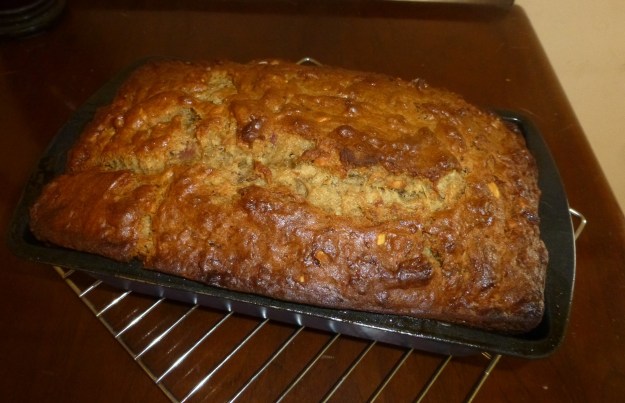
done-baking

It all started when I bought a few too many overripe bananas. At 99 cents for six, how can one not buy a dozen?

For years, I’d read about Elvis Presley’s love for a grilled sandwich containing bananas, peanut butter, and bacon. While actually making and consuming same seemed a bridge too far (I hadn’t yet lost all respect for my oft-abused arteries), I reasoned that the essence of The King’s bestest sammie could well be condensed into a single, less punishing, loaf.

Riffing off a basic banana bread recipe, I set out on the road to culinary Graceland. The first pass yielded a version that, while tasty, didn’t quite hit the sweet spot of a bread fit for a you-know-what (too peanut butter-y). A friend suggested that I could micro-manage the outcome by having bacon, peanut butter, and mashed bananas on hand to course-correct on a slice-by-slice basis, but that seemed to me like cheating. By the second go, I was TCB; peanut butter ratcheted back, bacon pumped up, and for good measure, I slipped in some bacon drippings for shortening.

I think the latter was my -ahem- good luck charm. Nailed it.

INGREDIENTS

1 pound (1/2 kg) bacon, cooked crispy
2 cups (250 gm) all-purpose flour
1 teaspoon (5 gm) baking soda
½ teaspoon (3 gm) salt
4 overripe bananas
½ cup + 2 tbsp. (145 gm) crunchy peanut butter (I used Kroger Crunchy Peanut Butter with Honey)
1 cup (250 gm) turbinado sugar
⅓ cup (80 ml) buttermilk
⅓ cup (80 ml) bacon drippings
2 eggs, room temperature
1 tbsp. (15 ml) vanilla extract

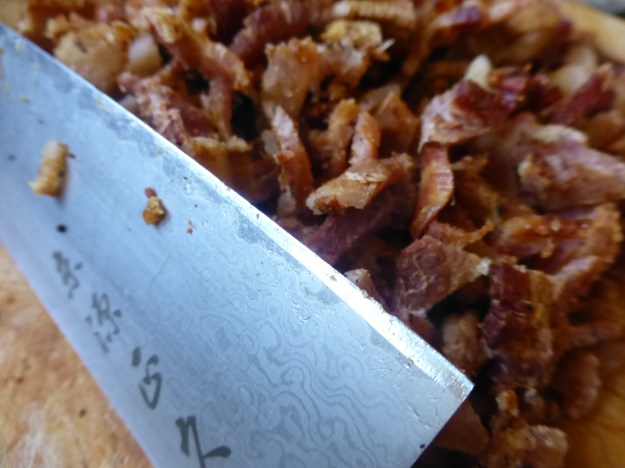
chop-the-bacon

DIRECTIONS

1. Fry bacon until crispy; crumble or chop and set aside.
2. Preheat oven to 350°F/ 175°C. Grease and flour an 8″ x 4″ loaf pan.
3. In a large bowl, whisk together the flour, salt, and baking soda; set aside.
4. In a separate large bowl, combine the banana, chopped bacon, peanut butter, sugar, buttermilk, bacon drippings, eggs, and vanilla extract with electric mixer until completely mixed.
5. Pour the wet ingredients into the flour mixture and fold together with a rubber spatula or wooden spoon until completely combined; be sure to moisten all the flour, but don’t overmix — or overthink.
6. Transfer the batter to the prepared loaf pan, smoothing the top into an even layer. Bake until the loaf is golden brown and a toothpick or thin knife inserted into the center comes out almost perfectly clean, about 1 hour to 1 hour 15 minutes.
7. Let the bread cool in the pan for about 10 minutes, then turn it out onto a wire rack to finish cooling. Wrap the cooled loaf tightly in plastic wrap; it can be stored at room temp for up to 5 days. [Good luck keeping it around that long.]

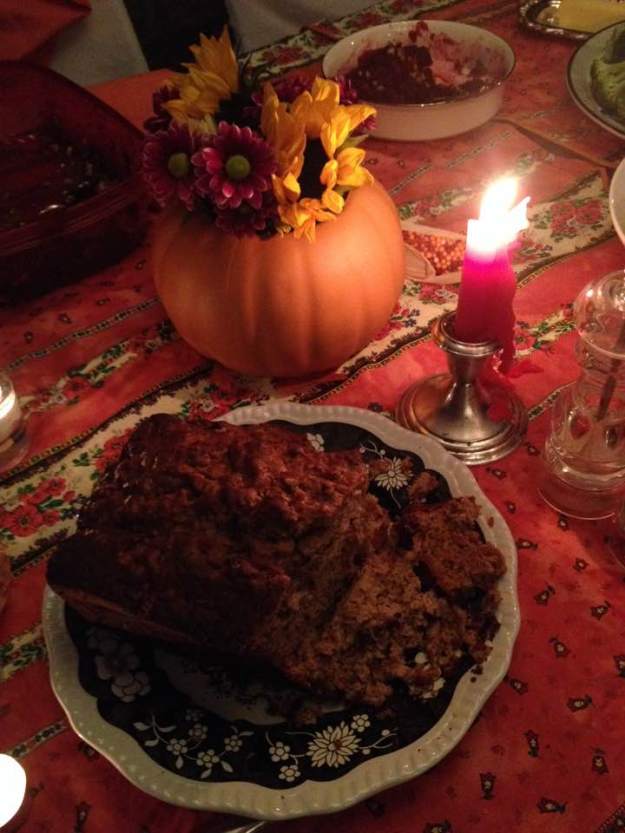
elvis-bread-at-thanksgiving

Should you require a soundtrack in the background while you bake your Elvis bread, I might modestly advance an odd little ditty that a record label I once worked for released nearly thirty years ago.


Rosemary Apple Butter — Savory To The Core

1
Sugar and spice and everything nice.

Sugar and spice and everything nice.

Who doesn’t like apple butter? Seriously. One of the real joys of this humble spread is that it can be made so easily, and with almost no general kitchen aptitude. If you can manage to get a bunch of ingredients into a pot — or, in this case, a slow cooker — you’ve pretty much got it made.

My main quarrel with most of the apple butters I’ve consumed over the years (and a minor one at that) is that they were a tad sweet for my taste; I aimed to veer off a few degrees toward the more savory side, and because I have a thriving rosemary bush immediately adjacent to my house, I decided to employ its bountiful, um, bounty. Basil or thyme would also make excellent partners in the savory apple butter process, but rosemary works magnificently on its own, and it was at hand in abundance.

The first time I made apple butter, I peeled all the apples with a hand-held vegetable peeler. Very old-school, and plenty effective, but it does lend itself to a bit of carpal tunnel syndrome, and it’s slow. For just about $20 USD, you can pick up a peeler/corer unit that really speeds up the process, and keeps your wrists supple and cramp-free.

The slow cooker is a perfect match for this recipe, but it’s easily doable on the stove or in the oven; basically, you bring the liquid to a boil, then back off on the heat, and let it cook until it reduces to the desired thickness. If you were putting it in the oven in a covered pot (a Dutch oven, for instance), you’d want to keep it covered for most of the time, and the temp fairly low, say 250˚F/125˚C, and you can leave it overnight.

ROSEMARY APPLE BUTTER
6 Jonagold apples
6 Golden Delicious apples
6 Granny Smith apples
6 Red Delicious apples
½ cup turbinado sugar (honey or agave syrup can be used as a substitute, as can regular cane sugar, white or brown)
Juice of 2 lemons
6 sticks cinnamon
1 cup unfiltered Honeycrisp apple juice
8 star anise
1 branch rosemary (6-8 twigs)

[NOTE: I picked the apples I did due to the fact that they were all on sale; the Red Delicious are definitely the weak sister in the bunch, taste and texture-wise, so you might want to have either eight apiece of the first three varieties, or substitute some other variety for the Red Delicious. As it turned out, the apple butter was delicious (no pun intended), but I think it could have been even better with Romes or Galas or McIntoshes or Fujis or many other options.

Also, the unfiltered Honeycrisp apple juice was on sale, so I opted for it. It’s really quite good, but I expect that pretty much any apple juice is equal to the task.]

Peel, core, and cut up apples and put into a slow cooker with the rest of the ingredients. Leave on high for two hours, then switch to low for another twelve or so until desired consistency is reached. Remove cinnamon sticks, star anise, and rosemary twigs. Process in food processor or with immersion blender. [Be careful if using a food processor, especially if it’s still warm; the steam needs a place to go, so don’t cover your food processor tightly. Just set a towel over the opening.]

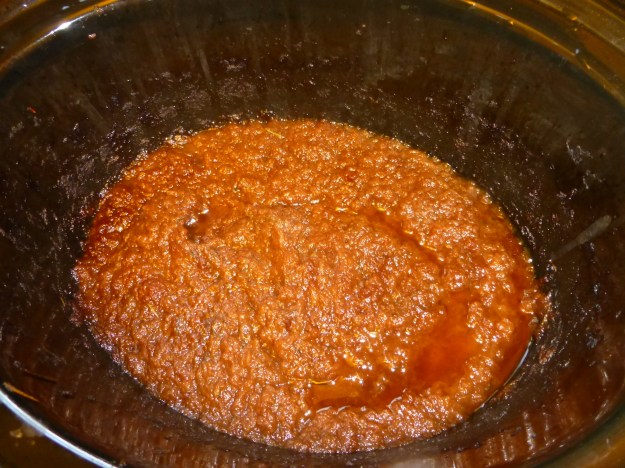
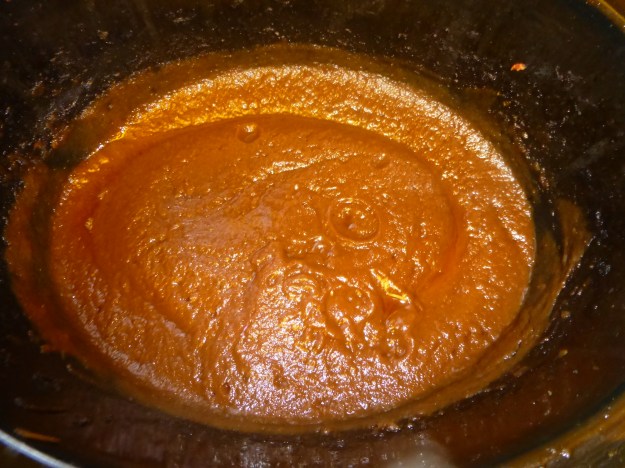
After about 12 hours or so, it should look kinda like this.

Cooked WAY down.

Cooked WAY down.

Some people prefer the rustic lumps and clumps of apple butter as pictured above, but the rosemary had shed some of its leaves, and I wasn’t happy to have them texturally in the finished product. I suppose I could have pulled all the leaves out with tweezers, but that wasn’t a happy prospect, so I let the immersion blender do its work.

Smooth as butter.

Smooth as butter.

At this point, the only decision remaining was whether or not to can. Because I added only a minimal amount of sugar, and because I wasn’t sure how acidic the apple varieties I used were, and because it didn’t yield an unworkable amount of finished product, I decided not to process the final apple butter in the traditional water bath, and opted for refrigeration instead. (My pH strips have since indicated that it’s well within the safe range for canning, so if you care to, go ahead and process the standard way; no need for pressure canning.) I’m guessing that between your own uses and the friends who will be clamoring for it, your apple butter won’t spend a long time on the shelf.

Where the heck did those 24 apples go?

Where the heck did those 24 apples go?

The apple butter pairs well with any sort of stinky cheese in hors d’oeuvres, but it’s also delightful with good old everyday Cheddar, or on a toasted English muffin either with or without butter. It also makes a terrific glaze for pork or chicken, should the occasion arise.

Torta or Tarta de Santiago (or maybe not)

3
On the road to Santiago... specifically, Triacastela.

On the road to Santiago… specifically, Triacastela.

In May of 2015, my bride and I took a journey along the Camino de Santiago, an ancient Catholic pilgrim route (more specifically, we traveled along a portion of the so-called Camino Francés, which is one of a number of Camino routes that all end up in Santiago de Compostela, Spain). It’s an excellent thing to do, as evidenced by the motion picture The Way, and by the still-incomplete blog chronicling our trip, Two Roads to Santiago.

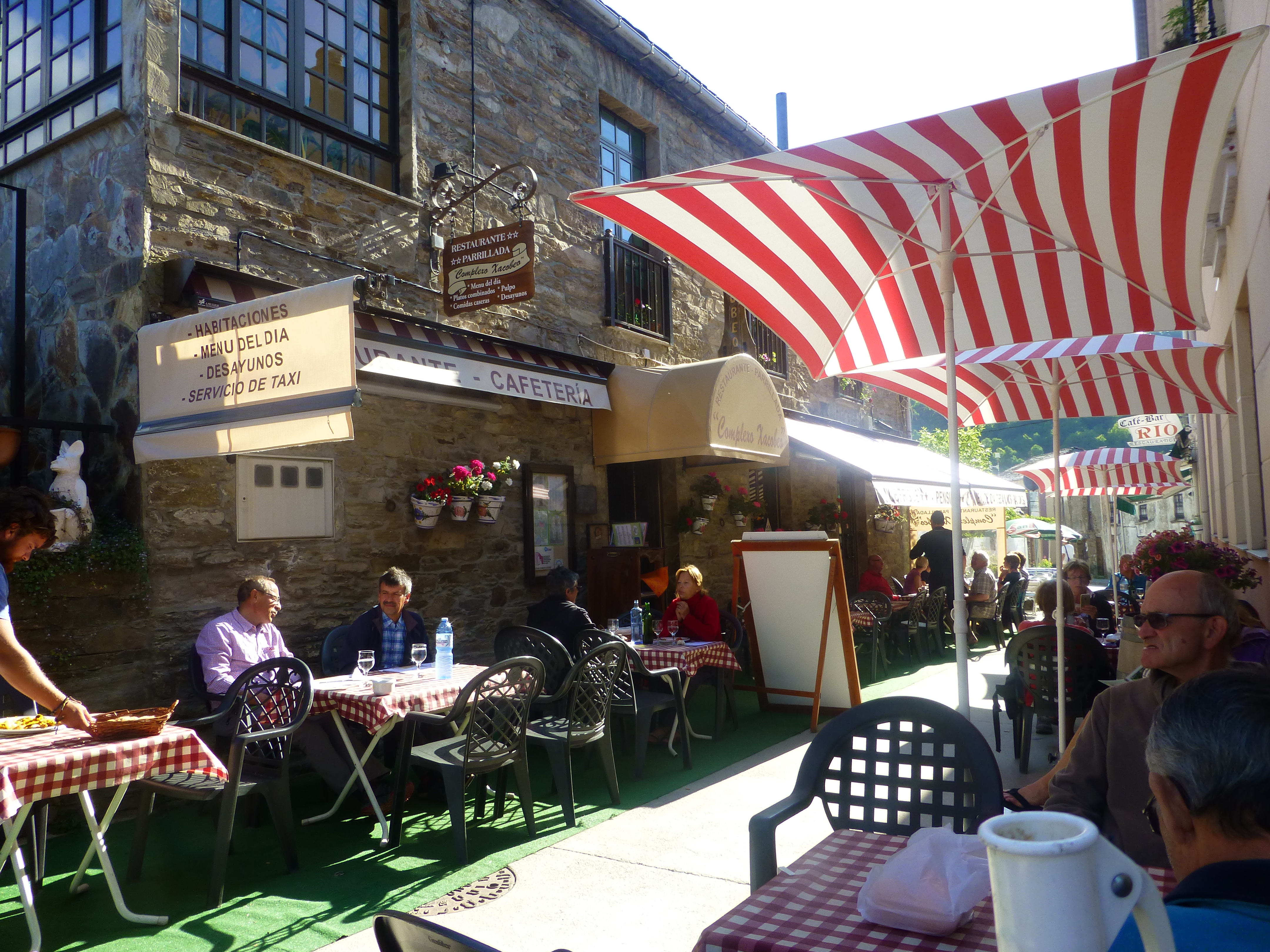
Complexo Xacobeo. Food, lodging, taxi, you name it, you got it.

Complexo Xacobeo. Food, lodging, taxi, you name it, you got it.

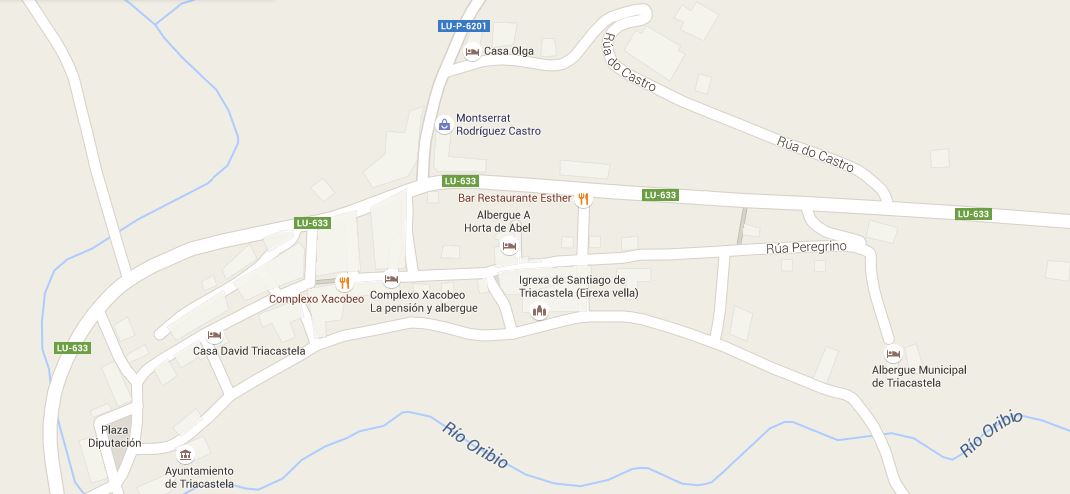
Triacastela is a small (pop. 721) town in the province of Lugo, in the Galician region of Spain; it’s about 135 km east of Santiago de Compostela. It got its name from three castles that once stood there (though none of them do now). We stayed there the evening of 24 May, Bob Dylan’s birthday, apropos of nothing. After disgorging our luggage, we wandered into the center of town for dinner, and had an excellent meal at the Complexo Xacobeo.

We didn't have just wine and water, but it was a good start.

We didn’t have just wine and water, but it was a good start.

At dinner’s close, the bride and I had a minor disagreement that would change my life — our lives — for the better. I wanted a cool, refreshing ice cream for dessert, and she preferred to try a local delicacy called tarta de Santiago (in Spanish, anyway; in the local Gallego, it was torta de Santiago). It’s an almond cake whose recipe will follow later in this post.

I like almonds and I like sugar, but most almond confections have generally left me unimpressed; marzipan actually engages my gag reflex. But the bride had walked 20-odd kilometres that day over steep terrain, so she won. Wow, am I glad she did. It was so delicious that I dedicated the balance of our time in Spain to sampling as many versions of it as I could reasonably consume, and no fewer than eight bakers’ interpretations of the ancient recipe passed my lips.

1835? 1838? Galicia? Elsewhere? You decide.

1835? 1838? Galicia? Elsewhere? You decide.

How ancient is the recipe? It certainly goes back as far as the Cuaderno de confitería, which was compiled by Luis Bartolomé de Leyba circa 1838. It’s actually based upon this publication that the tarta/torta obtained its Indicación Geográfica Protegida, which protects its status and authenticity the same way that Champagne does for certain French sparkling wines and Parmigiano Reggiano does for certain Italian regional cheeses. That’s all good as far as it goes, but Spanish culinary historian Jorge Guitián discovered that the Cuaderno de confiteria was largely a rehash of recipes that had previously been published elsewhere, including one cookbook, Art Cozinha, that was published in Lisbon in 1752, not to mention Juan de la Mata’s Arte de Repostería, published in 1747. One source sets its first publication date at 1577, as “torta real,” claiming it was brought to Spain by the Moors. And on top of that, some culinary historians have suggested that the recipe came originally from Sephardic Jews settled in the area, and its original use was as a Passover cake, as it’s unleavened.

Because of their generous and welcoming nature, I’m inclined to give the Gallegos a mulligan on this one. Whether or not the tarta de Santiago actually originated in Galicia, it flourished there, and they have embraced it as part of their cultural and culinary heritage. One thing is for certain: the habit of dusting the top of the cake with powdered sugar, save for a stencil of a cruz Xacobeo (Saint James’ cross) dates to 1924, when José Mora Soto, a baker in Santiago de Compostela, decorated his cakes with the mark to distinguish his from competitors’. In the intervening 90+ years, the tradition has been almost universally embraced.

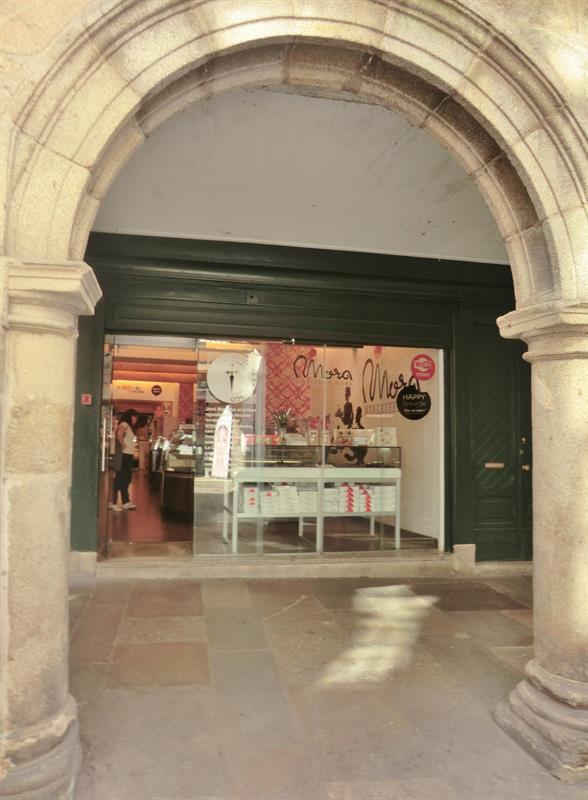
The ancestral home of the modern tarta.

The ancestral home of the modern tarta.

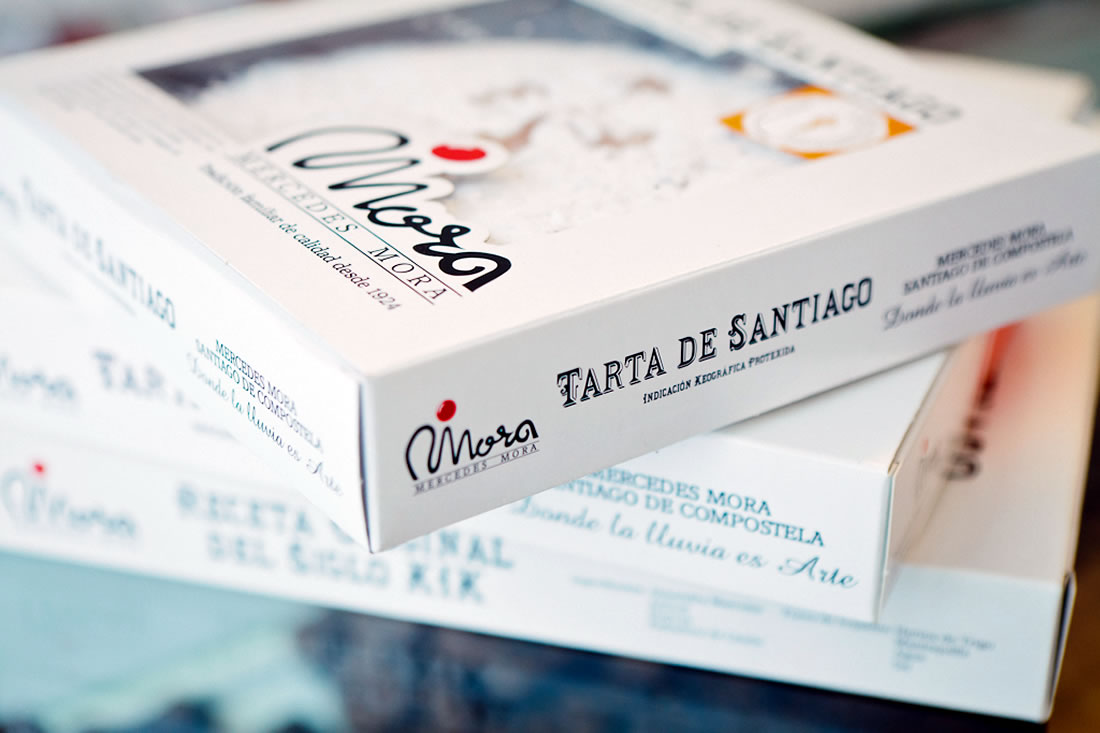
His bakery, rechristened Pastelería Mercedes Mora (for his granddaughter, pictured below), still makes the cakes today.

The real deal.

The real deal.

Good as they may be, it’s inconvenient to travel to Santiago de Compostela every time you care to have one of these cakes. So here’s a step-by-step version of the shockingly simple — and, if it makes a difference to you or your dining companions, gluten-free — recipe.

The finished item.

The finished item.

TARTA DE SANTIAGO

Ingredients

• 250 grams / 2.5 cups of almond flour (I use ½ blanched and ½ unblanched)
• 250 grams / 1.25 cups of sugar, preferably superfine/baker’s sugar
• 6 eggs
• Zest of two citrus fruits (lemon is traditional)
• Powdered sugar to sprinkle on the top
• 1 chunk of unsalted butter to spread on the springform pan
• You can use a variety of essences, extracts, or other scent enhancers to give the cake a nice aroma, such as brandy, cinnamon, etc. Use sparingly, though, so as not to overpower the simple and delicate flavours of the almond flour and citrus zest.
• 1 round detachable mold/springform pan / 22 to 25 cm or 9 to 10 in. diameter
• Lemon juice or other liquid for moistening top of cake
• a paper (or plastic) St. James cross for stencil

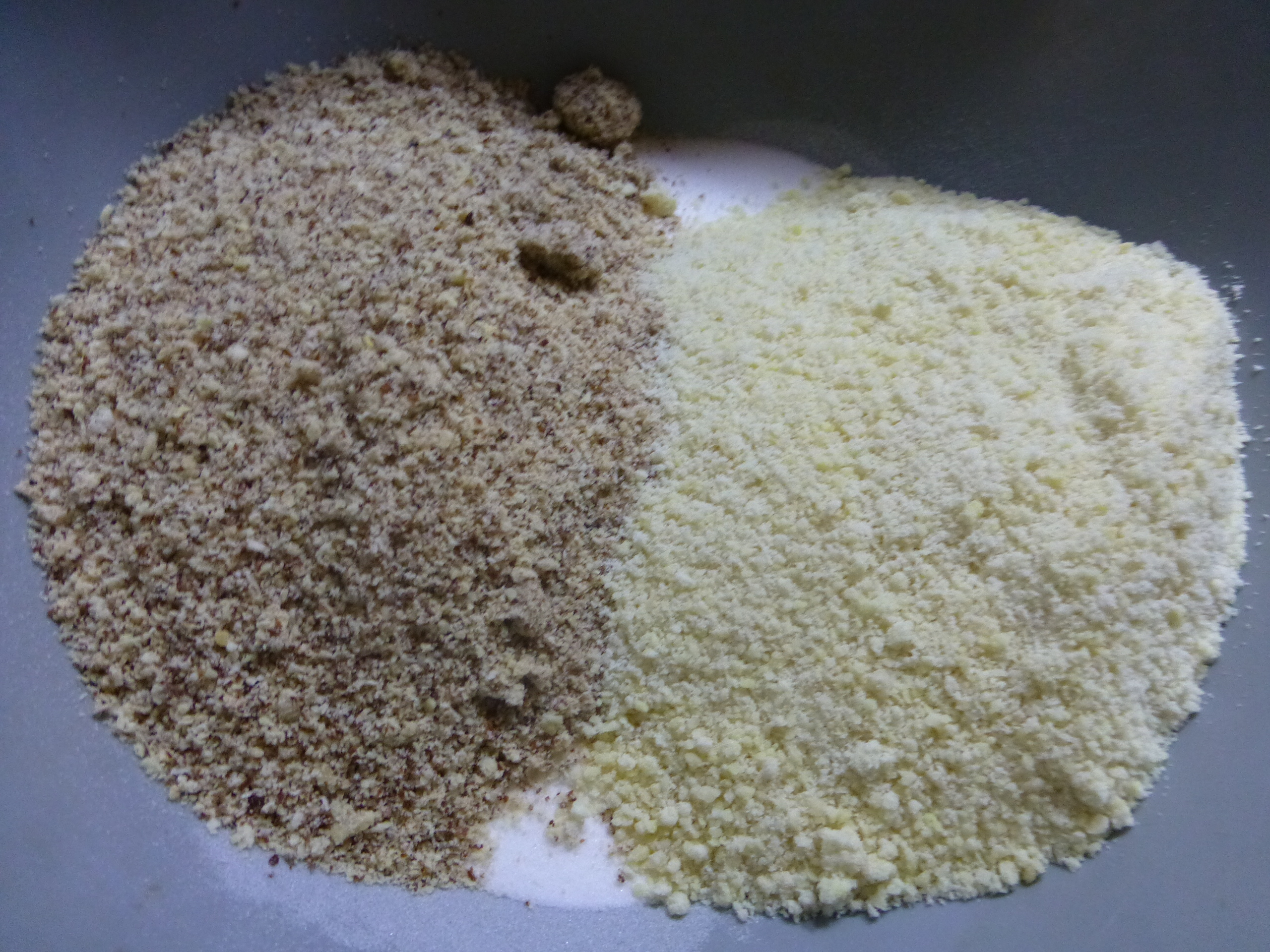
Two different almond flours are optional.

Two different almond flours are optional.

Batter will be fairly loose when you pour it into the pan; don't worry.

Batter will be fairly loose when you pour it into the pan; don’t worry.

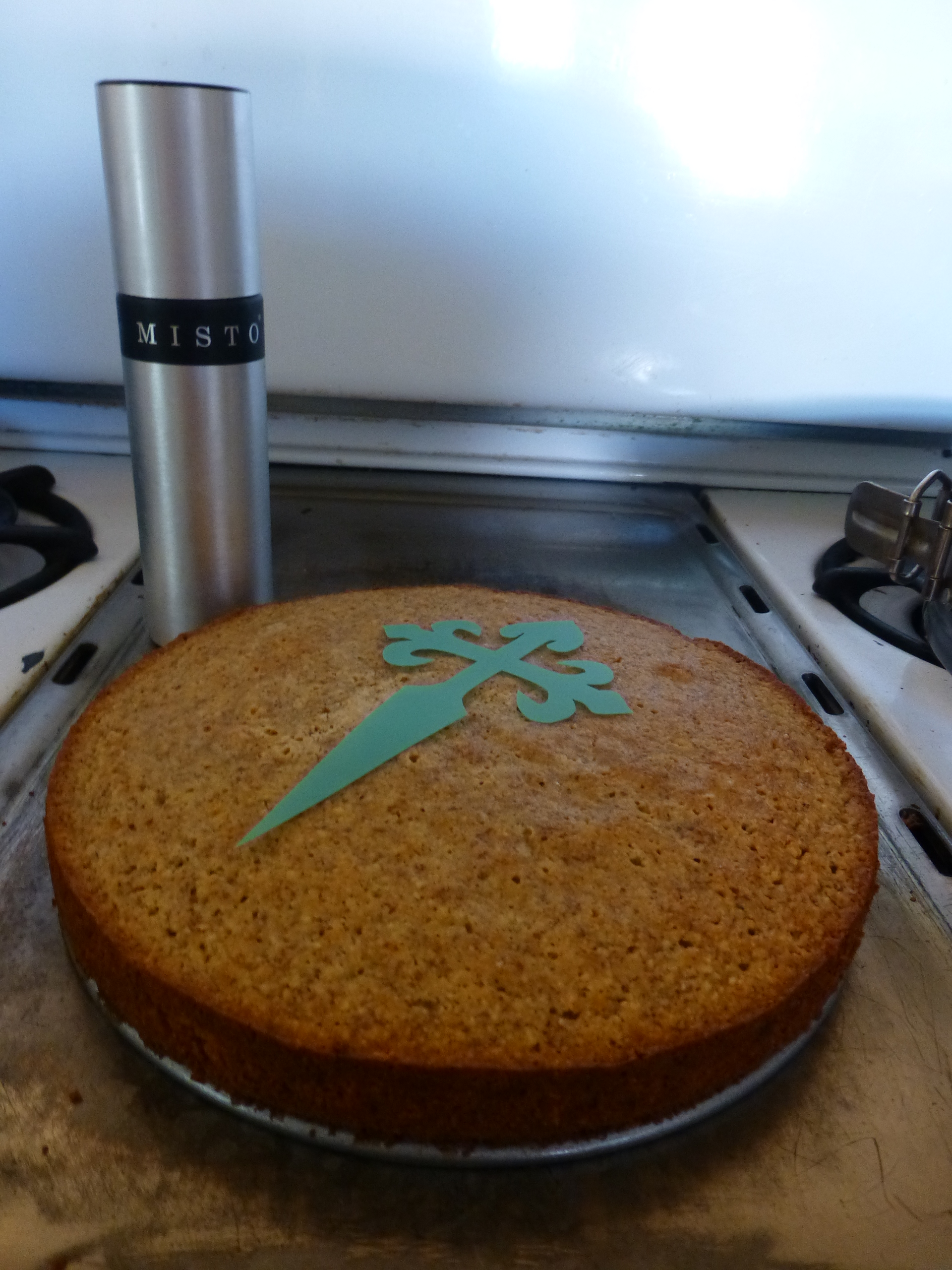
Out of the oven and ready for stenciling.  I use a spray bottle to apply the liquid, but a dish and pastry brush works fine too.

Out of the oven and ready for stenciling. I use a spray bottle to apply the liquid, but a dish and pastry brush works fine too.

Preparation

• Preheat the oven to 175º C (350º F)
• In a large bowl, combine the sugar, almond flour, and lemon zest or other essence. Mix ingredients well with a fork.
• In separate bowl, mix eggs with fork until blended.
• Add the eggs and mix well with a spoon or rubber spatula, but do not whisk, only make sure all the ingredients are moistened.
• Spread the butter on the mold (or spray with PAM) and pour the mix in it.
• Bake at 175º C (350º F) for 40-45 minutes until the surface is toasted and golden; when a toothpick inserted in the center comes out clean, it’s done.
• When the cake is done, remove from the oven and let it cool before unmolding. You may want to run a knife or spatula around the edge to make sure the tarta hasn’t stuck to the pan, but do be careful not to scratch the pan when you do it.
• When the cake has cooled, place the paper/plastic cross on top of the surface, moisten the entire top of the cake (including the stencil) with citrus juice or other liquid (brandy, etc.), then sprinkle powdered sugar evenly over the entire surface, using a mesh strainer.
• Remove the stencil carefully, as to avoid dropping sugar from the stencil onto the cake.

Maybe not quite Mora, but pretty darn close and a whole lot easier.

Maybe not quite Mora, but pretty darn close and a whole lot easier.

A Close — And Sweet — Shave

0
A sweet ride.

A sweet ride.

[Full disclosure: I have been acquainted with the owner’s family for something approaching a decade, so make of that what you will. As a for-example, I adore my mom, but she made some of the Worst. Tacos. Ever. Taste and truth trump ties. And if I’m willing to dis my own mother (who also, incidentally, was capable of crafting a world-class roast of beef), you can bet I’m not going to be shy about pulling punches here. Apart from mentioning that the CEO is a 17 year old entrepreneur named Jack Kaplan, I’m going to leave the history of the enterprise for him to tell as it unfolds.]

Kakigori, for those of you who might be unfamiliar with it, is the Japanese version of shave ice (in the “shaved” vs. “shave” ice argument, I come down on the latter for no particular reason except that’s how I learned it). But before you turn your thoughts to sno-cones filled with something that looks like anti-freeze and tastes vaguely of an alleged “blueberry” lollipop, please jettison every childhood image of sno-cones, Icees, Slurpees, or other frozen concoctions. Kakigori is to sno-cones as an éclair is to a Twinkie. Conceptually similar, but light years apart in terms of taste.

Its origins date back to Japan’s Heian period (AD 794 to 1185), where it is mentioned in The Pillow Book (枕草子 Makura no Sōshi), a collection of observations and musings written by Sei Shōnagon, a lady in the court of Empress Consort Teishi. [The book was completed in 1002.] At the time, the delicacy was confined strictly to the upper classes, due in part to the scarcity of ice, especially in the summertime. During the Meiji period, in the late 1800s, so-called “Boston ice” arrived by ship from America, and kakigori was made available to the masses. Yay.

Generally speaking, kakigori is not merely a flavouring poured over ice, though it can be. Often times, the ice itself is infused with some sort of flavouring agent (as you will see below). In addition, many recipes may include elements such as sweetened condensed milk, ice cream, fresh fruit, syrups featuring caramel or chocolate, and other sundry goodies, such as sweetened mochi, a confection made from rice paste that takes on a chewy/sticky texture not altogether unlike a soft gummi bear.

It’s not available widely in America at present, but that may be about to change with the debut of Kakigori Kreamery’s mobile unit (seen pictured at top) in Venice, CA, on 25 July 2015. That’s an auspicious launch day, as the Japan Kakigori Association designates that date as the “day of kakigori” because its pronunciation sounds like “summer ice” in Japanese.

Green Kara-Tea

Green Kara-Tea.

At press time, there are nine flavours:
Strawberry Samurai
Green Kara-Tea
Kookie Kabuki
Mt. Fuji
Ginja Ninja
Blueberry Banzai
Mokamania
Konichiwa Kitty
WATA-WATAmelon

Okay, the names are a little goofy, though not to the level of IHOP’s popular “Rooty Tooty Fresh ‘N Fruity®” pancake entrées, which I would absolutely refuse to order by name just because. But underlying the frivolous nomenclature lies some serious taste delight. If I might direct your attention to the photo above, do note that the ice is shaved, rather than cracked or crushed, which gives it a texture far more delicate than the traditional sno-cone (and even much of the “Hawaiian-style” shave ice, which frequently is no more shaved than Duck Dynasty‘s cast members). This is the Green Kara-Tea kakigori, which is made from green tea ice, rainbow mochi, and matcha-infused condensed milk. [Matcha, of course, is green tea powder, with its stems and veins removed before processing.] It’s sweet enough for kids to enjoy (and they’ll adore the rainbow mochi), but not an adult-repelling sugar bomb.

I should have taken a shot of the Ginja Ninja, because it was may fave of the bunch (I tried five of the nine flavours, and I’m going back next weekend to complete the date card). With its ginger ice, snappy gingersnap crumble, Maldon salt, and caramel sauce, it’s a bracing and energizing blast of spray from a rousing sail on the Ginger Sea.

WATA-WATAmelon!

WATA-WATAmelon!

Tastewise, the WATA-WATAmelon totally nails it; mint, lime, and basil meld with watermelon the way Kardashians meld with camera lenses. They were made for one another. Its one slight drawback is that the delicate watermelon ice shavings, like Blanche DuBois, tend to wilt in the heat. You have to plow through your portion at speed, or risk the possibility of having a cup of refreshing watermelon drink, rather than an icy delight. That said, it’s something of a small quibble, because it’s pretty great in either state (mine wound up half and half).

But Kakigori Kreamery’s secret weapon in its quest for world domination may well be their Kookie Kabuki: cookies ‘n’ cream ice, crushed Oreos, and condensed milk. This. Is. Irresistible. While the Ginja Ninja is still my favourite, it (much like me) is a little idiosyncratic. The Kookie Kabuki, on the other hand, has its sights locked on a multi-generational, multi-ethnic, multi-you-name-it target that wants a summertime comfort sweet that hits every familiar note. With a little luck, this might just supplant Häagen-Dazs’ Vanilla Swiss Almond ice cream as the heavyweight champ in the chocolate-meets-vanilla arena. But this is the case only if, of course, you happen to be in southern California. Otherwise… well, Japan is nice this time of year, but a SoCal sojourn might well be both less expensive and less complicated.

You can follow the exploits of Kakigori Kreamery here and here.

If you want to be around for their official debut, come check them out at the grand opening:
7/25 from 8:30am – 2:05pm
Venice Arts & Collectibles Market
13000 Venice Blvd.
Los Angeles, CA 90066

And should you care to try a home version of kakigori, you can pick up a Japanese-style ice shaver here, and a recipe for Peach Yogurt Kakigori with Mint Syrup here.

We Be Jammin’ (Specifically, Strawberry Balsamic Jam with Black Pepper)

1
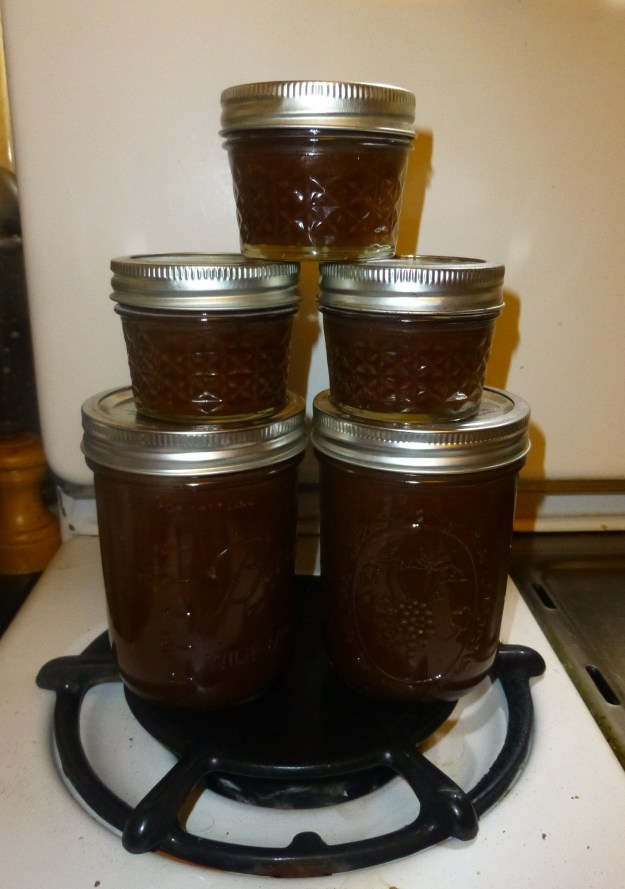
Itty bitty jars of sweet and savory goodness.

Itty bitty jars of sweet and savory goodness.

Ah, the joys of ADHD. I had planned on making a strawberry-cherry pie, then strawberry-rhubarb tarts, but when the steam had settled, my two pounds of luscious Driscoll strawberries found their way into a jam. Generally speaking, I’m not a huge fan of strawberry jam, because it tends to be both a little sweet and a little insipid for my taste, but I came across several recipes for a strawberry balsamic jam, and then the vision of serving it with an aged white Canadian Cheddar kicked in — no, wait; goat cheese! or maybe a stinky Roquefort! (see what I mean about the ADHD?) — so I committed to making a small batch.

Six ingredients. Six. No added pectin. Comparatively speaking, a fair amount of work for six four-ounce (118 ml) jars, but highly satisfying, especially when you give them away as gifts to a grateful palate (even if it’s your own).

STRAWBERRY BALSAMIC JAM (makes six 4 oz./118 ml jars)
Ingredients
2 lb./1 kg fresh strawberries
3 tbsp/45 ml lemon juice (fresh-squeezed, if you can get it)
1.5 cups/300 g granulated white sugar
4 tbsp/60 ml balsamic vinegar
1 tsp/5 g sea salt or kosher salt
1/2 tsp/1-2 g freshly ground black pepper

Berries and sugar, macerating nicely.

Berries and sugar, macerating nicely.

Rinse and hull strawberries. Place in a bowl with sugar and let sit for at least 1-2 hours (or overnight, if it’s convenient), mashing the strawberries after about 10-20 minutes.

Berries and sugar, all mashed up.

Berries and sugar, all mashed up.

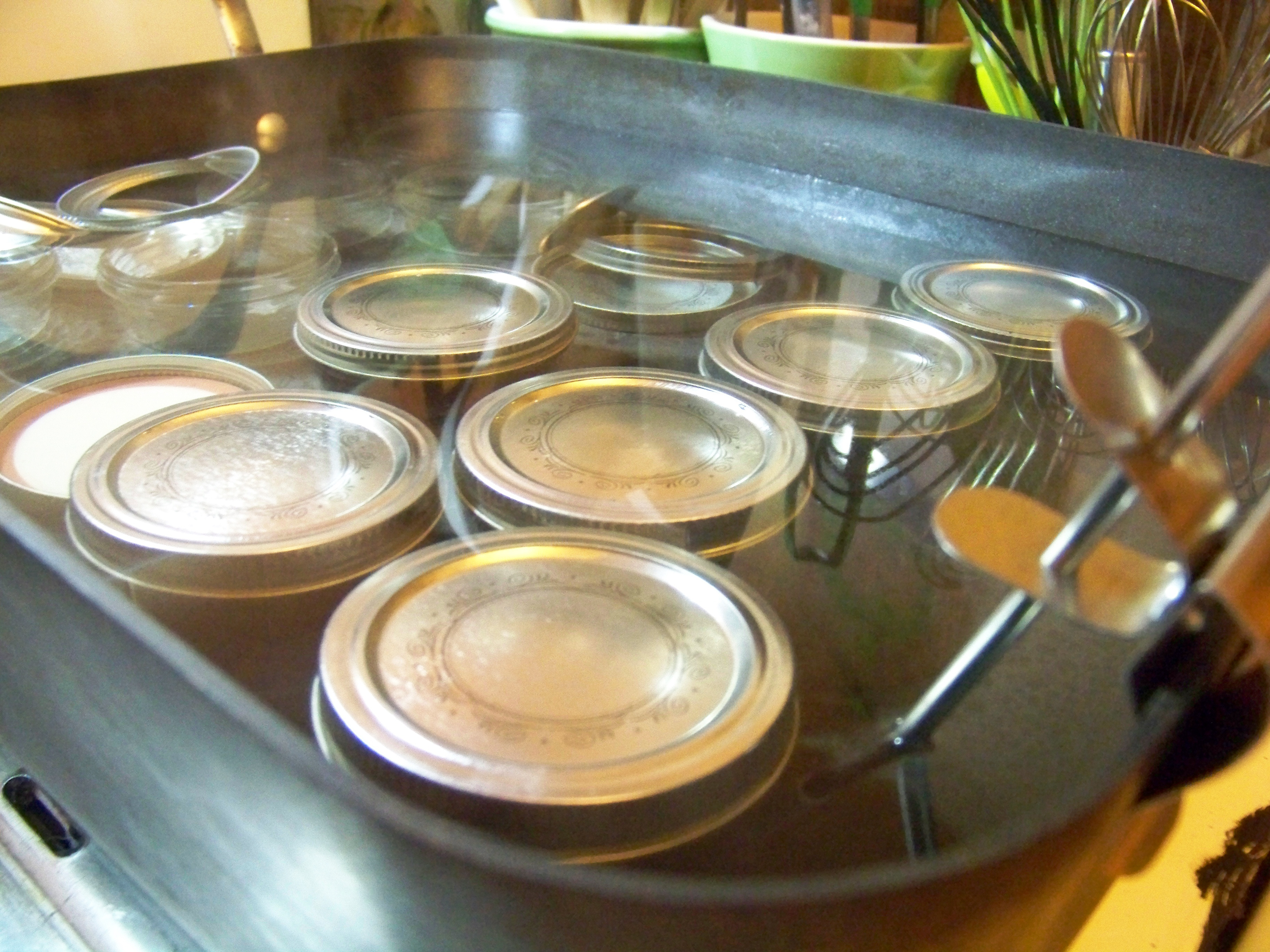
Meanwhile, prepare jars and lids (which is to say, throw them in boiling water for a minimum of 10 minutes). [You have the option of making this a refrigerator jam if you don’t care to do the whole home canning thing; strictly up to you. I chose to preserve the preserve in the traditional manner. Otherwise, be sure to use it up within about 10 days.]

It may not be quick, but it does get thick.

It may not be quick, but it does get thick.

Place the strawberry and sugar slurry in a non-reactive saucepan, add the lemon juice, and bring to a boil on medium-high heat. Reduce heat to medium and continue to cook until jam is at the jell stage, stirring frequently and watching at least semi-observantly. [For me, this was about 45 minutes, but your pan and stove may bring about a different result, timewise; one of the recipes I read said you could get there in 30 minutes.] Add the balsamic vinegar, salt, and black pepper the last five minutes of cooking, stirring continuously. Remove the pan from heat.

Jam and a few spare jars.

Jam and a few spare jars.

Pour jam into hot, prepared jars, leaving 1/4″ headspace. Refrigerate immediately or seal and process jars for 10 minutes in a water bath canner. If processing in water bath, remove and let jars sit for 24 hours, ensuring a good seal. Remove bands and store for up to one year… if you think you can wait that long before finishing it all off.

Boiling, but not mad.

Boiling, but not mad.

[Thanks to my pal Susan Park for the suggestion of adding the salt; it cuts the sweetness nicely, and plays well with both the strawberries and the vinegar. And thanks to my cousin Sheryl for the gorgeous cutting board that served as a tray for the jars.]

Maple. Bacon. Muffin. Yum.

0
Maple bacon munchable.

Maple bacon munchable.

Maple and bacon go together like… well, maple and bacon. Just saying those two words together conjures up pastoral images of a smokehouse out in the woods of rural Vermont (or Québec, if you happen to be a Canadian like me), nestled among a stand of sap-producing trees, each with its own bucket. Heck, people even cure bacon with maple. So naturally, I was curious about how to make a portable (and edible) vehicle for conveying these two great tastes that taste great together.

I started with Maple Bacon Cookies, but try as I might (several batches), I couldn’t quite get the balance right. I tried making them with maple sugar (very expensive), with maple bacon liqueur, with enough maple syrup to turn the cookie dough into something resembling cake batter. In every case, the maple flavour seemed to get swallowed up like an extra in a Tarzan movie, disappearing irrevocably into the quicksand of the dough.

So I abandoned the project temporarily. And yet, the problem nagged.

One afternoon, I thought I might try my hand at a maple bacon muffin, rather than a cookie, and I came across an interesting recipe on littleleopardbook.com. This author’s version called for a streusel topping, which I knew I didn’t want, but I was curious to try the muffin itself. Not bad, but it suffered from the same problem I’d had with the cookies; not enough maple. Another blogger suggested using maple extract, but the local grocery had only imitation maple flavouring — that was right out — and online bakers reviewing the various extracts available through Amazon frequently experienced The Case of the Disappearing Maple Flavour. One product in particular looked interesting, but it had only three reviews, and at $4 per oz. (it was $9.89 + $6.60 shipping for a 118 ml bottle), I decided to go a different route for the time being.

If the maple flavour was being swallowed up on the inside, why not put it on the outside? So for the next pass, I added the requisite amount of maple syrup to the batter, but I also fixed upon a post-bake maple glaze to ramp up the taste.

I also opted to use the grease left over from the cooked bacon as part of the shortening for the recipe. Instead of the 1/2 cup of oil that the original had called for, I substituted approximately 1/4 cup of rendered bacon grease (all I had from cooking 1 lb. of applewood smoked bacon) and topped off the measuring cup with canola oil.

Those two little tweaks turbocharged the flavour, and turned my “grrrrr” into “grrrrreat.”

One last tip: If you have access to it, No. 2 or Grade B maple syrup is — perhaps somewhat counterintuitively — preferable to what is commonly sold as Grade A. It’s darker and has a more pronounced flavour. Vermont’s maple syrup producers, in a typical case of grade inflation, have recently decided to reclassify all commercially available maple syrup produced in the state as Grade A, with descriptors on the label to distinguish the varying colours. What was Grade B is in the process of being rebranded as “Grade A Dark With Robust Taste.” New York state has opted in on this scheme as well, and it seems like most other maple syrup producing regions will be on board by the end of 2015. Or maybe not.

Incidentally, many websites and blogs will imply — or even declare! — that Vermont maple syrup is the ne plus ultra of sap-derived products, but I will humbly (and with some degree of national pride) suggest that while Vermont’s state flag sports a pine tree, the Canadian national flag displays the maple leaf. Caveat emptor. But no matter where your maple syrup came from, by all means use real maple syrup and not that imitation chemical Frankensyrup. That abomination’s only legitimate application is as a weak adhesive, suitable for sticking papers together. You might save a few cents, or even a couple of bucks, but life is short, and some corners were meant not to be cut.

Batter up.

Batter up.

MAPLE BACON MUFFINS [Gluten-Free Version] (makes 12 muffins)
Ingredients
1 lb./.45 kg crispy cooked bacon, crumbled
2 cups/250 g flour (I used gluten-free Cup4Cup)
3 tsp/12 g baking powder
1/2 tsp/4 g salt
1/2 cup/120 ml milk
1/2 cup/120 ml mix of bacon grease and vegetable oil
1 egg
2/3 cup/160 ml pure No. 2/Grade B/Grade A Dark With Robust Taste maple syrup
1/3 cup/75 g dark brown sugar

Preheat the oven to 350°F/175°C. In a small bowl, combine dry ingredients (flour, baking powder, salt) and whisk together. In a larger bowl, whisk together the milk, oil/bacon grease, and egg, then add the syrup and sugar and whisk until the sugar is pretty well dissolved. Gradually add the dry ingredients, stirring as you add. No need to get super fussy about getting every little flour lump out, just give it a good quick mix and make sure that all the flour is coated with the liquid. Stir in crumbled bacon. Pour into paper cupcake liners or directly into a pre-greased and floured cupcake pan. Bake for 25-30 minutes, or until a toothpick inserted in the center comes out clean. Remove from cupcake pan onto cooling rack and allow to cool for 15-20 minutes before dipping in Maple Glaze (see recipe below).

Fit to be dipped.

Fit to be dipped.

MAPLE GLAZE
Ingredients
1/4 cup/60 g unsalted butter
1/2 cup/120 ml pure No. 2/Grade B/Grade A Dark With Robust Taste maple syrup
1 cup/112 g sifted confectioners’ sugar

You may not need this much glaze, so the important thing to remember is the butter-syrup-sugar ratio: 1-2-4. And if you want a “glazier” glaze, up the maple syrup just a bit. It’s less opaque and even more chock full of maple goodness.

As for the prep, you can heat the butter and syrup in a pot on the stove, or just pop them in a microwave-safe container to melt the butter (about 60-90 seconds on high should do the trick). Whisk in the powdered sugar and set it in the fridge to cool. When the surface has hardened (15-20 minutes), it’s ready for dipping.

Celebrating Celeriac with a Superb Soup [Vegan]

4
Celeriac, before and after a trim.

Celeriac, before and after a trim.

If there is an uglier vegetable on the planet Earth than celeriac (Apium graveolens variety rapaceum), I have yet to find it. Fortunately, much as beauty is only skin deep, in the case of this magnificent and underappreciated vegetable, so is ugly.

While celeriac itself doesn’t grow very deep — maybe six inches or so beneath the surface of your average garden plot — its roots in food history are deep indeed. In Book V of Homer’s Odyssey, it’s described as a component of Calypso’s garden, albeit in the Greek it is referred to as selinon. In one passage, Hermes admires the environs of Calypso’s cave, festooned with grapes, violets, and wild celery before stepping inside to beseech her to let Odysseus go and finish his journey back to Ithaca. But that’s another, much longer, story.

In ancient times, and for much of their early history, both celery and celeriac were regarded more as medicines than as foodstuffs. Pliny the Elder claimed that the so-called helioselinon was “possessed of peculiar virtues against the bites of spiders.” He also suggested that it could be used to revive sick fish. But by the 17th century, it was being cultivated in France, and by the 18th, it was being used in England for soups and broths.

Fast forward to today: soups and broths! For your consideration, here’s a soup that contains not just one, but two of the planet’s least photogenic vegetables (the latter being parsnips), along with a little ginger (no beauty contest winner itself), some onion, tarragon, and lemon thyme.

CELERIAC AND PARSNIP VELOUTÉ WITH GINGER AND LEMON THYME

Ingredients
48 oz./1.42 litres vegetable broth
2 large celeriac roots, peeled and roughly cubed
3 large parsnips, peeled and chopped
1 large onion, roughly chopped
1 tablespoon (or more, to taste) fresh ginger root, finely chopped
2 tsp./1.2g dried tarragon (it’s what I had at the time; fresh is good too, but use less)
4 sprigs fresh lemon thyme
1 carrot, cut into “coins” (optional)

Before you get all huffy, this is not technically a velouté, inasmuch as it is not thickened with a roux and cream, but it resembles one in texture. If you just want to call it soup, you have my blessing.

Cleaning the celeriac is best done with a very sharp knife, and it may be treated the same way you would strip off the rough outer skin of a pineapple; ideally, you’ll get off all the brown bits underneath the skin, but don’t make yourself crazy (or whittle the vegetable down to half its original size) getting there. Chopping the peeled celeriac is a bit of a chore, and may require rocking your knife back and forth a bit to get through the dense root. Alternatively, you can use a cleaver, if you have one. The parsnips should be scraped with a vegetable peeler, much like carrots, then chopped. As for the ginger, I started with a segment that was about the size of my thumb and scraped off the peel with a spoon before mincing it as finely as my admittedly mediocre knife skills would permit.

Once the prep is completed, making the soup is a snap; basically, you just dump all the ingredients into a big pot, bring it to a boil, and back it off to a simmer for about an hour to soften up the veggies and give the flavours a chance to blend. Then remove the thyme sprigs (which will have shed their leaves), and transfer the soup, in batches, to a food processor, blender, or Vita-Mix. [IMPORTANT NOTE: Do NOT clamp down the lid on your food processor/blender in such a way that steam cannot easily escape, or you will run the risk of both scalding yourself and decorating your walls with hot soup. I leave the top plug out of my Vita-Mix’s “Action Dome” and drape a tea towel over the opening to allow steam, but not solids, to egress.] Alternatively, the soup can be processed in situ with an immersion blender. Process until smooth.

Perhaps not the root of all soups, but it is a soup of all -- well, almost all -- roots.

Perhaps not the root of all soups, but it is a soup of all — well, almost all — roots.

You might note that salt is not a component of the ingredients list, and that’s because the vegetable broth I used (I’m ashamed to admit that I didn’t have any vegetable stock of my own lying around) contained 570mg of sodium, presumably in the form of sodium chloride, which was plenty salty for my taste. Your taste (and your broth) may vary.

To finish the soup off, I sliced a small carrot on a hand-held mandoline, arranged the carrot “coins” into a small “flower,” and sprinkled a few leftover thyme leaves on top. I might drizzle a few drops of olive oil on it as well next time, but it’s by no means necessary. Serves 6-8 (easily!) as an opening course.

You can call me Al. Albóndigas.

2
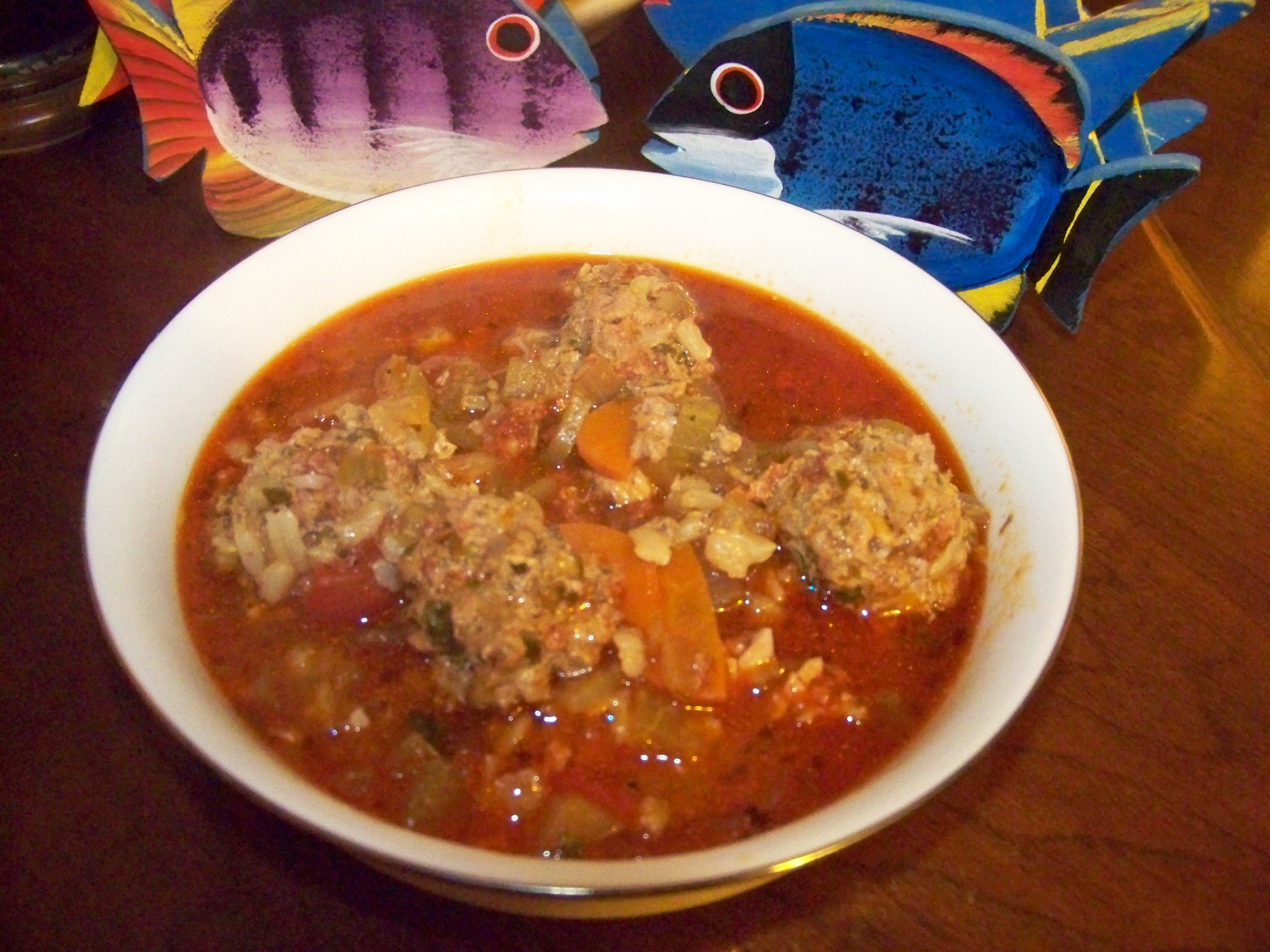
Believe it or not, the red colour comes mostly from the chorizo, not the tomatoes.

Believe it or not, the red colour comes mostly from the chorizo, not the tomatoes.

One inevitable responsibility after Thanksgiving dinner is the disposal of the turkey carcass. Picked clean for sandwiches and goodness knows what all else — tamales? sliders? pot pie? — there’s still a significant heap of bones and attached bits that deserve a better resting place than the rubbish bin.

Around our house, we generally made turkey and vegetable soup, but it just seemed too… turkey-ish. By the time we’d gotten down to the carcass, believe me, most of the members of our household were all done with turkey. This year, I decided to make some simple turkey stock (something on the order of four liters, as it turned out, because I wasn’t patient enough to let it condense into what Julia Child called a “semi-demi-glace”). But not for turkey soup. No. I figured it would make an excellent base for one of my favourite Mexican dishes, sopa de albóndigas (meatball soup).

While this soup is decidedly Mexican, its roots go back to the times that Arabs ruled Spain. The word “albóndigas” is derived from the Arabic word for hazelnut, “al-bunduq,” because the meatballs of the era were about the size and shape of said nuts. Their preparation was described in one of the great cookbooks of its day (its day being the 13th century), Kitab al- tabikh fi Maghrib wa al-Andalus (An Anonymous Andalusian Cookbook). Not too surprisingly, the meatballs emigrated to the New World with the conquistadores (along with smallpox and syphilis, albeit with a happier outcome for the locals). The use of mint in this recipe is almost certainly a descendant from a Middle Eastern predecessor, given the region’s historic proclivity for employing the herb as a seasoning for meats.

Far as I’ve been able to discover, there are two general schools of thought on sopa de albóndigas. One holds that it’s primarily a tomato-based soup, and the broth ought to be more or less jam-packed with tomato-y goodness and coloured fire engine red (PMS 199); the other is that tomatoes play a role, but not the lead. I opted for the latter. After all, I’d gone to some trouble to make the turkey stock, and I didn’t want it completely buried in the mix. The soup ultimately turned out a rich red colour, but that was thanks to the chorizo, not the tomatoes (as you can see in the picture below, when it was just the veggies and stock).

ALBÓNDIGAS SOUP

Carrots, planed on the mini-mandoline. I then cut the "coins" in half.

Carrots, planed on the mini-mandoline. I then cut the “coins” in half.


Ingredients
Broth
12 cups/3 liters turkey stock (or chicken, or vegetable, or beef)
2 carrots, sliced
1 large onion, chopped
4 stalks celery, diced
1 (14 ounce/411 g) can diced tomatoes (these were fire roasted)
1 (7 ounce/198 g) can diced green chiles, drained
1 cup/150 g cooked rice
2 teaspoons/2 g dried oregano
2 teaspoons/2 g ground cumin
1 clove garlic, minced
1 to 3 tablespoons/15-45 ml sauce from a can of Chipotle chiles in adobo sauce, to taste
1 seeded Chipotle chile in adobo sauce, optional
Sea salt and pepper to taste (smoked salt works well in this)

Here’s a trick for the rice; just cook 1 cup/180 g of dried rice (I used Brown Jasmine), put 2/3 of it in the soup and reserve 1/3 for the meatballs.

[A NOTE ABOUT CHILES: If you’re seeding Chipotle chiles in adobo sauce, wear gloves. Even the sauce is pretty hot, and if you touch your face… well, you won’t do it a second time. For the uninitiated, add the adobo sauce a tablespoon at a time, stir the broth, taste, and decide if you want to add more. If you dump it all in at once, good on you, you brave soul, but remember that this is a bell that can’t be unrung. Also, if you don’t have Chipotles in adobo sauce handy, you can get Chipotle pepper powder; use 1-3 teaspoons/1-3 g, tasting as you go.]

Broth and veggies. Mmmm.

Broth and veggies. Mmmm.

Making the broth is super easy; basically, you just dump it all into a big pot, bring it to a boil, and then back it off to a simmer. I let mine simmer for a couple of hours, because I started making it one evening after dinner. [In fact, I put the broth in the refrigerator overnight and finished the soup the following day.] If, however, you are doing a same-day soup, allow it to simmer for about an hour, so you can soften up the celery and onions and carrots, and give the flavours a chance to blend.

Meatballs (makes about 50 small meatballs)
1 lb/.5 kg lean ground beef
1 lb/.5 kg chorizo sausage, casing removed (not the fully cooked kind)
2 eggs, beaten
1/2 cup/70 g cooked rice
2 garlic cloves, minced
5-10 mint leaves, chopped
1/2 cup/25 g cilantro leaf, chopped
1/2 teaspoon/3 g salt
1/4 teaspoon/.5 g freshly ground black pepper

Full disclosure: I had about 100 g of turkey bits that I ran through a food processor and added to the meatballs. It’s not part of the “official” recipe, but it did taste good.

Mint and garlic get all muddled up.

Mint and garlic get all muddled up.

Some people say to make the meatballs first, but there’s really no need; getting the broth together and letting it simmer will afford you more than enough time to make them. The only trick to assembling the meatballs is that you should mash the garlic and the chopped mint into a sort of paste; otherwise, it’s just a matter of mixing it all up and rolling little meatballs (albóndigas) to about 1″/2.5 cm each. Heat up the broth to a low boil and lower the albóndigas — gently — into the broth. Let the meatballs cook at that temp for 5 minutes, then back the heat off, and simmer a further 20 minutes. Remember, at this point, your chief aim is to cook the meatballs through. That’s why smaller is better.

Tiny little soldiers of meat, preparing to parachute into -- quite literally -- the soup.

Tiny little soldiers of meat, preparing to parachute into — quite literally — the soup.

You can serve it straight, or if you want to get extra fancy, you can make corn tortilla ribbons for garnish. Just quarter small corn tortillas, stack the quarters, then slice the edges into ribbons. Heat 2 tablespoons of oil in a frying pan, dump the ribbons inthe pan and stir until slightly browned. Remove them to a paper towel to drain and crisp up. Sprinkle over soup.

With the fried corn tortilla strips; these were spinach corn tortillas, for colour primarily.

With the fried corn tortilla strips; these were spinach corn tortillas, for colour primarily.

Redeeming the world’s least favourite veggie — the Brussels sprout

0
They don't have to be your gastronomic enemy. (image courtesy foodrepublic.com)

They don’t have to be your gastronomic enemy. (image courtesy foodrepublic.com)

A quick spin around the Web the other day proved to me that I was not alone in my longtime antipathy to what has been called “cabbage’s evil cousin.” According to a 2008 survey conducted by Heinz, Brussels sprouts are the most hated vegetable in America (and Britain as well). This conclusion was supported by a casual tour of several relevant websites, including ones here and here and here.

For most of my life, I weighed in with the majority opinion. But thanks to a small restaurant in Manhattan Beach, California, my point of view was irrevocably swayed. And while I can’t promise you absolutely that yours will be as well, this may be the best bet to nudge you (and yours) toward a sprout-supporting stature.

First off, part of the reason that you probably hate Brussels sprouts is that, well, they stink. Literally. Brussels sprouts contain chemical compounds called glucosinolates, which have health benefits, but also exhibit the unfortunate tendency to release lots of sulfur the longer they’re cooked. And if you — like me — grew up during a time when vegetables were boiled until grey, you no doubt have been served at least one plate of sprouts that smelled like a skunk with gas. Bad prep = bad rep.

If, however, you roast the little green gems, they caramelize (actually, technically, they undergo a Maillard reaction), and become sort of sweeter and nuttier, free of the sulfur stink, and actually quite palatable.

Here’s how to do it.

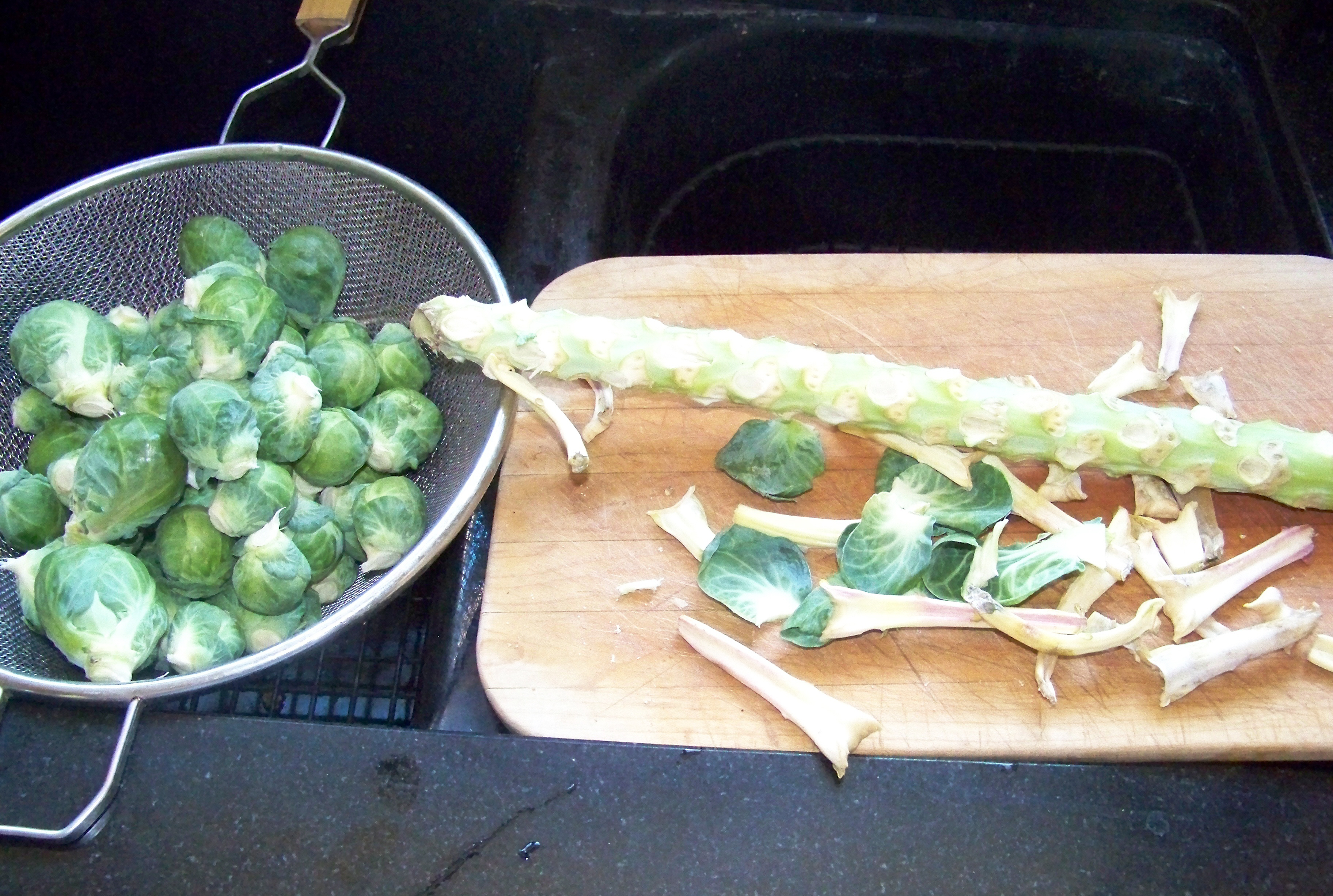
Straight from the stalk.

Straight from the stalk.

TIN ROOF BISTRO BRUSSELS SPROUTS

Ingredients

1 lb./.5 kg Brussels sprouts
3 tablespoons/45 g butter (or, if you’re dairy-challenged, Earth Balance vegan sticks)
1 teaspoon/5 g minced garlic
1 teaspoon/5 g minced anchovy (optional) — you can substitute cooked bacon, if you prefer
1 tablespoons/15 ml lemon juice
1 teaspoon/5 g capers
1 teaspoon/1 g chopped parsley
Salt and pepper to taste
2 slices of ciabatta bread (optional)
3 tablespoons/15 ml extra virgin olive oil

Sprouts going in.

Sprouts going in.

Directions

Preheat over to 350ºF/175ºC.

Remove ends and rough outer leaves from Brussels sprouts. Cut in half lengthwise. Put in bowl and add 2 tablespoons / 15 ml olive oil. Toss sprouts in oil and then lay out on sheet pan. Roast for 30-40 minutes until lightly “caramelized.” Brown is good.

Sprouts coming out.

Sprouts coming out.

Brush ciabatta with remaining tablespoon / 7.5 ml olive oil. Grill or toast ciabatta.

When Brussels sprouts are roasted/caramelized, heat up small sauté pan. Melt butter (or margarine/non-dairy spread) and add garlic and anchovy (or bacon). Cook for several minutes until garlic turns a golden color. Add lemon juice, capers, parsley, and salt & pepper. Toss sprouts in sauce until thoroughly coated.

Oh, you saucy little devil, you.

Oh, you saucy little devil, you.

Place grilled ciabatta in bottom of bowl. Pour Brussels sprouts over bread, or serve without bread; they’re good either way.

There’s no way of knowing how many sprouts haters there were at Thanksgiving dinner this year, but we made a double batch (as a side dish for 12), and there were no leftovers. That kinda smells like success to me.

Lovely Little Lentils, BBQ- (and Vegan-) Style

0
Unlike, say, in Ireland, the orange and the green go very well together here.

Unlike, say, in Ireland, the orange and the green go together very well here.

Much as I once was with beets (which is to say not a fan), The Bride used to be with lentils. I’ve long loved these little legumes, probably had my first infatuation with them as dal in the street food stalls of Mumbai (which was Bombay when I was there), and I brought it home with me. Sadly, it was not shared. Red, orange, green, yellow; I tried making all sorts of lentils for my then-girlfriend (now The Bride) in all sorts of ways, and to no avail. She said they all had an unpleasant aftertaste, and I figured that it must be some genetic thing, like people who find that cilantro has a “soapy” taste.

One evening, we were dining at a now-shuttered, much-missed restaurant, Zax in Brentwood, when they served lentils cooked in duck confit, and I ordered same, prepared to eat them all myself, if necessary. To my way of thinking, one could probably cook the contents of an ashtray in duck confit, and it would be at the least palatable. [I might be stretching the truth a w-e-e bit there.] Long story short, she had them and loved them. Yay! At first I thought that some chemical compound in the confit might have bound itself to whatever was triggering her (thankfully absent) aftertaste. But I also asked the waiter to query the chef (former Top Chef runner-up Brooke Williamson) on whether they had done anything special to prepare the lentils (other than the confit, of course): blanched them first, soaked them in brine overnight, something that I hadn’t thought to do. The answer: “No, nothing at all.” But she did mention that they had used Le Puy lentils.

Le Puy lentils, much like Champagne and Parmigiano-Reggiano cheese, may only be produced in a specified region, according to national law (and international custom, even though some disreputable sparkling wine producers call their product “Champagne” and some non-Italian cheeses claim – falsely – to be Parmigiano-Reggiano). They’re grown on the mountain plateau around the French town of Le Puy en Velay in the Haute-Loire region, whose climate and volcanic soil impart a particular flavor to the humble legume. In fact, they were the first French foodstuff, apart from wine and cheese, to be awarded the famous “Appellation d’ Origine Contrôlée” designation of quality and assurance of origin.

Above and beyond their terroir, Le Puy lentils are their own species (Lens esculenta puyensis), as distinct from other lentil species as a tasty Portobello mushroom is from the poisonous California Agaricus. Le Puy lentils tend to be comparatively expensive in America (generally $7 – $10 USD per pound/half kilo, though domestically grown versions may go for a little less), but they’re tasty, and The Bride likes them, so what’s a few extra bucks? That said, this recipe can be made with virtually any variety of lentil. Have a care, though; some varieties cook much more quickly, and some don’t hold their shape, turning somewhat mushy (though still tasty).

The original recipe from which this one was inspired came from an excellent cookbook by Cara Eisenpress and Phoebe Lapine, In the Small Kitchen: 100 Recipes from Our Year of Cooking in the Real World. It chronicles two twenty-somethings on a tight budget trying to make tasty and inexpensive meals in their tiny kitchens. It’s a great starter cookbook for someone who’s getting their first apartment, but it also has some recipes that really resonated with me as well (I encountered it as part of a piece I wrote for the LA Review of Books a couple of years ago). I haven’t changed it much, although this version makes a double batch and adds kale, because California law requires kale to be an ingredient in every vegetarian recipe (just kidding, but it almost seems true).

If they don't say "Le Puy," they're just not for me.

If they don’t say “Le Puy,” then they’re just not for me.

BARBECUE LENTILS WITH SWEET POTATO AND KALE
Serves 4-6

Ingredients
1 cup / 200 g Le Puy lentils
4 teaspoons / 20 ml olive oil
2-3 teaspoons / 11-17 g salt
4 cloves garlic, 2 minced, 2 whole
1 onion, diced
1 small sweet potato or yam, diced
1/4 – 1/2 teaspoon / .75 – 1.5 g dried chipotle pepper powder (or cayenne pepper)
1/8 teaspoon / .4 g ground ginger
1/2 cup / 120 ml ketchup
2 teaspoons / 10 ml Dijon mustard
4 tablespoons / 60 g brown sugar
2/3 cup / 160 ml balsamic vinegar
dash or two Worcestershire sauce (optional, leave it out for Vegan version)
1 small bunch kale, shredded

Maybe 6-8 stalks; not a whole lot. Probably 3 cups when chopped.

Maybe 6-8 stalks; not a whole lot. Probably about 2-3 cups when chopped, maybe a little less.

Bring the lentils to a boil with 3 cups (or 700 ml) of water and the two whole garlic cloves. Simmer 30-35 minutes, uncovered, until lentils are soft but still hold their shape. Toward the end of cooking, add 1 teaspoon (5.5 g) salt.

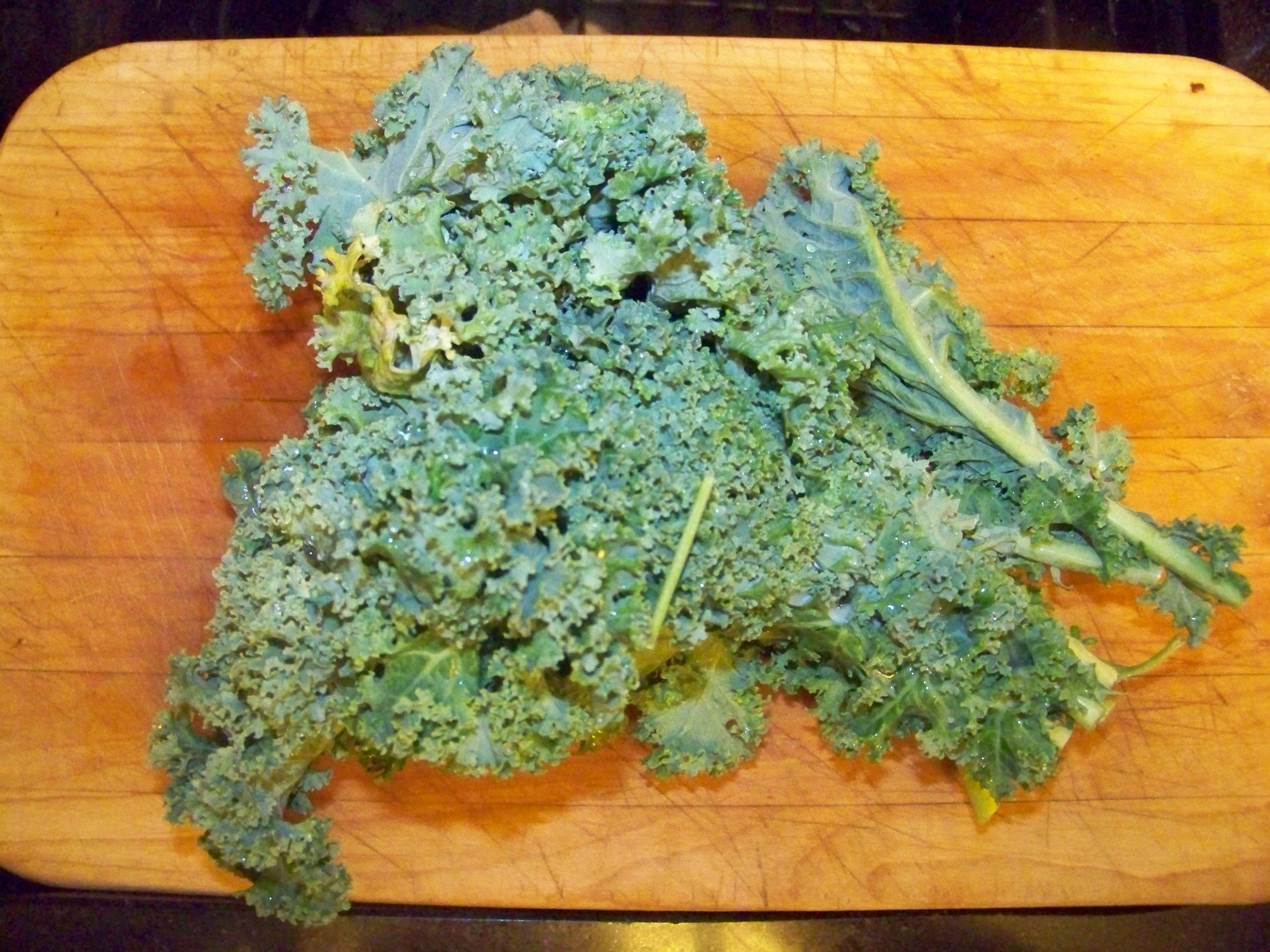
Wash kale, pat dry and shred, removing stems. (If you wish to include chopped stems in the finished dish, you’ll add them at the same time the lentils are added; otherwise, you can discard them.) Set shredded kale aside.

Meanwhile, heat the olive oil in a frying pan. Add the onion and minced garlic and sauté until soft and slightly brown. Add the sweet potatoes and cook until softened, about 5-8 minutes. Stir in the chipotle pepper and ginger, coating the vegetables, then add the ketchup, mustard, sugar, vinegar, and remaining 1-2 teaspoons (5.5 – 11 g) of salt (taste after adding the first teaspoon!), and bring to a simmer. Drain the lentils, reserving the cooking water, and add them and about 1 cup of cooking water to the pan. [This is also where you add the chopped kale stems, if you are using them.] Simmer until the sauce coats the lentils and is fairly well thickened. Taste for seasoning, adding Worcestershire sauce and sugar or vinegar if necessary. Somewhere around 15-30 minutes prior to serving, stir in the shredded kale, making sure to coat it all; give it time to soften to desired consistency, then serve.

FUN LENTIL FACT: The words “lens” and “lentil” both share the same Latin root, and it’s because a biconvex lens (like the one in your eye or a typical magnifying glass) is shaped like a you-know-what.

A Sweet Spot Between Laura Calder and Martha Stewart

0
A beautiful book, in every way.

A beautiful book, in every way.

If you’ve been on this blog before, you’ll know that I’m all over exploring the unknown, from exotic ingredients like lutenitza and sriracha salt, to crazy science stuff, from sous vide to avoiding botulism. But today, let’s take some advice from The Far Side creator Gary Larson’s cow: “Don’t forget to stop and eat the roses.”

First time cookbook author Gwen Rogers is neither a trained chef (like Laura Calder) nor a multi-gazillion-dollar-crafts-and-style marketing juggernaut (like Martha Stewart), but in her new book Welcome to Honeysuckle Hill, she deftly threads the needle between the two, creating simple dishes that are simply gorgeous.

Take, as a for instance, her Blueberry Crisp with Almond Streusel recipe.

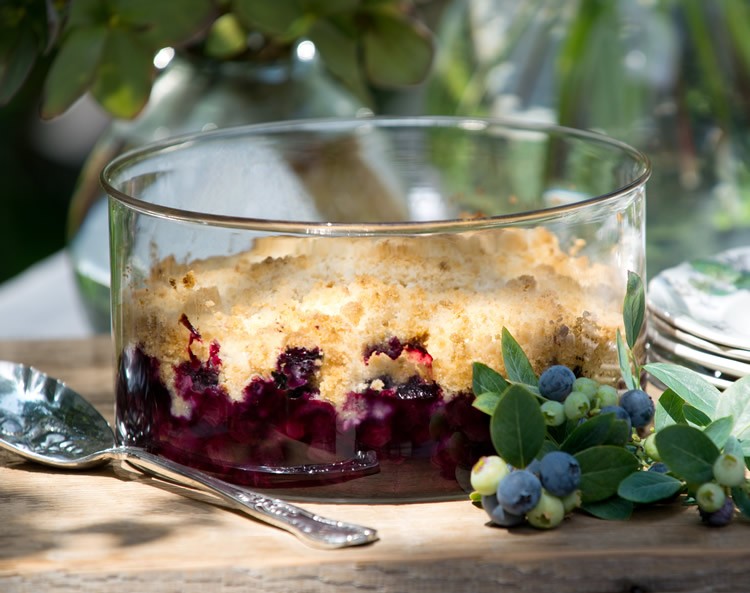
Blueberry Crisp with Almond Streusel. (photo by Renée Anjanette, courtesy Gwen Rogers)

Blueberry Crisp with Almond Streusel. (photo by Renée Anjanette, courtesy Gwen Rogers)

This is so simple, an eighth-grader could make it. But it looks, and tastes, delightfully sophisticated (in its rustic way).

Blueberry Crisp with Almond Streusel (adapted from Gwen Rogers’ journal)

FOR THE ALMOND STREUSEL:
¾ cup/150 g granulated sugar, unleveled
12 tbsp/170 g unsalted butter (for the vegan variant, substitute Earth Balance Vegan Buttery Sticks)
2 cups/256 g all-purpose flour, scant
¾ cup/115 g finely ground almond meal flour, heaping

FOR THE FILLING:
4 cups/400 g fresh blueberries, washed and dried
½ cup/100 g granulated sugar
1 tbsp/15 ml lemon juice, freshly squeezed
1 tsp/5 ml lemon zest

Preheat oven to 375°F/190°C.

FOR THE STREUSEL: In a medium bowl, combine sugar, all-purpose flour, and almond flour and mix thoroughly. Cut in butter until mixture becomes a coarse crumb. Set aside.

FOR THE FILLING: In a medium bowl, use a spatula to gently toss together the blueberries, sugar, lemon juice, and lemon zest. Let mixture sit for about 15 minutes. Place blueberry mixture into a 1.5-quart baking dish (9″ x 9″ x 5″ or 11″ x 11″ x 4″) and cover completely with Almond Streusel. Bake for approximately 45 minutes, until top is browned and berry filling is bubbling.

NOTE: This streusel makes enough for 2 (9-inch) pies or 2 blueberry crisps. If you only plan to make one, freeze the remainder for later use on your morning yogurt or evening ice cream. Serves 8.

Simple, elegant, tasty; the host's (or hostess') trifecta. (photo by Renée Anjanette, courtesy Gwen Rogers)

Simple, elegant, tasty; the host’s (or hostess’) trifecta. (photo by Renée Anjanette, courtesy Gwen Rogers)

Her Watermelon, Feta, & Mint Kabobs (pictured above) can be assembled in just slightly more time than it took to type this sentence, and yet they are a welcome and refreshing change from more traditional hors d’oeuvres, especially in the summer.

What Rogers brings to the table — quite literally — is a sense of casual elegance that’s all about making life easy on the chef/host/hostess and making life comfortable and welcoming for the guest. Her recipes will remind you that you don’t have to be a CIA grad to put together a menu that will leave your guests feeling happy and impressed, and you don’t need to deploy a squadron of minions to put together a table that looks thought through and stylish.

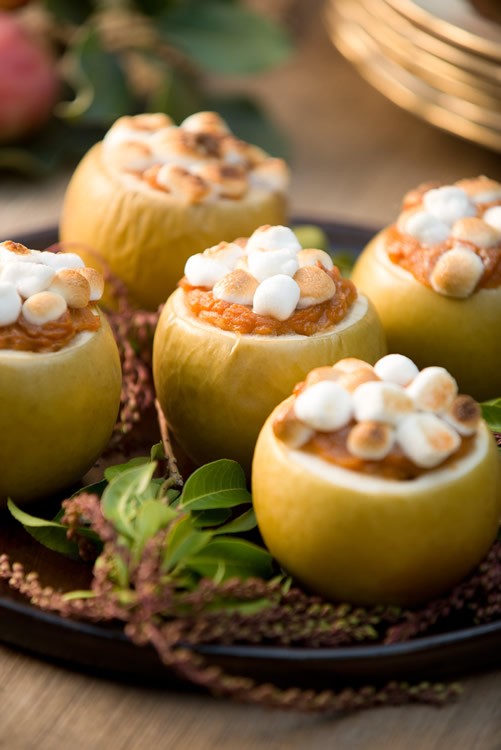
Ho do you like them yapples (apples stuffed with sweet potato)? (photo by Renée Anjanette, courtesy Gwen Rogers)

How do you like them yapples (Granny Smith apples stuffed with sweet potato)? (photo by Renée Anjanette, courtesy Gwen Rogers)

And when it comes to the book itself, the photography is a visual feast comparable to the actual foodstuffs being described. The printing is voluptuous, replete with pictures of the author and her family that would give Giada De Laurentiis and clan a run for their money. It’s beautiful, inspiring, and empowering, and worth every centime of its $35(USD) price tag.

Welcome to Honeysuckle Hill can be purchased at Gratus, should you find yourself in Beverly Hills, or through the author’s website, http://honeysucklehillbook.com.

Calabaza Rellena con Todo lo Bueno — or — Pumpkin Stuffed with Everything Good

1

Four years ago almost to the day, I was listening to National Public Radio (on KPCC in Pasadena, one of the two NPR stations to which I donate). I heard a woman hitherto unknown to me named Dorie Greenspan wax poetic about a French recipe that seemed to be the most delightful non-dessert pumpkin dish imaginable; she simply called it Pumpkin Stuffed with Everything Good. Intrigued by the concept, I purchased her most excellent cookbook (Around My French Table: More Than 300 Recipes from My Home to Yours), and I’ve made it a number of times, with great success. [Her version is simpler than this one, because there’s no pre-cooking involved; you just slice and dice and stuff and cook. Or, as the French, say, “Voila!” But hang with me here, and you’ll see where I was going.]

As I walked into the market this past Thursday, a cart piled high with gorgeous sugar pie pumpkins greeted me, and I was inspired to take a shot at reinventing the dish with a Southwest/Mexican flair. This is a fine way to introduce pumpkin into a Thanksgiving meal in some form other than pie, and it’s a remarkably flexible recipe. In many ways, this “recipe” sort of resembles a road map, with a thousand thousand routes that will all lead you from your point of departure (the kitchen) to your destination (the table).

You’ll want to note that all measures are approximate, because the pumpkin sizes will vary widely, but if you have leftover stuffing, you can always wrap it in tin foil (or, if you’re trying for a little more Southwest authenticity, a banana leaf or two), and cook it alongside the pumpkin. Arranging and wrapping the banana leaves in a way that will keep the liquid from seeping out may be something of a challenge, but it’s manageable.

This version is gluten-free; it can easily be “veganized” by substituting your favourite vegan cheeses, and full-fat coconut milk for the cream (the reason I suggest the full-fat coconut milk as opposed to soy-, rice-, or almond milk is that the coconut milk better replicates the creamy mouthfeel).

CALABAZA RELLENA CON TODO LO BUENO
(PUMPKIN STUFFED WITH EVERYTHING GOOD, SOUTHWEST STYLE)

Ingredients:

1 pumpkin (approximately 3 lbs/1.5 kg)
1 can (15.25 oz/432 g) corn, drained
4-6 slices of stale bread, cubed (I used Whole Foods’ Sun-Dried Tomato and Roasted Garlic Gluten-Free Bread)
12 oz/345 g Monterey Pepper Jack cheese, shredded (you could also use Cheddar or Gouda or Manchego)
3 Hatch chile peppers (or Anaheim chile peppers), seeded and diced (or a 4 oz/113 g can of diced green chiles)
6-8 shallots, chopped
6-8 stems fresh cilantro leaf (also known as coriander leaf or Chinese parsley), chopped
2-3 cloves garlic (to taste), peeled, germ removed and coarsely chopped
1 tsp/1.8 g dried oregano
4-6 sliced of crisp bacon, crumbled
2 links chorizo (about 1/2 lb/0.25 kg)* [see note on chorizo below]
1 plantain, diced (optional)
1 small or 1/2 large brown onion, diced
salt and pepper to taste
1/3 cup/80 ml heavy cream (or half and half, if you prefer)
2 tbsp/12 g Cotija cheese, crumbled or grated, for garnish (optional)
Fresh cilantro leaves, chopped, for garnish (optional)
3-4 banana leaves, optional (available at most Latino grocery stores)

Directions:

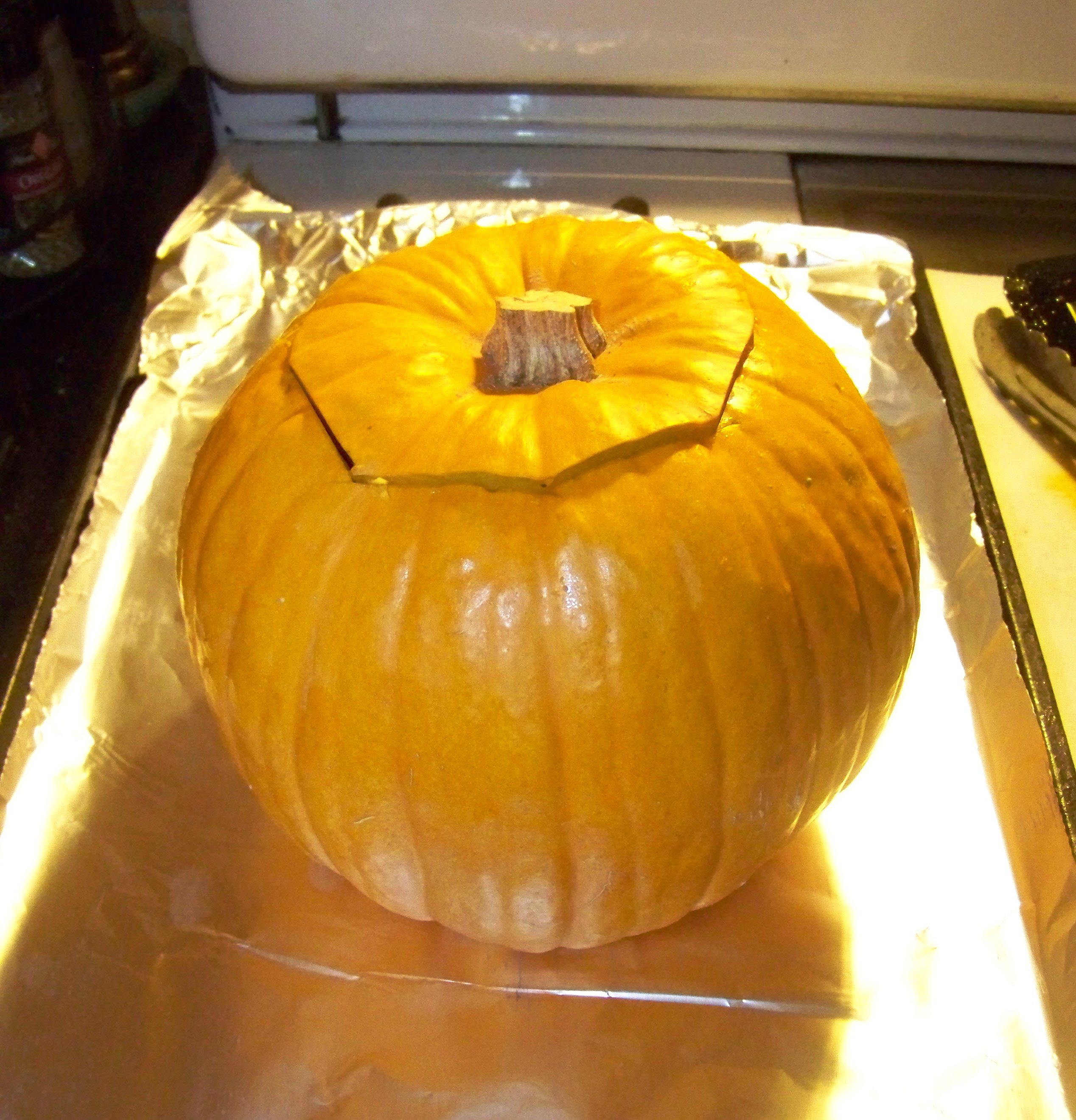
Center a rack in the oven and preheat it to 350°F/175°C. Line a baking sheet with aluminum foil, parchment, or a silicone baking mat so that if the pumpkin innards boil over (which they sometimes do, a bit), they don’t soil the inside of your oven.

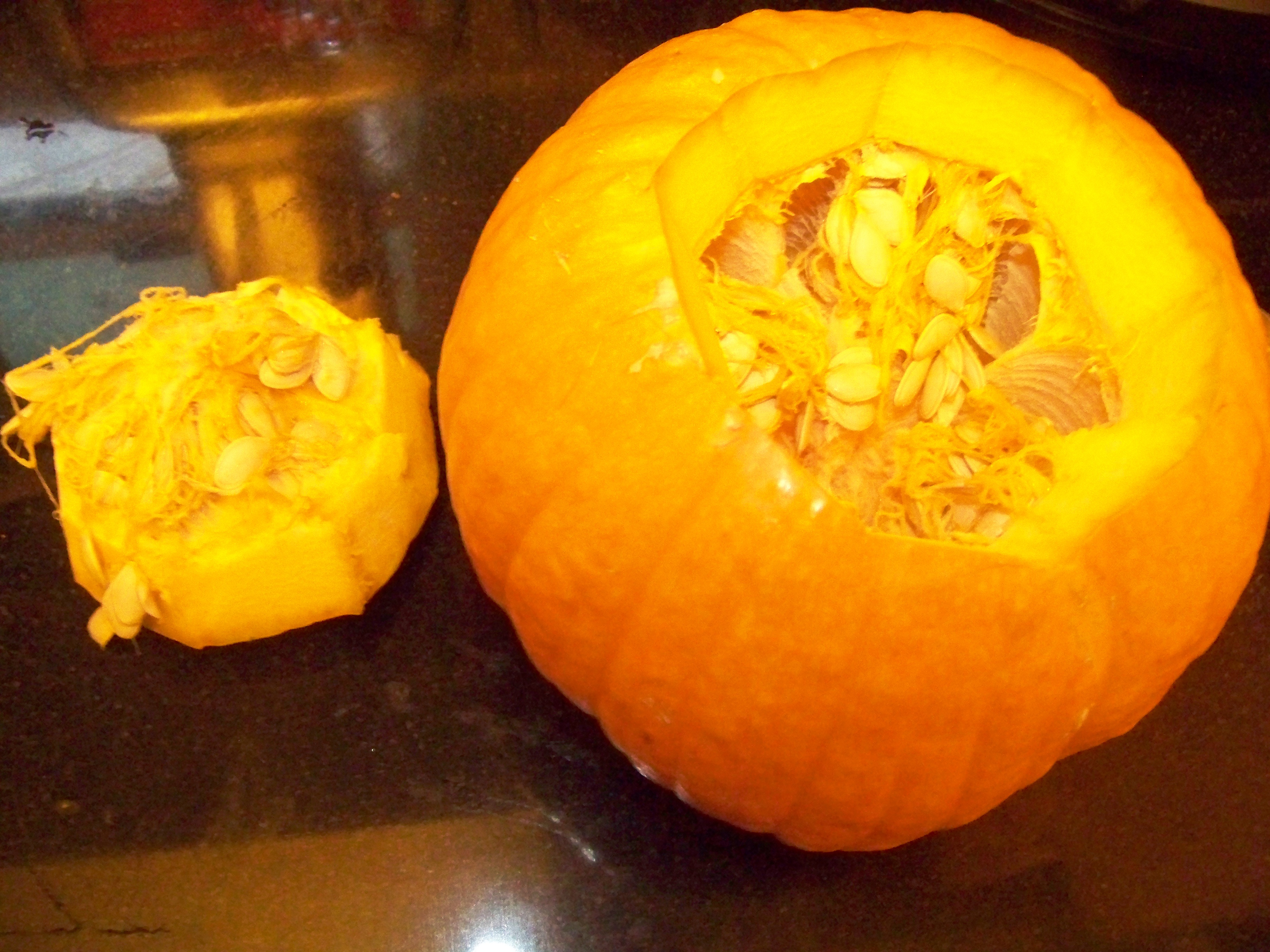
This pumpkin needs a cleaning out.

This pumpkin needs a cleaning out.

Using a sharp and sturdy knife, carefully cut a cap out of the pumpkin’s top the way you would if making a Jack-o’-lantern. [Ms. Greenspan’s suggestion is to cut at a 45-degree angle. But be careful; the pumpkin rind is tough. I find that a stabbing motion, a la Psycho, is emotionally satisfying, but it’s your call.] The opening should be large enough for you to work inside the pumpkin. Clean the strings and seeds from the cap, and set it aside (we’ll be using it later). Scoop out the loose guts (again, strings and seeds) from the pumpkin’s interior. [The seeds can be cleaned, salted, and roasted later, should you desire, or you can toss them.] Season the inside of the pumpkin with salt and pepper, and place it on the baking sheet.

Chorizo and onions and plantains, oh my!

Chorizo and onions and plantains, oh my!

Heat a frying pan and cook the bacon until crispy, then let it drain on a paper towel. Peel the plantain and dice it into quarter-inch cubes. Remove the chorizo from its casing and put it, the chopped plantain, and the chopped onion into the still-warm frying pan (which should still have bacon grease in it, so no need for oil), being careful not to splatter hot grease. Cook for about 8-10 minutes, breaking up the lumps of chorizo, and stirring occasionally. Remove plantain, onion, and chorizo from pan with a slotted spoon (or drain in colander over a ceramic or Pyrex bowl, as you don’t want that grease going down your sink) and place in a large bowl. Add the bacon, bread, peppers, cheeses, scallions, garlic, cilantro, and oregano, then toss. Season with a bit of freshly-ground black pepper, and pack the pumpkin with the mix, leaving enough room for the cap to fit back on. [We’ll come back to what to do with any extra filling a little later.] Pour the cream into the pumpkin, and use your judgement to decide whether you need to use all of it; it’s for moistening the ingredients, not immersing them.

All stuffed up...

All stuffed up…

...and capped for cooking.

…and capped for cooking.

Replace the cap and bake the pumpkin for about 2 hours — check it after 90 minutes — or until the pumpkin filling is bubbling and its flesh is tender enough to be pierced easily with the tip of a knife. You may want to remove the cap for the last 20-30 minutes of cooking to brown the top and evaporate some of the liquid.

Note the colour change on the pumpkin. Gorgeous.

Note the colour change on the pumpkin. Gorgeous.

IF YOU HAVE LEFTOVER PUMPKIN STUFFING…
You can moisten it with a little cream (not too much!) and wrap it in a banana leaf, seal it in tin foil, or even put it in a small covered casserole dish, and roast it alongside the pumpkin on the baking sheet. It can come out after 60-75 minutes (after all, it wasn’t insulated by all that pumpkin flesh), but even if you forget, it should still be plenty moist. Alternatively (as this recipe yielded just about enough for TWO small pumpkins), you can freeze the remainder, making the next pumpkin-stuffing party all that much quicker.

Serving:

When the pumpkin is ready, allow it to rest on the baking sheet for about 5 minutes or so before trying to move it. Then, carefully transfer it to a platter and bring it to table. Remember, it’s hot, and the cooking will have reduced the pumpkin’s structural integrity, so take your time. It can either be cut into wedges with the filling spooned over, or you can scoop out pumpkin flesh and filling together. Garnish with the chopped cilantro leaves and/or Cotija cheese. Depending on the size of the pumpkin, the size of your guest list, and the size of your appetite, it can serve as either a main course, or the perfect accompaniment to a turkey or some other fowl.
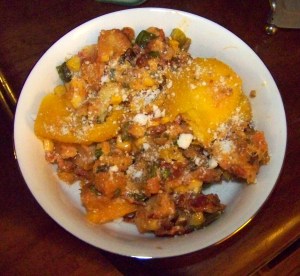
A little Cotija, and now the stuffed pumpkin is ready to return the favour and stuff you.

A little Cotija, and now the stuffed pumpkin is ready to return the favour and stuff you.

*A NOTE ABOUT CHORIZO: Depending on where you live, the sausage known as chorizo may come in one of two forms. Typically, in Southern California (where I live), it comes in a loose, uncooked state, sometimes packed in a typical intestinal sausage casing (or a plastic one), but it is also sometimes sold without a casing, much like any spiced ground meat. In many other places, including my homeland of Canada, chorizo is generally sold fully cured and has a texture not unlike a dry salame. Either one of these will work, but it’s entirely unnecessary to fry the dried version of chorizo; it can merely be diced (about 1/4 inch is good), and added to the pumpkin stuffing mix just like any of the other ingredients. [You should, however, peel off the casing before dicing it.]

All Hail the Green Goddess! (plus a godlike potato salad recipe)

1

How in the world did we ever get from this…

The late, great George Arliss. (photo courtesy Arliss Archives)

The late, great George Arliss. (photo courtesy Arliss Archives)

to this?

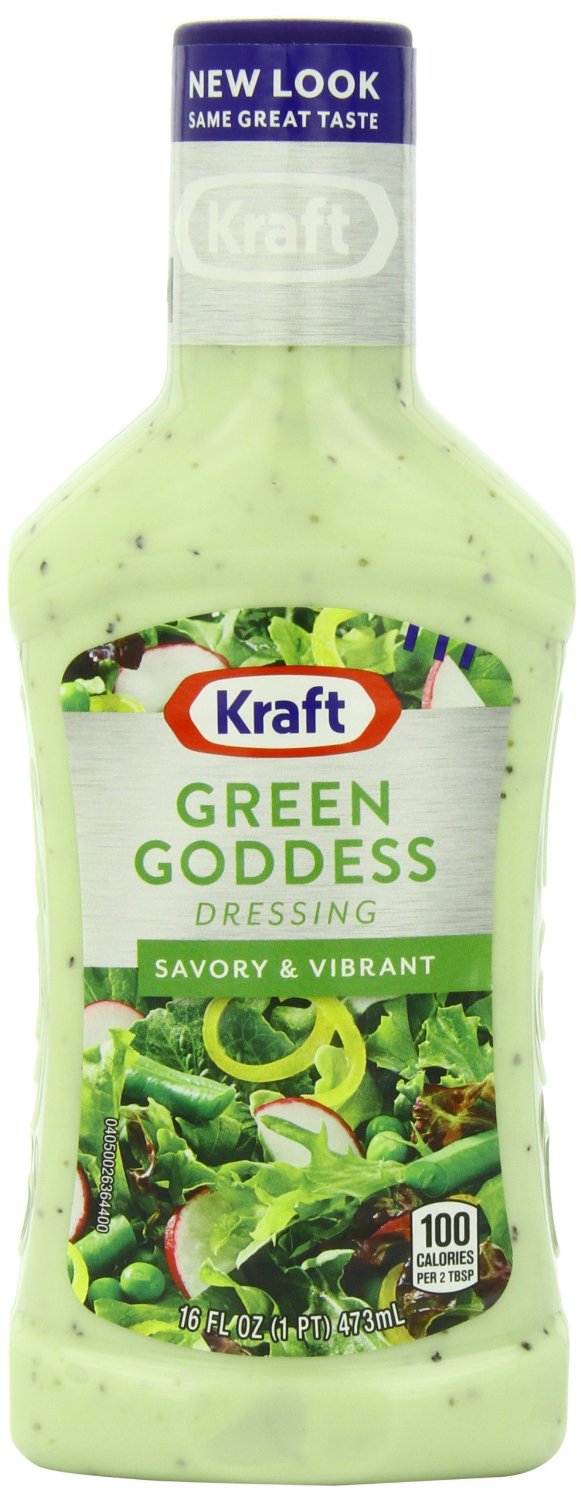
Savory & Vibrant. It even says so.

Savory & Vibrant. It even says so.

Funny story, that. It involves a Scots drama critic’s first play, a British star of stage and screen, and a classically-trained hotel chef. [If you just want to skip ahead to the recipe for Green Goddess Potato Salad, not to worry. Just jump down a page or three.]

In 1920, drama critic William Archer took his own advice (from his 1912 non-fiction book Play-Making: A Manual of Craftsmanship) and wrote his first play, something of a pot-boiler called The Green Goddess. It opened, to some acclaim, on 27 Deceember 1920, at the Walnut Street Theatre in Philadelphia, and starred a gentleman named George Arliss. So popular was it that it opened on Broadway (at the Booth Theatre) less than a month later, and toured America for the better part of three years before opening a highly successful (and lengthy) engagement in London.

Along the way — and by the best triangulation available to me, sometime around March of 1923 — it played in San Francisco. While in The City, Arliss stayed at the Palace Hotel (which is still around, incidentally), and dined at the hotel’s restaurant, which at the time was overseen by Executive Chef Philip Roemer. Depending on which story you want to believe, either the chef decided on his own to honour Arliss with a salad dressing inspired by the play, or Arliss himself put the chef up to it as a publicity stunt. Personally, I would like to think the former.

And, before you could say, “Wow, I wonder if this salad topping will still be around and popular nearly a century later,” Roemer had created the Green Goddess dressing. [Before we get into the actual recipe stuff, a couple of notes. Not only was the play successful, but it was made into a movie twice (both times starring Arliss), once as a silent in 1923, and once as a “talkie” in 1930. It’s worth noting that the goddess was more grey than green, as both films were shot in black and white. Arliss was nominated for the Best Actor Academy Award for the 1930 version (he had won the previous year for Disraeli), but ultimately lost to Lionel Barrymore, who won his only Oscar for A Free Soul. In fact, Arliss himself presented the Oscar to Barrymore.]

Much like the salad dressing’s creation myth (even the hotel’s own website has gotten it wrong, predating the play’s creation by half a decade), the “official” recipes for Green Goddess dressing vary widely. And while I mean no disrespect to any of the bottled versions’ manufacturers, do have a go at making it yourself. It’s dead simple, and it tastes so much better. As for the potato salad, which calls in the original recipe for green beans, I think asparagus (if available fresh) is better suited to it. Both provide a bit of toothiness, but roasted asparagus and roasted potatoes mesh like Ginger Rogers and Fred Astaire.

"Fred, I can't believe he compared us to vegetables! He can't even DANCE!"

“Fred, I can’t believe he compared us to vegetables! He can’t even DANCE!”

GREEN GODDESS POTATO SALAD WITH ASPARAGUS
Ingredients
:
3/4 pound/1/3 kg roasted or grilled asparagus
3 pounds/1.5 kg roasted fingerling or “baby” potatoes, halved or quartered according to size
1/4 cup/60 ml olive oil
sea salt
cracked black pepper
Green Goddess Dressing (recipe below)

For the potatoes:

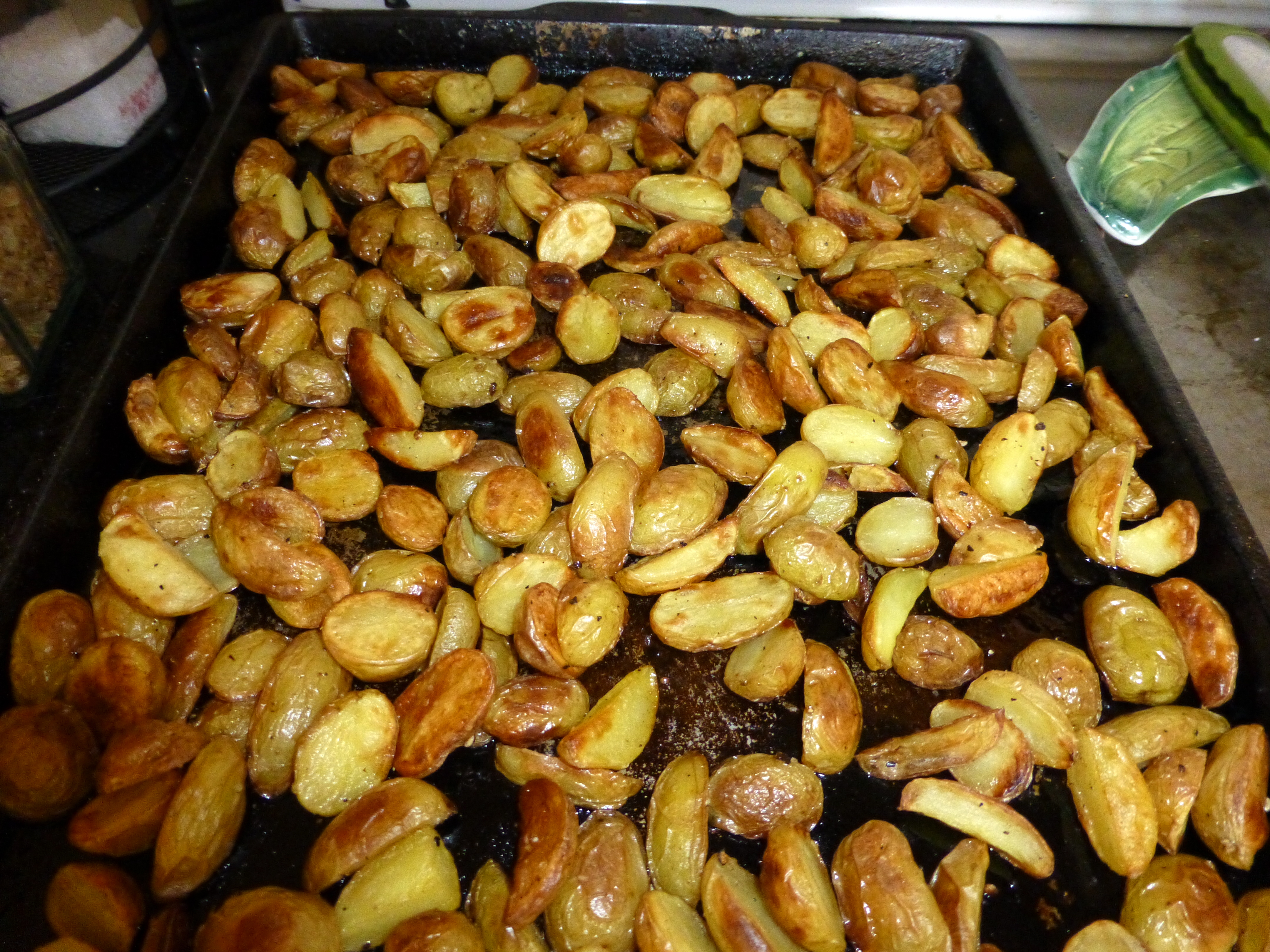
Teeny taters.

Teeny taters.

Preheat oven to 450°F/230°C Halve or quarter potatoes and place in plastic bag with olive oil; shake until coated and arrange in a single layer on a cookie sheet. Liberally sprinkle salt and pepper over. Roast for about 30-35 minutes, or until golden brown. (About 20 minutes in, turn over with spatula for even roasting.) Remove when done, allow to cool, and place in large mixing bowl.

For the asparagus:

Chopped spears that have nothing to do with Britney.

Chopped spears that have nothing to do with Britney.

Preheat oven to 400°F/200°C Wash and trim and place in plastic bag with olive oil (you can use the bag from the potatoes if you wish, although you may need to add a little olive oil); shake until coated and arrange in a single layer on a cookie sheet. Liberally sprinkle salt and pepper over. Roast for about 15-20 minutes, or until slightly browned, but still with a little snap. Remove when done, allow to cool, chop into 1 inch/2.5 cm pieces, and place in large mixing bowl with potatoes. Mix with Green Goddess dressing and chill for 1-2 hours in refrigerator. Devour unreservedly.

GREEN GODDESS DRESSING (adapted from Gourmet magazine)
Ingredients:
3/4 cup/180 ml mayonnaise
3/4 cup/180 ml sour cream
3 tablespoons/45 ml tarragon vinegar or white-wine vinegar
3 scallions, chopped
3-4 flat anchovy fillets, chopped, or 2 teaspoons anchovy paste
1/4 cup/10 g chopped fresh flat-leaf parsley
2 teaspoons/2 g chopped fresh tarragon
1 teaspoon/5-6 g sea salt or kosher salt
1/2 teaspoon/2.5-3 g black pepper

Pulse mayonnaise, sour cream, vinegar, scallions, anchovies, parsley, tarragon, salt, and pepper in a food processor until dressing is pale green and herbs are finely chopped. Refrigerate until use. Editor’s note: You don’t have to be either green or a goddess to make this salad spectacular. Although either would certainly enhance the presentation.

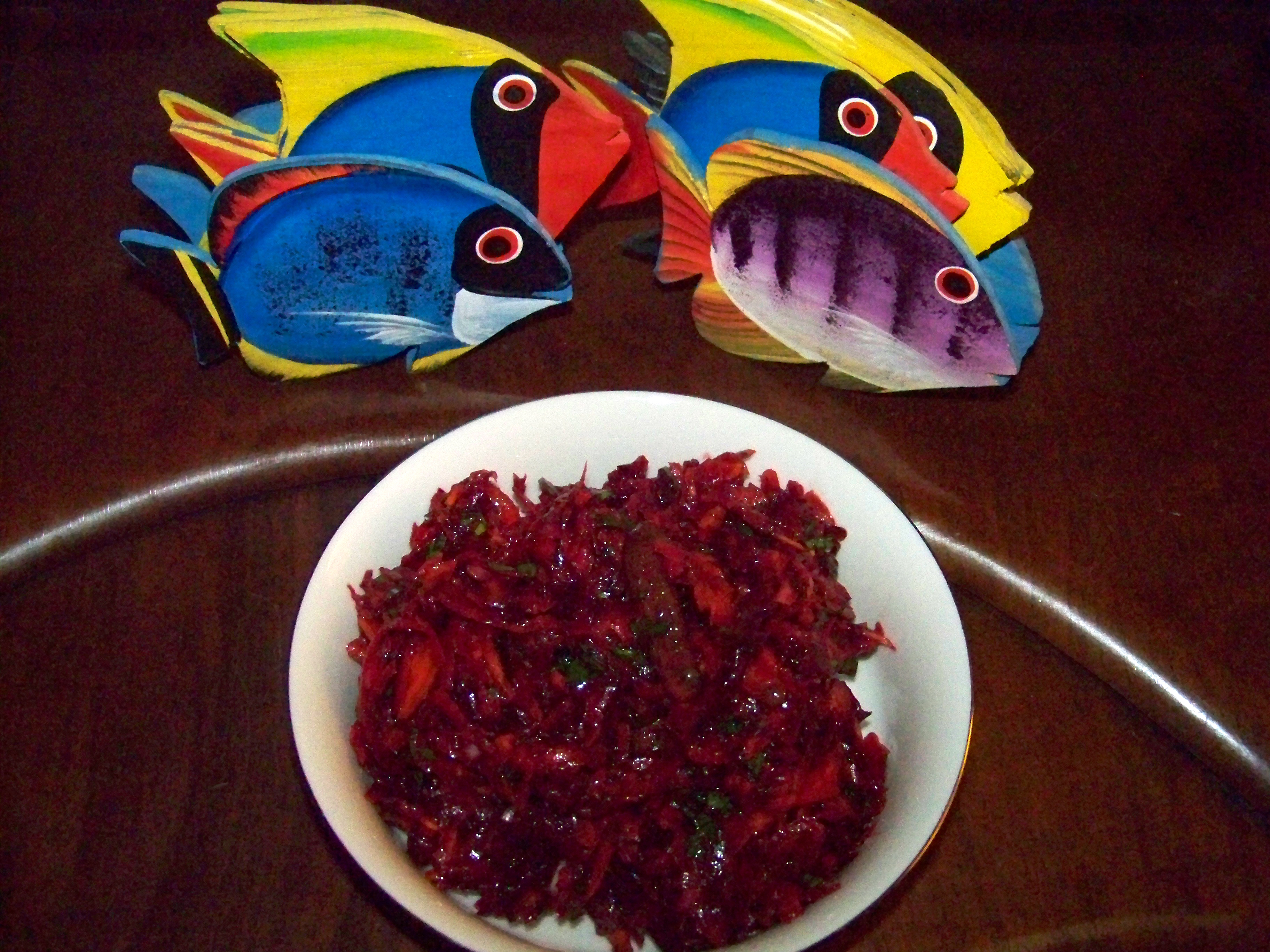
The finished salad, with wooden fish.

The finished salad, with wooden fish.

Note on metric conversions:
Since American measurements are generally based on volume rather than weight, I’ve had to be a little loose with the metric conversions. For liquids, of course, they are pretty precise, but for dry ingredients, they’re a little more fungible (after all, a tablespoon of salt weighs a lot more than a tablespoon of dried parsley flakes). That said, the Interwebs have some conversion guides that have allowed me to get close, and fortunately, this recipe is pretty forgiving. I suppose in future that I would be wise to use my fabulous OXO Good Grips Stainless Steel Food Scale with Pull-Out Display to give an accurate measurement. But wisdom was never my long suit.

Gluten-Free, Dairy-Free Blood Orange Olive Oil Honey Cake

0
At $20 USD, how could I resist?

At $20 USD, how could I resist?

All right. I admit it. I’m a sucker for odd Bundt pans and other cake pans with funny shapes. And when I saw this one on Amazon for twenty bucks, I just had to have it. Had to. It’s like certain women (like the one to whom I’m married) and shoes. The sooner you learn to stop resisting — I’m speaking from personal experience here — the happier your life will be. That said, I’m not interested in becoming the Imelda Marcos of goofy baking tins, so my rule is that if I buy it, I have to use it. After I make 20 cakes in this pan, the price of the bakeware will have added a mere eight bits to the cake’s cost.

As luck would have it, the Internets this evening (24 September in lovely California) yielded a plethora of honey cake recipes, given that sundown marked the beginning of the Jewish holiday Rosh Hashanah, and some version of honey cake is a staple of the holiday in many households. While I myself cannot number myself a member of the tribe, many of my dearest friends are, and their cuisine has been a mitzvah in my life.

The main recipe I improvised from can be found at epicurious.com, though I made a couple of modifications that I believe enhanced it significantly. First, instead of using any old vegetable oil, I used Stonehouse extra-virgin blood orange olive oil. Oranges and honey take to one another like Marilyn Monroe’s arm and an elbow-length satin glove. I wasn’t keen on adding a coffee flavour to the mix, but I needed the additional moisture, so I substituted some French vanilla coconut milk “creamer” instead (think orange + vanilla = creamsicle). And I used some stupidly expensive (and largely unavailable) ingredients, such as Manuka honey that a friend hand-carried over from New Zealand (and which sells in America for about $20 USD for a 12 oz. / 350 ml jar), and Green Spot single pot still Irish whiskey, of which only about 500 cases are made per year, making it the Pappy van Winkle of Irish whiskey. I’m sure some of my friends would happly clout me upside the head with a 4×4 for using such an extraordinary spirit in baking, and they might be right. But the batter was excellent, and it was only two tablespoons / 30 ml of the whiskey.

19 little mini-cakes of goodness.

19 little mini-cakes of goodness.

Gluten-Free, Dairy-Free Blood Orange Olive Oil Honey Cake

Ingredients
• 1 3/4 cups / 225 g. Cup4Cup gluten-free flour (or all-purpose flour, if you’re OK with gluten)
• 1 teaspoon / 2.6 g. ground cinnamon
• 3/4 teaspoon / 4 mg. baking soda
• 3/4 teaspoon / 6 g. salt
• 1/2 teaspoon / 2 g. baking powder
• 1/2 teaspoon / 1 g. ground ginger
• 1/4 teaspoon / .75 g. ground cloves
• 1 cup / 237 ml honey (I used Manuka honey that a friend had brought from New Zealand)
• 2/3 cup / 158 ml blood orange olive oil (available from Stonehouse Olive Oil Company)
• 1/2 cup / 125 ml So Delicious French Vanilla coconut milk “creamer” (or freshly brewed strong coffee, cooled)
• 2 large eggs (I used duck eggs, because I had some)
• 1/4 cup / 60 g. packed brown sugar
• 2 tablespoons / 30 ml whiskey or bourbon (I used Green Spot Irish Whiskey)

Preparation
Put oven rack in middle position and preheat to 350˚F / 175˚C. Spray pan with Baker’s Joy, PAM cooking spray with flour, or oil pan well and dust with flour, knocking out excess.
Whisk together flour, cinnamon, baking soda, salt, baking powder, ginger, and cloves in a small bowl. Whisk together honey, oil, and coconut milk in another bowl until well combined.
Beat together eggs and brown sugar in a large bowl with an electric mixer at high speed 3 minutes. Reduce speed to low, then add honey mixture and whiskey and mix until blended, about 1 minute. Add flour mixture and mix until just combined. Finish mixing batter with a rubber spatula, scraping bottom of bowl.
Pour batter into Nordic Ware honeycomb pan or loaf pan (batter will be thin) and bake 30 minutes. Cover top loosely with foil or parchment and continue to bake until cake begins to pull away from sides of pan and a wooden pick or skewer inserted in center comes out clean, about 30 minutes more. Cool on a rack 1 hour.
Invert rack over pan and invert cake onto rack. Turn cake right side up and cool completely.
Baker’s note: • Cake keeps, wrapped tightly in plastic wrap or in an airtight container, at room temperature 1 week. As if you’ll be able to keep from devouring it for that long. Seriously.

NOTE: When I first posted this, I had some truly wacky cup-to-gram (or -ml) conversions, which I have since revised. [Some of them were computational errors, some mere typos.] I presume my astute audience would have correctly divined that 225 mg. of flour wouldn’t have made a very large cake in the best of scenarios, and given the amounts of the other ingredients, it would have been overwhelmed by, um, just about everything else. Because I am in America, I foolishly tend to continue to use cup/tablespoon/etc. measurements, and while the metric equivalent is printed on my measuring spoons, it’s not printed on my measuring cups. I should probably just measure the stuff on my fabulous kitchen scale, which is bilingual both in metric and the ridiculous and outdated Olde English measurements. Sorry about that.

Fig Onion Rosemary, um… It’s a Jam! It’s a Conserve! It’s a Very Thick Sauce!

2
Destemed figs await being destiny.

It’s figgy! It’s oniony! It’s rosemary-y! It’s… Supercondiment!

When it comes to a project like this, seems to me there’s only two ways to go: 1) You can make just enough for yourself, and let’s face it, a little goes a fairly long way, or 2) If you’re going to bother with it at all, you may as well make a bunch, and share it with friends, neighbours, co-workers, etc. After all, you’re committing the same amount of time in either case, and in the latter mode, you can share the wealth. Sure, your cost of ingredients doubles, but by a back-of-the-napkin calculation, that came to about $12 in this case, less if you use red onion rather than Vidalia sweet onions, a cheaper wine, and can find a better deal on fresh figs than Whole Foods‘, all of which are well within pretty much everyone’s reach.

Clostridium botulinum, or Botox in the wild.  (Photo Credit: Dr. Gary Gaugler/Science Photo Library)

Clostridium botulinum, or Botox in the wild.
(Photo Credit: Dr. Gary Gaugler/Science Photo Library)

I’m going to say this up front, because food safety is paramount: THIS MUST BE REFRIGERATED. You can’t really preserve it in a standard water bath as you do other jams, because the pH isn’t low enough (or, put another way, the acidity isn’t high enough) to guarantee that our old pal Clostridium botulinum won’t rush in and ruin the day. The spore that causes botulism — and turns actresses of a certain age into Stepford Wife-looking creatures — is given a perfect home to reproduce in a fairly low-acid foodstuff that has been canned in an anaerobic (air-free) environment. You could get around this by adding a healthy dose of lemon or lime juice (or citric acid powder), but that would muck about with the flavour in a way that I wasn’t aiming for, personally. That said, if you do want to adjust the recipe and can it in the trad fashion, I’d recommend getting a pack of pH test strips and make sure you have the acidity at a pH lower than 4. Then the nasty little beastie is banished from the kingdom.

Now that I’ve frightened you, let me say that this is the same advice you’d get for canning meat, or asparagus, or mushrooms, or wax beans, or pretty much any veg that isn’t a tomato (and yes, I know a tomato is technically a fruit).

If, on the other hand, you have a pressure cooker/canner, you could do this no worries, so long as you get the canning temp above 240° F/115.6° C for a specific period (there are online guides), and it makes sense to err on the side of caution. Otherwise, you’re just going to have to treat it the same way you do pretty much everything else: put it in the fridge, and use it within 10 days or so. [Since it isn’t going to be in an anaerobic environment, botulism isn’t an issue, but as you well know, nothing in the fridge keeps forever… except that box of baking soda that doesn’t really absorb the odors the way it’s advertised to do.]

On to the good stuff.

This jam/conserve/very thick sauce is most excellent when served with stinky cheese, or as a glaze/condiment for a pork tenderloin, chops, or chicken. [Of course, since it’s vegan, it’s also good with crackers and flatbreads, not to mention garden burgers.] I tried to keep the sugar content as low as practicable, favouring the umami as much as possible.

Destemmed figs, awaiting their destiny.

Destemmed figs, awaiting their destiny.

FIG ONION ROSEMARY JAM/CONSERVE/VERY THICK SAUCE
INGREDIENTS:

45ml (3 tbsp.) extra virgin olive oil
3 large Vidalia sweet onions, sliced (about 1kg) (any onion can be substituted here)
5g + 1.25g (1 tsp. + 1/4 tsp.) sea salt or kosher salt
15g + 250g (1 tbsp. + 1 cup) turbinado sugar (white sugar works also)
1.25kg (2.75 lbs.) fresh Kadota figs (or whatever variety is convenient)
30ml (2 tbsp.) fig balsamic vinegar (or other balsamic vinegar or wine vinegar)
500ml (2 cups) red wine (2/3 of a standard bottle)*
15g (1 tbsp.) fresh rosemary, finely chopped

DIRECTIONS:

[Mise en place notes: Slice the onions and set then aside in a bowl; wash and destem the figs, then cut them in half (north/south) and set aside in a separate bowl. Chop the rosemary and set it aside. You can measure out your other moist and dry ingredients at this time if you want to, but nothing here is so time-sensitive that it’s really necessary.]

The only time the Sweet Vidalia onions made me cry was at the checkout counter.

The only time the Sweet Vidalia onions made me cry was at the checkout counter.

Heat pan on high and add the olive oil; when oil begins to shimmer, add the sliced onions, 5g/1 tsp. salt, 15g/1 tbsp. sugar, and stir briskly, to coat onions with the oil and mix in the salt and sugar. Reduce heat to medium high and allow onions to caramelize, about 20 to 30 minutes. [Note: If you haven’t done this before, it’s a little tricky. Stir them too often, and they don’t brown up. Stir them too infrequently, and they can burn. Don’t freak out if a couple of the onions look overdone; not a big deal. Timing is approximate depending on the amount of onions, your pan, and the heat of your cooktop.]

Onions, rosemary, and figs! Oh my!

Onions, rosemary, and figs! Oh my!

When the onions are browned, add the balsamic vinegar and wine to deglaze the pan, being sure to scrape any brown bits off of the bottom of the pan. Add figs and simmer until tender, about 20-30 minutes, stirring occasionally and pressing the figs against the side of the pan with a wooden spoon to break them up. Add the remaining turbinado sugar and salt (to taste) and simmer for an additional 20 minutes. If jam/conserve/very thick sauce gets too thick, add more liquid (either wine or water) as needed until the desired consistency is reached.

Jam, condiment, or very thick sauce? We report, you decide.

Jam, conserve, or very thick sauce? We report, you decide.

Allow to cool until it is safe to handle, then spoon into clean jars and refrigerate. Makes approximately 1.5 liters/just over 6 cups. Should be just fine for at least 7-10 days.

Fancier than it needs to be?

Fancier than it needs to be?

* A note on wine: I used Kendall-Jackson 2010 Vintner’s Reserve Summation Red, a blend of 28% Zinfandel, 27% Merlot, 14% Cabernet Sauvignon, 7% Petite Sirah, 3% Grenache, and 2% Petit Verdot. Why? I’d like to tell you that I did because it was the perfect match for the Brix (sweetness) level of the figs, but in fact it was around, I wasn’t particularly interested in drinking it at the time, and it wasn’t so expensive that I’d feel bad about having used it for making jam/conserve/very thick sauce. Any dry red will do; I may try a Pinot Noir or some other wine for the next batch, just to see how that works. You’ve probably heard this before, but you should avoid using any wine in cooking that you wouldn’t drink. So-called “cooking wines” are about as appetizing as Drāno®.

ADDENDUM:
I gave away a pint of the you-know-what to my pal Lisa Jane Persky, who is an actress, writer, artist, and a damn fine cook in her own right; here’s the chop she made with it. Nice.

Mmmmmm.

Mmmmmm.

ADDENDUM #2:
The other week, I attended a food festival at which restaurateur/radio host/generally cool individual Evan Kleiman was speaking about preserving tomatoes, and she said that (given the comparatively high pH of some newer varieties of tomato), she sometimes adds straight citric acid (which can be purchased either online or at many fine markets) to acidify the solution rather than adding lemon or some other citrus juice. The reason is that, while citric acid will make your jam/conserve/really thick sauce lower in pH (and hence, more sour-tasting), it won’t introduce any new flavour. You can buy pH strips or litmus paper to check to see if its pH is below 4. Alternatively, as noted above, you can pressure can the conserve/jam/really thick sauce. Or just stick it in the fridge. You’ll probably go through it faster than you thought.

Unbeatable Beets

0
Best. Beets. Ever. Sans the hard-cooked eggs, which Tanis said were optional.

Best. Beets. Ever. Sans the hard-cooked eggs, which Tanis said were optional.

“As Bokonon [actually the late author Kurt Vonnegut] says: ‘Peculiar travel suggestions are dancing lessons from God.'” And I’m sure, were Bokonon here, he’d be happy to include “peculiar dining suggestions.” A couple of weeks ago, my pal Dan Fredman sent me an email about a wine dinner happening at Lucques in Beverly Hills, celebrating both the loose confederation of wine producers known as In Pursuit of Balance and the release of chef David Tanis‘ latest cookbook, One Good Dish. It was on a Thursday night, which interfered with The Bride’s workout schedule, and it was to start at 7 PM, which is always a challenge in Los Angeles traffic. I knew of Tanis tangentially, but I was not deeply acquainted with his history, so my natural tendency was to give it a miss. But Bokonon spoke to me, as he often has before, so I made the reservation, albeit with some reservations. But not many: dinner at Lucques has always been delightful, and at the worst, I’d have a chance to hang with Dan, which is always edifying. Also, as part of the deal, I’d get a copy of the cookbook, which kinda made the whole thing a bit of a no-brainer.

When we arrived, Dan greeted us and bade us to sit at his table, where Tanis himself was ensconced, along with a couple of other of our acquaintances whose conviviality is highly evident. The author was, by design, supposed to circulate. In practice, though, he hung out mostly at our table, often serving the dishes that he himself created.

He cooks, he scores. He even serves.

He cooks, he scores. He even serves.

The entire menu was — and this is a technical term — really tasty. All of it came from One Good Dish, with page numbers thoughtfully included. No doubt I could wax poetic about the crostini, or the espresso-hazelnut bark, and perhaps I will after I have made them. But this time, I’m going to lavish my praise upon the beets.

A perfect meal.

A perfect meal.

I’ve never been a big fan of beets. I’ve tried roasting them, cooking them in soup, glazing them, whatever. It’s not like I haven’t tried to like them, but I never had a beet-eating experience that made me want more. Until April 3, 2014, when The Bride, with whom I have been paired for more than three decades now, heard these words pass my lips for the first time ever: “May I have some more of the beets, please?”

Tanis’ Red Beet Salad, at its heart, is grated raw beets served in a fancy vinaigrette. And the Bugatti Veyron, at its heart, is a motorcar. The ingredients aren’t hard to locate or particularly sophisticated, but it’s absolutely worth using the very best available to you, especially super-fresh beets, and really good Dijon mustard, red wine vinegar, and olive oil. I used some red wine vinegar that I had picked up at Turley Wine Cellars, and cold-pressed extra virgin olive oil from Oliana.

A minor digression: The difference between $15 olive oil and $3 olive oil is often hugely significant. I highly recommend splurging whatever your budget can afford on a great bottle of olive oil for finishing soups and salads, serving on bread, etc. Oliana in West Hollywood (sadly now closed) and Beyond the Olive in Pasadena (whose storefront is also now closed, but still sells online) and Stonehouse California Olive Oil in the San Francisco Ferry Building all have tasting rooms, where you can select from a variety of olive oils with a wide spectrum of characteristics. Most major cities in America have some gourmet store that offers a similar experience. [2017 update: Of late, we’ve been subscribing to a thrice-yearly variety package from Olea Farm in Templeton, CA.] Do give it a go; if you haven’t done it before, you will be shocked — pleasantly, but shocked nonetheless — at just how different olive oils can be.

All you need to make this excellent salad.

All you need to make this excellent salad.

Basically, you need to peel and grate the beets (I used both red and golden beets for my version), being very careful not to give yourself a case of what I like to call “box grater rash.” Alternatively, you can julienne the beets with a sharp knife. You might be well advised not to be wearing your bestest white shirt while doing this. Fresh beets are juicy, n’est–ce pas?

A bunch of beets.

A bunch of beets.

After the beets have been cut or grated, season them with a little salt and pepper and set them aside while you prepare the dressing. [I put them in the refrigerator to give them a slight chill-down.]

Great grated beets!

Great grated beets!

From the shallot to the cornichons on the ingredients list, everything is diced and/or measured and/or whatever as appropriate and gets mixed in a bowl. [Please consider buying the book; while this recipe isn’t complicated, it will do your karma good to support writers and chefs such as Tanis. And it’s a really terrific book.] The finished dressing will look something like the picture below, except that I took the shot before adding the parsley. Idiot me. So imagine some chopped flat-leaf parsley. Pour the dressing over the salad, mix, and let it marinate for at least 10 minutes. [Again, I put it in the fridge for this step.]

Yummy dressing for yummy salad.

Yummy dressing for yummy salad.

Serve, eat, and eat some more.

The second-best part about this salad is that it still tastes terrific the day after.

Mmmmm. Still good the next day.

Mmmmm. Still good the next day.

The recipe claims to serve four to six people, but don’t be surprised if your guests (or yourself!) are keen on seconds.

Vegan Tomato-Dill Soup

0
It's soup!

It’s soup!

Despite the widely-held belief that “it never rains in southern California,” it does, albeit not often enough. Tonight, for instance, was a prime example of the occasionally intemperate nature of SoCal weather; a much-needed downpour, most of which would wind up in storm drains on a quick trip to the Pacific Ocean, rather than into the aquifers and reservoirs that could make the best use of it. Rain, for me, signals an opportunity to make soup, which matches inclement weather the way pearls go with Sophia Loren’s exquisite neck.

In my youth, tomato soup meant a can of Campbell’s, made famous by Andy Warhol. My late and much beloved mom used to prepare it in high style, diluting it with milk rather than water for an instant “cream of tomato” concoction, which remained the gold standard for tomato soup in my estimation until well into my adulthood. One weekend in my thirties, though, on a trip to Lake Tahoe, I tasted freshly prepared tomato soup for the first time, and it was nothing short of revelatory. I’ve been spoiled ever since.

INGREDIENTS:

2 tbsp.olive oil
1 medium onion, finely chopped
2 tbsp. Cup4Cup gluten-free flour
2 cloves garlic, minced
1 can (28 oz.) San Marzano diced tomatoes
4 tbsp. stemmed and chopped fresh dill + 4 fronds for garnish
28 oz. vegetable broth (or chicken broth, if the vegan version isn’t sufficiently compelling)
1 bay leaf
salt
ground black pepper
dollop of cashew cream (for vegan version) or sour cream or yogurt (non-vegan version)

The humble onion.

The humble onion.

DIRECTIONS:
First, heat the olive oil in a soup pot, then add the diced onion at medium heat. Sweat the onion, allowing it to release its liquids, but don’t brown it. Add the Cup4Cup gluten-free flour, and stir, making sure to break up any lumps that might ensue (a whisk is good at doing this). Add the garlic and cook for about two minutes, stirring occasionally. Then add the tomatoes, broth (a simple way to measure this is to fill up the empty tomato can), chopped fresh dill, bay leaf, salt, and pepper.

Adding the flour.

Adding the flour.

Cook over medium low heat, stirring occasionally, for about 30 minutes, but you needn’t be particularly fussy about the timing; it’s just enough to let the flavours blend.

Spices added; stirring ensues.

Spices added; stirring ensues.

From here, you have a couple of options. 1) Allow the soup to cool overnight in the refrigerator, and serve it the following day as a rustic cold soup, garnished with a dill sprig (and remember to remove the bay leaf!).

A quick trip to the Vita-Mix.

A quick trip to the Vita-Mix.

2) Alternatively, you can remove the bay leaf, toss it in the food processor and purée it. Be sure to work in small batches, and DON’T plug the feeding tube unless you’d like your kitchen walls redecorated with a fine spray of tomato soup. [The steam needs somewhere to go; best bet is to drape a kitchen towel LOOSELY over the top of the feeding tube.]

You can add a delightfully silky texture by stirring a dollop of cashew cream into each bowl (or cup). Garnish with a dill sprig, and serve.

Serves 4-6

Sriracha + Salt = Success

0
Everything you need to make this recipe. Seriously. Including the oven.

Everything you need to make this recipe. Seriously. Including the oven.

I love flavoured salts. Smoked salts, herbed salts, lemon, garlic, chili pepper, whatever. And I’ve happily been paying sums for them that my late pal John Wayne would call [and I should alert you to salty language here] “rigoddamndiculous.” Particularly in this case, when making it yourself is ridiculously simple.

It’s been my experience that no recipe is foolproof, because just as I find one that might fill the bill, along lumbers a bigger fool. But if you are incapable of getting this one for Sriracha salt right, you may as well convert your kitchen into a darkroom or a tool shed or a walk-in closet, because you have no business cooking in it.

Before I get into the particulars, I owe a shout-out to Let’s Give Peas a Chance, from whom I got the recipe, and Radical Possibility, from whom they got the recipe.

Salz, sel, salt, sal, tuz, gatza... whichever you prefer.

Salz, sel, salt, sal, tuz, gatza… whichever you prefer.

INGREDIENTS:
1 cup sea salt (or kosher salt, or fleur de sel)
4 tbsp./60 ml Sriracha sauce (or, as my Canadian homies call it, “Cock sauce” — because of the rooster on the label)

Add the sauce to the salt

Add the sauce to the salt.

Coated.

Coated.

DIRECTIONS:
Preheat oven to 350ºF / 175 (actually 176.67)ºC. Mix salt and sriracha in bowl. Transfer from bowl to aluminum foil-lined cookie sheet. Spread out with spoon or spatula to thin layer. Turn off heat in oven. Place tray in oven and allow to dry, about 2 hours, but it’s fine to leave it in overnight. You’ll want to give it a stir and a scrape every 20 minutes or so for the first hour, just to help prevent excess clumping and promote drying. Any crystals that remain clumpy can be broken up by shaking vigorously in a covered container, or separated mechanically, either with a fork in a bowl or in a small spice grinder/food processor (just a few quick pulses will do the trick — you don’t want to pulverize the salt!). [Of course, you could also spread your salt mix on the fine-mesh screen of your dehydrator as well, but I’m guessing that for every kitchen equipped with a dehydrator, there are about half a million that are not.]

Spread the salt on the cookie sheet.

Spread the salt on the cookie sheet.

Put it in the oven.

Put it in the oven.

After a couple of hours, it will look like this.

After a couple of hours, it will look like this.

Works great for dry rubs, or as a finishing salt for salad, or probably a hundred billion other things I haven’t thought of. But it’s simple, and inexpensive, and it makes a great gift. Heck, everybody uses salt. And any friend who receives a little container of this as a present will think you’re some sort of kitchen wizard, possessed of superhuman culinary powers. Don’t ruin it for them. Let’s just keep this our secret, okay?

Ready to rock.

Ready to rock.

Saffron Risotto with Peas and Langoustine

2
No, I didn't make my own stock or grate my own cheese this time; please don't judge

No, I didn’t make my own stock or grate my own cheese this time; please don’t judge

In what passes for winter in Southern California, one may on occasion wish for a wintry dish, and nothing fills that bill quite like risotto. There are a million ways to make it, but I had a hankering for some peas, and I had gotten a great deal on some frozen (and pre-cooked) langoustine, so I cogitated on what spice might work well with the two of them; I settled on saffron. I had some that my brother had brought back from Turkey, and a little (slightly fresher, if not as exotic) Spanish saffron from Trader Joe’s, each of which made it into the final mix.

Risotto (or “little rice”) can be traced back to 16th century Milan, though rice’s role in Italian cooking predates that considerably, having likely been introduced by the Arabs who conquered Sicily in the 9th century. By many accounts, saffron arrived in Italy in the 13th century, though it’s not clear who brought it in. Why it took the Italians three centuries to marry saffron and rice in this dish is something of a mystery, but it just bears out the thesis that risotto is the great-granddaddy of the slow cooking movement. Arborio rice, which is central to the dish, is a short-grain rice named after the town of Arborio in the Po Valley, where it is grown. [Some areas in Italy use other varieties of rice; Milanese chefs are said to prefer Carnaroli rice, while Vialone nano is more popular around Venice. Neither are as widely available in America as Arborio, though both can be found at Italian specialty markets or through Amazon.]

Two things about risotto: First, don’t be intimidated. It’s time consuming, no doubt, but once you get your head around that, it’s really not hard to make a very tasty, elegant dish that will wow your friends (or, in this case, endear me to The Bride). Second: There is no speed round when it comes to risotto making. Commit to stirring constantly for the better part of 45 minutes. Think of it as a kitchen meditation, where all the world’s cares drop away and you can focus on the gastronomical, physical, and spiritual union of stock and rice.

INGREDIENTS:

• 1 liter (4 cups) vegetable stock, maybe a bit more
• 75g (5 tbsp) unsalted butter
• 30ml (2 tbsp) olive oil
• 1/2 medium brown onion, finely chopped
• 1/2 celery stick, finely chopped
• 2 garlic cloves, crushed and chopped
• 375g (1 3/4 cups) Arborio rice
• 190g (1 1/4 cups) frozen peas
• 500g (1 lb) frozen cooked and shelled langoustine
• Pinch of saffron threads
• 125g (1 cup) finely grated Parmesan
• Salt & freshly ground black pepper
[Remember, grams are a measure of weight, and cups are a measure of volume, so there’s a little room for movement here. We’re not in a science lab.]

Stock warming nicely

Stock warming nicely

DIRECTIONS:
First, bring the stock just barely to a boil, then set it back to a simmer. If you have not yet defrosted the langoustine (they often to tell you to do it the night before by moving them from the freezer to the fridge, but I rarely plan that far ahead), take them from the freezer, put them in a sealed plastic bag, and set the bag in warm water. Since they will only be at this warming temp for about 40 minutes or so, you don’t need to panic about bacterial bloom or other fishy evils.

Butter and allium products bubbling

Butter and allium products bubbling

Next, heat the butter and oil in a large saucepan over low heat until foaming. Add the onion, celery and garlic, and cook, stirring, for 5 minutes or until onion softens. Add the rice and cook, stirring, over medium heat for 1-2 minutes or until the grains appear slightly glassy.

Stir until the rice is coated with butter and begins to turn glassy

Stir until the rice is coated and begins to turn glassy

Add a ladle (about 125ml / 1/2 cup) of the heated stock to the rice mixture and use a wooden spoon to stir until the liquid is completely absorbed. Why wood? It’s so much nicer than plastic, isn’t it?

Adding some stock, then stirring, and stirring, and stirring...

Adding some stock, then stirring, and stirring, and stirring…

Continue to add the stock, one ladle at a time, stirring constantly and allowing the liquid to be absorbed before adding the next.

As the rice absorbs the stock, it gets creamier

As the rice absorbs the stock, it gets creamier

Cook until the rice is just tender and the risotto is creamy (this will take at least 25 minutes — DON’T RUSH).

Ready for the last little mix; langoustines, peas, and cheese all added

Ready for the last little mix; langoustines, peas, and cheese

Add the langoustine, peas, and saffron, and cook, stirring, for 3 minutes or until well combined and heated through. Remove from heat and stir in the Parmesan. Taste and season with salt and pepper. Remember: the Parmesan brings its own saltiness, so have a light hand with the NaCl! You can always add more salt — even at the table — but you can’t take it away.

C'est fini! Or, more appropriately, è finito.

C’est fini! Or, more appropriately, è finito.

Spoon the risotto into bowls and serve immediately. Try not to consume it like a just-uncaged wolverine.

Shepherdless Pie — or — Don’t Kvetch About Guvech

0

Gyuvech: It's not only the container... it's what's inside.

Gyuvech: It’s not only the container… it’s what’s inside.


One-paragraph history and etymology lesson rolled into one: In Bulgaria (and throughout the Balkans), meat and vegetable casseroles are often made in beautifully decorated earthenware pots known by a staggering variety of names, including guvech, gyuvech, đuveč, ѓувеч, гювеч, ђувеч, and others. The word has become not only synonymous, but indeed coterminous, with the meal prepared within it. [In that sense, it’s kind of the opposite of the word restaurant, which, back in the mid-18th century, was the name of a bouillon, later morphing into its modern definition of where that bouillon is served (when bouillon is served there at all, rarely the case these days).] By the time the word reached Turkey, it had become güveç, which more or less transliterates into guvech or guvetch, which is how we know it in North America.
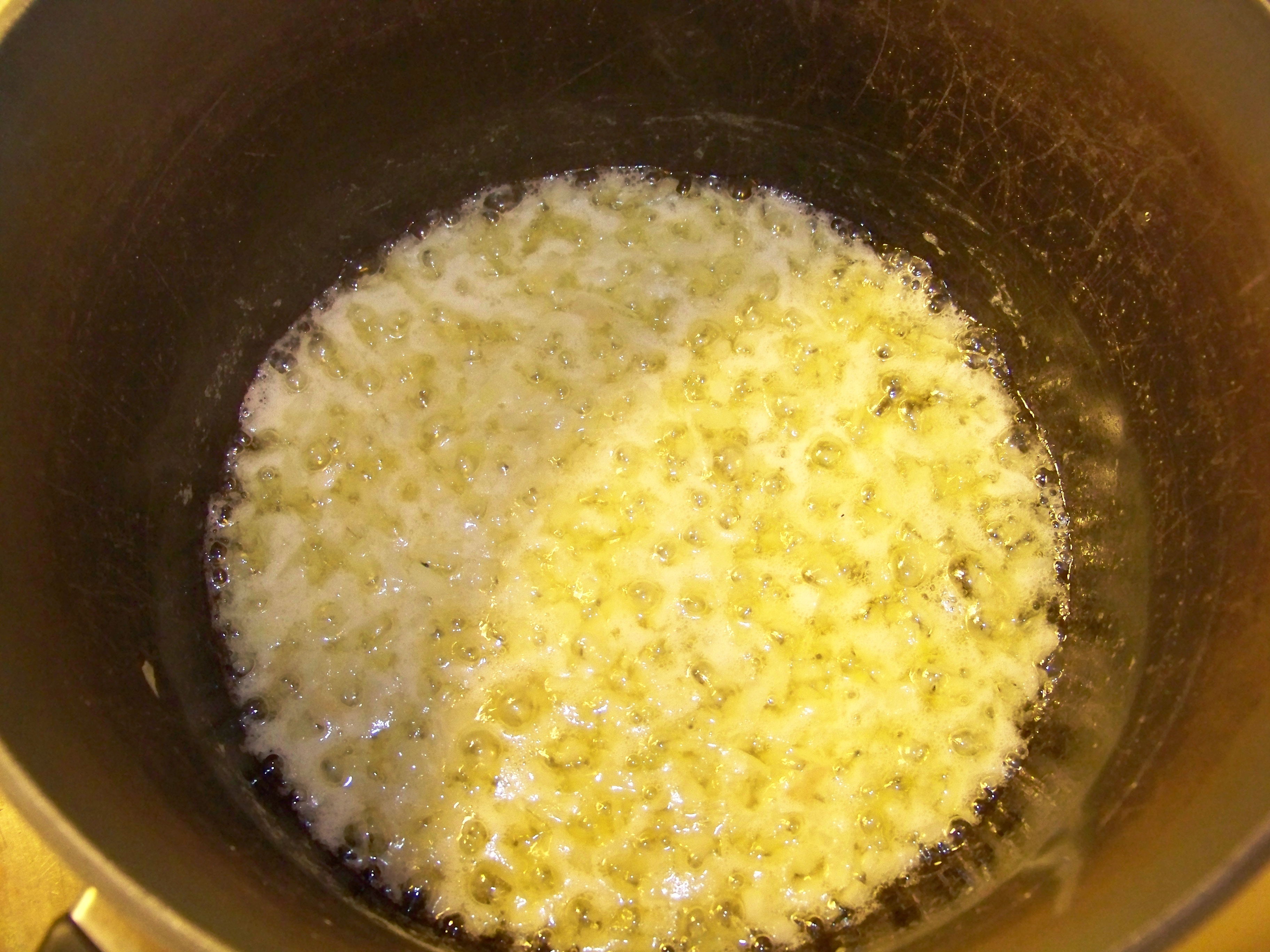
Just like my great-grandma didn't used to make. But someone else's did.

Just like my great-grandma didn’t used to make. But someone else’s did.

As with any casserole/stew/hotchpotch, there are something approaching an infinite number of recipes for guvetch, but I’m quite fond of this meatless commercial variety, produced in Bulgaria by Konex Foods and marketed In America by Indo-European Foods under the label ZerGüt. It may be my favourite guvetch because it’s the only kind I’ve ever had (which is true), but it’s quite delicious on its own terms. According to a spokesperson for Konex, the commercial recipe is derived from one handed down by one of the company founder’s ancestors. The vegetarian guvetch they market (pictured above) is a simple mélange of aubergines, peppers, potatoes, carrots, water, sunflower oil, green beans, tomato paste, peas, salt, okra, onion, sugar, and parsley, with no preservatives, artificial flavours, or colours. At 250 calories per 19 oz. bottle, it’s easy on the diet, too.

A potful of potatoes.

A potful of potatoes.

Flash forward to earlier this evening. I’d had a hankering for shepherd’s pie, but there wasn’t any ground lamb to hand, and I decided to take a whack at a vegan version.

SHEPHERDLESS PIE

Ingredients
2 large Russet potatoes
4 smallish yams (about a pound or so)
3/4 cup unsweetened almond milk
2 tsp salt
1 jar ZerGüt guvetch

Directions
Set a pot of salted water on to boil. Peel potatoes and yams; cook in boiling water for about 20 minutes, or until soft. Drain. Return to pot and mash with almond milk and salt; set aside to cool slightly.

Mashed potatoes, yeah.

Mashed potatoes, yeah.

Divide guvetch evenly into six ramekins. Microwave on high for about 2 minutes to warm.

Microwave me, baby!

Microwave me, baby!

Here’s where I got silly. The simple thing to do would have been to spoon the mashed yam-and-potato mixture on top, fluffing it with a fork to create those peaks that would brown underneath the broiler (about 8 minutes, and rotate the tray at 4 minutes). Instead, I pulled out a pastry bag and a star tip, and piped the potatoes in over the guvetch. Totally unnecessary, totally fun.

Sack o' spuds.

Sack o’ spuds.

If you decide to do it that way, work in a circular motion from the edge toward the center, finishing with a little peak on top.

Piped, but not yet piping hot.

Piped, but not yet piping hot.

Place the ramekins on a foil-lined baking sheet. Eight minutes under the broiler (or you can use a kitchen torch, if you wanna get fancy about it). Rotate the pan at four minutes, and have a care, because some broilers are more efficient than the one in my sixty-year-old O’Keefe & Merritt.

Good to go, after they've cooled a tad.

Good to go, after they’ve cooled a tad.

Allow the ramekins to cool sufficiently that you can handle them — albeit gingerly — with your bare hands. Serve while warm. Makes six.

[NOTE: Bottled guvetch is available at markets that cater to an Eastern European clientele, but it can also be purchased online. The big issue here is the shipping cost, which makes it kinda prohibitive to buy a single jar. If you are willing to purchase a six-pack, you can bring your cost down to about $6.50-$8 per jar (depending on where you live), which is about twice what you’ll pay for it in an ethnic market. It can be ordered online from Salonika Imports in Pittsburgh, so the closer you are to them, the less you’ll pay to have it shipped. Alternatively, you could chop and heat your own vegetable mélange; Google “guvech recipe” for ideas, or just go for it as the vegetable bin provides and the spirit moves.]

Potatoes au Gratin sans Fromage (Vegan-style)

3
It's plane to see.

It’s plane to see.

We’ve been doing Meatless Mondays around the pad for years now, and that frequently means one of several standbys, often involving potatoes. [What can I say, I’m Irish.] My original intent had been to take a whack at Chef Thomas Keller’s Potato Pavé recipe, but time and energy conspired against me, so I opted for Potatoes au Gratin. As luck would have it, The Bride and I dined a few days ago at Crossroads, an excellent vegan restaurant in Los Angeles, and that inspired me to retool the cheese-oozing, cream-dripping, diet-busting fave of my youth.

Generally speaking, I’m not much of a fan of ersatz food products (diet sodas largely excepted). I’d much rather have a beautifully grilled portobello mushroom served like a burger than any sort of the Frankenmeats that often try to pass themselves off as beef patties. As a consequence, my first order of business was to strike off most of the over-the-counter vegan cheese substitutes available, as they more often taste like Firma-Grip paste with a side of FD&C Yellow No. 6 than anything resembling fromage. What I wasn’t willing to sacrifice, though, was the creamy, viscous, umami-laden mouthfeel of the real deal. Fortunately, I didn’t have to.

Gotta give some props here to Tori Avey’s blog, The Shiksa in the Kitchen, which published a recipe for Dairy-Free Saffron Scalloped Potatoes that launched me in the right direction. Basically, there are two parts to the recipe: The potatoes and onions, and the sauce. Here’s a list of ingredients:

100_4774100_4770100_4768

DAIRY-FREE, GLUTEN-FREE, VEGAN POTATOES AU GRATIN

For the Sauce:
2 tbsp non-hydrogenated butter substitute (I used Earth Balance)
3 1/2 tbsp flour (I used Cup4Cup gluten-free flour)
1 can (13.5 or 15 oz) coconut milk* — NOT THE NON-FAT OR LOW-FAT VERSION!
1 cup Almond Breeze almond milk, unsweetened
1 tsp sea salt
1 tsp finely minced garlic (or 1/2 tsp garlic powder)
½ tsp tamari sauce (gluten-free soy sauce)
1 ½ tsp mustard powder
¼ tsp Piment d’Espelette (or hot paprika or cayenne powder)
1 tsp celery flakes or parsley flakes (optional)

For the Taters:
4-5 lbs Russet potatoes (you could use Yukon Gold as well, but Russets are way cheaper)
1 large onion
several dashes paprika for colour and presentation, optional

You have a couple of choices here (more if you are not acting as your own sous chef, which I was). Either make the sauce first (which I did), or slice the potatoes and onions first. If you are slicing the veggies first, please feel free to skip ahead. [Do remember to put your potato slices in a bowl of cold water to keep them from going brown while you’re working on other stuff.]

Making the Sauce:

Making the roux.

Roux the day.

Melt the butter substitute (or margarine, even if it’s not called that) over medium heat in a saucepan or pot, and whisk in the flour a tablespoon at a time, stirring more or less constantly to make a roux. Let it brown a bit, maybe two minutes or so, and then begin adding the coconut milk, about 1/3 of a can at a time. [The full fat variety of coconut milk will probably have a big fatty plug at the top of the can; this is a good thing. Smooth it as you whisk.] Then add the almond milk and spices, continuing to whisk all the while (nothing says “M-m-m-m, tasty!” quite like a thumbnail-sized lump of mustard powder in your finished dish). The reason I used tamari rather than regular soy sauce was to keep the recipe gluten-free; if you don’t care about that, your basic Kikkoman will work just fine. All that need be done from here on is to keep it at a simmer; it only has to be warm (and liquid) enough to pour over the potatoes. Cover it (to keep it from reducing) and turn the heat down low while you focus on the next task: preparing the potatoes.

Preparing the Vegetables:

Spud ends.

Spud ends.

First, preheat your oven to 350ºF / 175 (actually 176.67)ºC

The potatoes (peeled or unpeeled, according to the chef’s whim) should be sliced to a thickness of about 1/8″ or so. More skilled craftsmen than I can perform this task handily with nothing more than a knife, but I use a mandoline (as you can see at the top of the post), and because I am a manly and foolhardy man, I use it without the safety guard. [THIS IS NOT RECOMMENDED!] Should you find the safety guard oppressive, one alternative is to wear a steel mesh or Kevlar glove. But in the true Anthony Bourdain spirit of recklessness, well, I don’t do either of those things. That being said, not only is slicing off your fingertips or shaving your palm — a real possibility! — painful and disfiguring, it also invalidates the recipe’s claim to being vegan. (Blood, even accidentally spilled, is an animal product.) When all the potatoes are sliced (and put in a bowl of water to prevent their discolouring), repeat the process with the onion.

Potatoes and onions, ring the bells of St. Bunion's.

Potatoes and onions, ring the bells of St. Bunion’s.

Layer the potatoes and onions into a greased large baking dish or Dutch oven (I used a 5 qt. Le Creuset Braiser, which worked magnificently). First set down a layer of overlapping potato slices, then scatter some onions on it, then ladle some of the sauce over. Lather, rinse, repeat, until the dish is full (I had about 1/2 lb of sliced potatoes left, which I put in the fridge, and will roast or fry later). Sprinkle some paprika on the top, if you so desire.

Ready for some ovenizing.

Ready for some ovenizing.

Cover with foil (or put on the lid), and pop it into the oven for 60 minutes at the aforementioned 350ºF / 175ºC. By then, the potatoes should be soft and yield easily to a fork. Give them another 10 minutes in the oven uncovered, and finish them off with about 5 minutes under the broiler to brown the top (be watchful during this process, because it can go pretty fast, depending on the distance between the dish and the flame).

Remove from oven, and allow them to cool for about 10 minutes.

Brown is beautiful.

Brown is beautiful.

Coda: I realized (a little too late) that some diced green chiles would be a terrific addition to the sauce; I heated some up and spooned them over top, but it didn’t have quite the same effect. Also, you may want to add some salt (or allow your diners to) at the table, as it was a tiny bit shy on the NaCl for my taste. And a little fresh ground pepper is also nice.

*The full-fat variety of coconut milk runs about 700 calories a can, which is a not inconsiderable amount, but don’t be tempted by low- or non-fat substitutions, because they won’t provide the same mouthfeel. And when you consider how many fewer calories it has than cream (52 per ounce vs. 103), it’s totally worth the “splurge.” [Also, the almond milk is only 7.5 calories per ounce, and given that you’ve also left out all the cheese, there’s a pretty dramatic reduction in calories compared to the standard au gratin recipe.]

The Incredible Hulk in a glass

0

incrediblehulkstylinonline_2270_78360219

The Bride and I were dining at Paiche, an excellent (and highly recommended) new restaurant in Marina del Rey, whose menu offers several intriguing non-alcoholic concoctions. As designated driver that evening, I recused myself from their wonderful wine list, but I wouldn’t settle for fizzy water as my sole potable, so I selected a drink they call The Incredible Hulk. [Cue the ever-litigious Disney (who now owns Marvel Entertainment), likely into its third draft of a cease-and-desist order; by the time you get to the restaurant, it may be called The Bruce (or David) Banner, or something else entirely.]

The Incredible Hulk consists of five simple ingredients: parsley, cactus, orange juice, pineapple juice, and celery. [Here’s a mnemonic for the ingredient list: CC POP.] Living as I do in the Los Angeles area, rounding up some cactus (known at the Mexican grocery store as nopales) was no big deal, and the rest of the items are available anywhere. I kinda cheated and bought pineapple juice and orange juice, rather than making them myself from fresh fruit, as I suspect the restaurant does. I revved up the old Vita-Mixer and ground up six large celery stalks, a pound of chopped nopales (do NOT buy the pickled version or the ones packed in brine for this!), and a bunch of curly parsley with the bottom inch of the stems removed.

Incredible Hulk sits on stove top without fear

Incredible Hulk sits on stove top without fear

I’ve discovered that adding a citrus juice (or any acidic juice) to cactus juice causes foam to rise more or less immediately, so don’t worry if that happens; you can skim it off or discard it. I just mixed it back in. I prefer my juice a little “greener” than the one Paiche serves, so I used less of the orange-pineapple juice blend than they do, but you can experiment to find your sweet (or not-so-sweet) spot.

Looking for vodka in all the wrong places

Looking for vodka in all the wrong places

THE INCREDIBLE HULK
1 bunch parsley
1 pound nopales (cactus), chopped
6 large celery stalks
32 oz. orange juice
32 oz. pineapple juice

Blend greens and a little bit of the orange and pineapple juices (mixed 50-50) in a Vita-Mixer (you’ll need a pretty powerful blender or food processor to deal with the pulpiness of the celery and nopales) until smooth. [You will likely have to do this in two or three batches.] Strain if you wish (I didn’t). Pour half a glass of the greens mixture into a glass with an equal amount of orange-pineapple juice. Stir and serve over ice. Go on rampage. “Hulk smash!”

A refreshing glass of the delicious beverage

A refreshing glass of the delicious beverage

Thai One On, or Larb is Just a Four-Letter Word

1
A somewhat inauthentic take on a great Thai salad

A somewhat inauthentic take on a great Thai salad

As truth would have it, despite its being on pretty much every Thai restaurant menu in North America, the salad known as larb actually originated in Laos, though versions can be found throughout Thailand, particularly in the northern part of the country, as well as in Myanmar and China’s Yunnan province (where there is a significant Lao community). The recipes from which I concocted my version come from highly authentic sources, Bon Appetit magazine and Giada De Laurentiis. Fortunately, I’ve had it a about a gazillion restaurants, so I knew the flavour profile. Also, being in the greater Los Angeles area, I had access to ingredients that may be more difficult to obtain in Dubuque, Des Moines, or Denton.

Rather than the traditional ground beef or chicken, I opted for lamb both because I wanted a break from beef and chicken, and also because the market was having a ground lamb sale. [Incidentally, fish and duck are popular protein options for larb as well, so feel free to try your hand with whatever’s at hand. I may yet take a whack at escargot larb if I ever get the wind up.]

Prep consists of a bunch of chopping, followed by a little sizzle in the pan, followed by dumping said protein on either the trad lettuce (or radicchio or endive) leaf, or piling it on some mixed greens, as I did earlier this evening. It’s a mere 30 minutes from concept to plate, making it a perfect alternative to a rabbit food salad with a burger patty sitting forlornly alongside, and simple to prepare after a long day’s work, presuming you have all the ingredients to hand. For those who don’t have immediate access to fresh whole lemongrass (or who don’t want to work at cutting it into bits so small they don’t appear as wood chips in the salad), many supers in the US (including Kroger and its subsidiaries) carry lemongrass paste in the produce section. It’s a bit pricey, but one tube will take you a long way.

Ground lamb and spices being browned

Ground lamb and spices being browned

Larb with Ground Lamb
INGREDIENTS
Dressing
1/3 cup fresh lime juice
2 tablespoons fish sauce (such as nam pla or nuoc nam)
2 tablespoons honey
1 tablespoon Sriracha sauce

Lamb (or other protein)
1 1/2 pounds ground lamb (chicken, turkey, beef, or pork may be substituted)
1/2 cup coarsely chopped shallots
2 tablespoons thinly sliced lemongrass
2 kaffir lime leaves, finely chopped (you can find these at Asian, Middle Eastern, and some Indian markets)
2-3 tablespoons fresh mint leaves, finely chopped
1 small red Thai chile (such as prik kee noo), thinly sliced
1 garlic clove, thinly sliced
2 teaspoons fish sauce (such as nam pla or nuoc nam)
1 teaspoon kosher salt

Greens
1 head iceberg lettuce, or 16 oz. mesclun mix (4 oz. per serving)
1 small bunch cilantro (optional)

PREPARATION
Dressing
Stir all ingredients in a small bowl to blend; set aside.

Lamb (or other protein)
Combine ingredients 2-8 in a food processor, or just chop on cutting board. Season ground meat with salt and place it in a large heavy nonstick skillet over medium–high heat. Add spice mixture and sauté, breaking up meat into small pieces with the back of a spoon, until it begins to turn golden brown and is cooked through, about 6 minutes.
Place mesclun (or a couple of iceberg lettuce leaves) on each plate. Top leaves with meat mixture, dividing evenly. Garnish with cilantro (if desired) and spoon reserved dressing over.

Shameless repurposing, part three: Wolf at the Door, or The Puck Stops Here

0
Wolfgang and Oscar, together again

Wolfgang and Oscar, together again

Yeah, I know I’m going to hell for the puns. I think it was the endless hours of watching Rocky & Bullwinkle as a kid, in which upcoming episodes would be teased with titles such as “The Midnight Chew-Chew, or Stick To Your Gums” and “Fuels Rush In, or Star Spangled Boner.” In 2012, I had the opportunity to interview Wolfgang Puck, who was as charming on the telephone as he is on the television (and, presumably, in person). I realize that one doesn’t climb to the Elysian heights that Puck has ascended without a healthy double dollop of ego, but I found him to be surprisingly modest. Much like Emeril Lagasse, Puck has built a loyal cadre around him, many of whom have been in his employ for upwards of 20 years, which is no mean feat in the remarkably transient business of hospitality.

And, like virtually everyone who has achieved justifiable fame in the cooking profession (I’m pointedly leaving out many — though by no means all — of TV’s instant celebu-chefs, who maintain a virtual chokehold on the Cooking Channel and the Food Network “reality” shows these days), he laboured for years before ever penetrating the public consciousness, leaving home at 14 to work as an apprentice at a bakery. His first major gig in America was in Indianapolis, of all places.

Fine Dining at the now-shuttered La Tour, Indianapolis, circa Wolfgang's era

Fine Dining at the now-shuttered La Tour, Indianapolis, circa Wolfgang’s era

It was all glamour and glitz from there, Oscar parties and multi-million dollar deals, but his passion for food still comes through in conversation. In fact, here’s a recipe he gave me for Savory Squash Soup that can be served warm or cold, making it an excellent year-round dish.

Savory Squash Soup in situ

Savory Squash Soup in situ

Savory Squash Soup (serves 6)

Ingredients
4 butternut squash (about 3 3/4 pounds)
2 acorn squash (about 1 3/4 pounds)
8 tablespoons (1 stick) unsalted butter
2 white onions (about 4 ounces), peeled, trimmed, and finely diced
1 teaspoon kosher salt
1/4 teaspoon freshly ground white pepper
1/2 teaspoon ground nutmeg
1/2 teaspoon ground ginger
1/4 teaspoon ground cardamom
8 cups chicken stock or vegetable stock, heated
2 cups heavy cream
2 sprigs of fresh rosemary

Garnish
Cranberry Relish*
Cardamom Cream**
Spiced Caramelized Pecans***
8 tablespoons pumpkin seed oil

Preheat the oven to 350° F/ 175° C.

Cut each squash in half and discard the seeds. Brush cut sides with 2 tablespoons of melted butter. Season with salt, pepper, and nutmeg. Arrange the squash cut side down in a roasting pan and bake until tender, about 1 hour. Cool, scoop out the insides of the squash, and purée the flesh in a food processor. Reserve. (You should have about 6 cups of puréed squash.)

In a medium stockpot, melt the remaining 4 tablespoons of butter. Over low heat, sauté the onion. Do not allow it to brown. Add the puréed squash and cook over very low heat until heated through, stirring occasionally. Do not allow it to bubble up. Season with the salt, pepper, ginger, and cardamom.

Pour in the stock and bring to a boil, still over low heat, stirring often. Cook about 20 minutes.

In a small saucepan, heat the cream with the rosemary sprig. Remove the rosemary and pour the cream into the soup. Transfer to a blender or food processor and process, in batches, for 2 or 3 minutes. Adjust the seasoning to taste.

To serve, ladle the soup into heated bowls. Place a tablespoon of Cranberry Relish in the center, top with a dollop of Cardamom Cream, then sprinkle with chopped pecans. Drizzle pumpkin seed oil over soup.

Note: If desired, bake small squash until tender, scoop out, and use as individual serving bowls.
Note #2: You don’t need to make the full recipe for the Cranberry Relish if you’re using it only for the soup.

***************

Cranberry Relish - photo courtesy wolfgangpuck.com

Cranberry Relish – photo courtesy wolfgangpuck.com

*Instructions for Cranberry Relish (serves 6)

3 cups cranberries, fresh
3/4 cup sugar
3/4 cup verjus or 4 tablespoons lemon juice

In a small saucepan, combine all the ingredients. Bring to a boil, then lower to a simmer. Continue to cook until the mixture is thick and the berries are glazed. Allow to cool. Transfer to a covered container and refrigerate until needed.

**Instructions for Cardamom Cream

2 cups heavy cream
1 tablespoon black cardamom seeds

In a small saucepan, bring 1 cup of heavy cream and the cardamom seeds to a boil. Reduce until only 1/4 cup remains. Strain through a wire sieve and allow to cool.
Add flavored cream to the remaining 1 cup of heavy cream and whip until stiff peaks form. Chill until ready to serve.

Spiced Caramelized Pecans

Spiced Caramelized Pecans

***Instructions for Spiced Caramelized Pecans

1 1/2 cups peanut oil
1 cup pecan halves
1 teaspoon kosher salt
1/4 teaspoon cayenne pepper
1/2 cup confectioners’ sugar

Add pecans to a pot of boiling water in two batches, boiling for two minutes. Drain and shake off all excess water.
Sprinkle salt and cayenne over nuts. Coat with sugar, allowing the sugar to melt into the pecans.
Toss the nuts in the strainer, slowly adding all sugar. [NOTE: Do not use utensil to toss.]
Carefully add nuts to hot oil. Cook until golden brown, about 3 minutes, stirring occasionally.
Remove with slotted spoon and allow to cool on cookie sheet.