Bite-Sized Bit — Chickens in Literature

0
Image: © Stephanie Metz, Chicken Legs, 2004. Felted wool, wood 17”H x 12”W x 15”D

Image: © Stephanie Metz, Chicken Legs, 2004. Felted wool, wood 17”H x 12”W x 15”D

My pal Lisa Jane Persky, in addition to being a fine actress, writer, and artist, numbers among her quirks a semi-obsessive desire to document the role of the humble Gallus gallus domesticus in the world of literature. From Proust to Palahniuk, she captures the cluck in word and image, honouring our fine feathered friends with an expert curatorial eye.

While I usually tend to find my chickens in the fridge, roasting pan, or fryer, I have to admit I’m partial to her recipe for a little brain food.

On the other hand, if you would prefer to put your brain in park for a moment, you might want to check out comedian Bruce Mahler’s ingenious use of a store-bought fryer as a prop for a skit on the ABC series Fridays.

And if you would like to find out more about Stephanie Metz, the artist who created the overbred fowl featured at the top of the post, her art can be found here.

Balkanizing My Kitchen, Part two — Ajvar and Pinjur

3
Oops. That's not Ajvar and Pinjur, it's Akbar and Jeff from Life in Hell, with apologies to creator Matt Groening.

Oops. That’s not Ajvar and Pinjur, it’s Akbar and Jeff from Life in Hell, with apologies to creator Matt Groening.

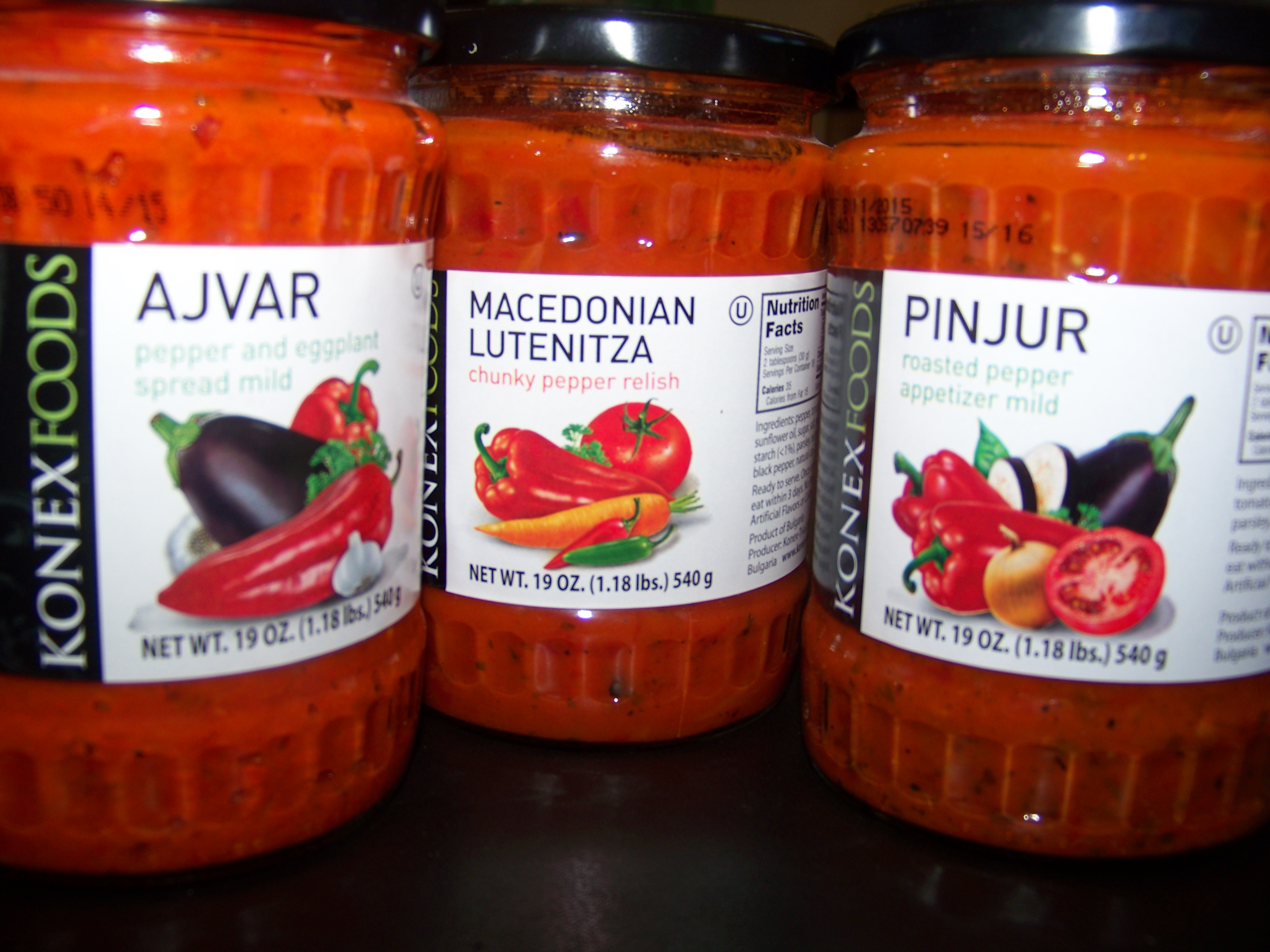
If you happened to see my earlier post on lutenitza, you’ll recall that I promised to return with a further exam of its kissing cousins, ajvar and pinjur. First, let’s have a look at the real deal.

The REAL Ajvar and Pinjur.

The REAL Ajvar and Pinjur.

Although thought to be Serbian in origin, ajvar (pronounced “EYE-var”) is said to have derived its name from the Turkish word havyar, which shares an etymology with “caviar.” [In Russian as well, the word ikra (or икра), can mean both traditional caviar and also a vegetable purée or paté.] It’s made from red peppers, aubergines, garlic, oil, and spices. Both lutenitza and pinjur, which share many ingredients with ajvar, generally include tomatoes, while ajvar does not. Perhaps the most striking difference between ajvar and the other two, though, is its consistency; you can turn a room temperature jar of ajvar upside down without spilling its contents. Pinjur and lutenitza, not so much. Depending on the recipe, ajvar may be made with smoked or roasted peppers or not; in this bottled version, the peppers are not roasted, giving it a lighter, brighter flavour than either the pinjur or the lutenitza.

The FatFree Vegan Kitchen blog has an excellent (and quite healthy) recipe for homemade ajvar, as does the Kitchen Window blog at NPR (where they dub the dish “Serbian Salsa“). In both cases, these recipes opt for roasting the red peppers.

Pinjur (also known as pindur, pindjur, pindzur, and pinđur) is widely available throughout Serbia, Bosnia, Herzegovina, Bulgaria, and Macedonia. Just in case you’re unclear on just where all these places are, here’s a map.

For the geographically challenged, this is where ajvar and pinjur come from. Photo courtesy Univ. of Texas Library.

For the geographically challenged, this is where ajvar and pinjur come from. Photo courtesy Univ. of Texas Library.

Unlike ajvar, which is more of a spread, pinjur (pronounced “PEEN-jur”) resembles a salsa or sauce. And, like salsas and sauces, it comes in a fairly wide variety of styles. It’s generally characterized as being an aubergine (eggplant)-based sauce/relish, rather than a roasted pepper sauce/relish, even though lutenitza generally contains aubergines, and pinjur generally contains roasted peppers. Confusing, ain’t it? In my limited experience so far, lutenitza is a little spicier than pinjur, but there are so many variants on the recipes, it would be impossible to make a generalization that really sticks. Dealer’s choice here.

Both pinjur and lutenitza are terrific mixed in with rice, ladled over vegetables or meat, or as a dip for chips; they can be served either warm or at room temperature. Both are gluten-free and vegan (as is ajvar), and they’re all a great way of dealing with the overabundance of vegetables from the summer garden, offering a tasty treat for home canning enthusiasts well into the winter months… provided you can wait that long to break into those jars.

The Food Network’s UK website has a tomato and pepper-free recipe for pinjur that relies heavily on aubergine for its base, but if you want something closer to the commercially available versions, you can opt for this recipe from the Healthy Food Base blog.

As the Macedonians would say, “Cреќен јадење!” [transliteration: “Sreḱen Jadenje!”] [translation: “Happy eating!”]

Balkanizing My Kitchen, Part one — Lutenitza

2
Three tasty pepper-derived foodstuffs.

Three tasty pepper-derived foodstuffs.

Not to worry: my kitchen has not split into warring factions. I just happened to be at Big Lots! [or, as some stores’ signage reads, Big! Lots (formerly Pic ‘N’ Save)] earlier today, poking around to see if they had any more jars of Macedonian Lutenitza, as one often does on a Tuesday. And that’s when it happened.

Let me back up a minute. Back in the ’50s, in Culver City, California (not far from where I live), a guy named William Zimmerman put together a chain of stores that specialized in overruns and closeouts, and called it Pic ‘N’ Save. Later, as the chain expanded — overexpanded, as it turns out — they redubbed themselves MacFrugal’s, and were purchased in 2002 by Consolidated Stores Corp., who converted the locations they kept open to their pre-existing brand, Big Lots! (and ultimately renamed the entire business Big Lots, Inc., which currently trades on the NYSE with the symbol BIG). While most of the merchandise in these stores is off-brand or otherwise out of favour (see picture below), they occasionally bring in weird little items that magically appear — and then just as magically disappear. So it was with my introduction to Macedonian Lutenitza.

Get 'em while they're not hot.

Get ’em while they’re not hot.

Lutenitza (also known variously as ljutenica, lyutenitsa, or lutenica, plus a dazzling variety of Cyrillic-alphabet spellings) is a type of salsa/sauce/relish widely made throughout Bulgaria, Serbia, and Macedonia. Its basic ingredients are tomatoes, red peppers, aubergines (eggplant), vegetable oil, sugar, and salt, though variants also contain onions, carrots, garlic, and black pepper, among other things. Like salsa, everybody’s grandmother makes “the best,” and family recipes are handed down as prized possessions. I’m sure my Bulgarian friends — if I had any — would blanch at the idea of buying commercial lutenitza, but heck, I didn’t even know about it until a week ago. [Note to self: Make some Bulgarian friends.]

For the geographically challenged, this is where lutenitza comes from. Photo courtesy Univ. of Texas Library.

For the geographically challenged, this is where lutenitza comes from. Photo courtesy Univ. of Texas Library.

While lutenitza itself is entirely vegan, it’s served on meats, fish, breads, roasted vegetables, French fries, and pretty much anything that doesn’t move. Some versions are apparently hotter than others, but if you make your own — which I’m guessing you’ll probably have to do, unless you have a Balkan grocery (or Big Lots!) in your area — you can adjust spices to taste. This recipe, courtesy of rhubarbfool.co.uk, looks like it would match up pretty closely to the one in the bottle I have, except it would seem that this commercial version has upped the pepper and carrot content in favour of using aubergine, and he uses olive oil rather than a more neutral one such as canola.

Lutenitza Serving Suggestion, courtesy http://www.mucizelezzetler.com

Lutenitza Serving Suggestion, courtesy http://www.mucizelezzetler.com

Lutenitza –- Bulgarian Vegetable Relish

Ingredients

2 medium carrots, peeled and diced
1 onion, diced
1 medium aubergine, diced
2 tablespoons olive oil
3 large roasted red peppers, skin and seeds removed and then diced
1 400g (14 oz.) can chopped tomatoes
1 tablespoon sweet paprika
1 teaspoon dried thyme (or summer savory if you have it)
2 tablespoons sugar
salt and pepper to taste

Take a medium sized saucepan and fry the onions, carrots and aubergines in the olive oil until soft. Add the red peppers and fry for a further 2-3 minutes. Add the tomatoes and seasoning, bring to the boil and simmer for 10 minutes. Add a little water if the mixture seems too dry. Mash some of the mixture using a potato masher. You are aiming for a thick ratatouille type texture. Spoon into a clean preserving jar, cool, seal and refrigerate. Makes about 1 kg/2 lb.

If, however, you plan on making it the old fashioned way — which is to say in bulk to put up for winter — this video, which calls for an astonishing 8kg (nearly 18 lbs.) of tomatoes, might serve you better, as might this video, featuring the “Sexy Chef,” Liz Todorova.

More on lutenitza’s cousins, ajvar and pinjur, in a later post. Do come back.

The Tournament of Rosés

0

100_4261

Dan, our gracious co-host (pictured at far right below), laid out the ground rules simply in his email:

100_4268

Bring a favorite bottle of rosé to share. Heck, feel free to bring more than a bottle if you’re the magnanimous sort. We love diversity, so no bring no more than one bottle of any one rosé, unless of course it’s Tempier or Valentini. Note-taking, reviewing or rating of the wines is heartily discouraged, and anyone overtly pimping bottles they don’t make themselves will be asked to leave (but we’re happy to send a note to your boss telling them that you did an admirable job representing the brand).

For eleventeen years or so, Dan has co-hosted a pagan summer event dedicated to the celebration of that most summer-y of beverages, rosé wines. The Tournament started on the deck outside his second-storey Malibu townhome with just a dozen or two people, and has grown geometrically in the years since, relocating to his friend Françoise’s back yard in Santa Monica. At first, it seemed something of a quirky kind of wine to revere. Much like the Jews, rosés wandered for years in the wilderness, having been given a bad name in America by the likes of Mateus and Lancers and (more recently) Sutter Home White Zinfandel. In fact, that one wildly popular White Zin was so poorly received by the cognoscenti that — despite being an economic juggernaut — it nearly tanked the reputation of the Zinfandel grape, and red Zinfandel (or just Zinfandel) is as far from white Zinfandel as red pepper is from white pepper. [That said, my pal Van Williamson makes a delightful rosé of Zinfandel (he calls it Rosato), so it is possible to make a “white Zin” that’s palatable.]

“So what,” I hear you ask, “is the key takeaway here? After all, I wasn’t invited to the party, and even if I had been, I missed it.”

100_4280

First of all: Don’t be afraid of rosés! They’re the perfect anti-wine-snob wines, mostly inexpensive, and the obvious bridge between people who claim not to like red wines and people who maintain they’re not interested in whites. They go great with food, from grilled meats to seafood to veggies. They’re widely available; most major grocery stores usually have one or two really tasty ones for under $20 (unless you happen to live in one of those unfortunate states where the liquor sales are controlled by the government, and even the state stores in places such as Pennsylvania and New Hampshire frequently carry an acceptable selection). If your local wine store clerk gives you attitude over your selection, give him — trust me, if it happens, it will always be a him — a clout upside his snooty pate and proceed proudly to the checkout counter. After all, the French, who know a thing or two about wine, consumed an average of 11.8 liters per capita in 2010.

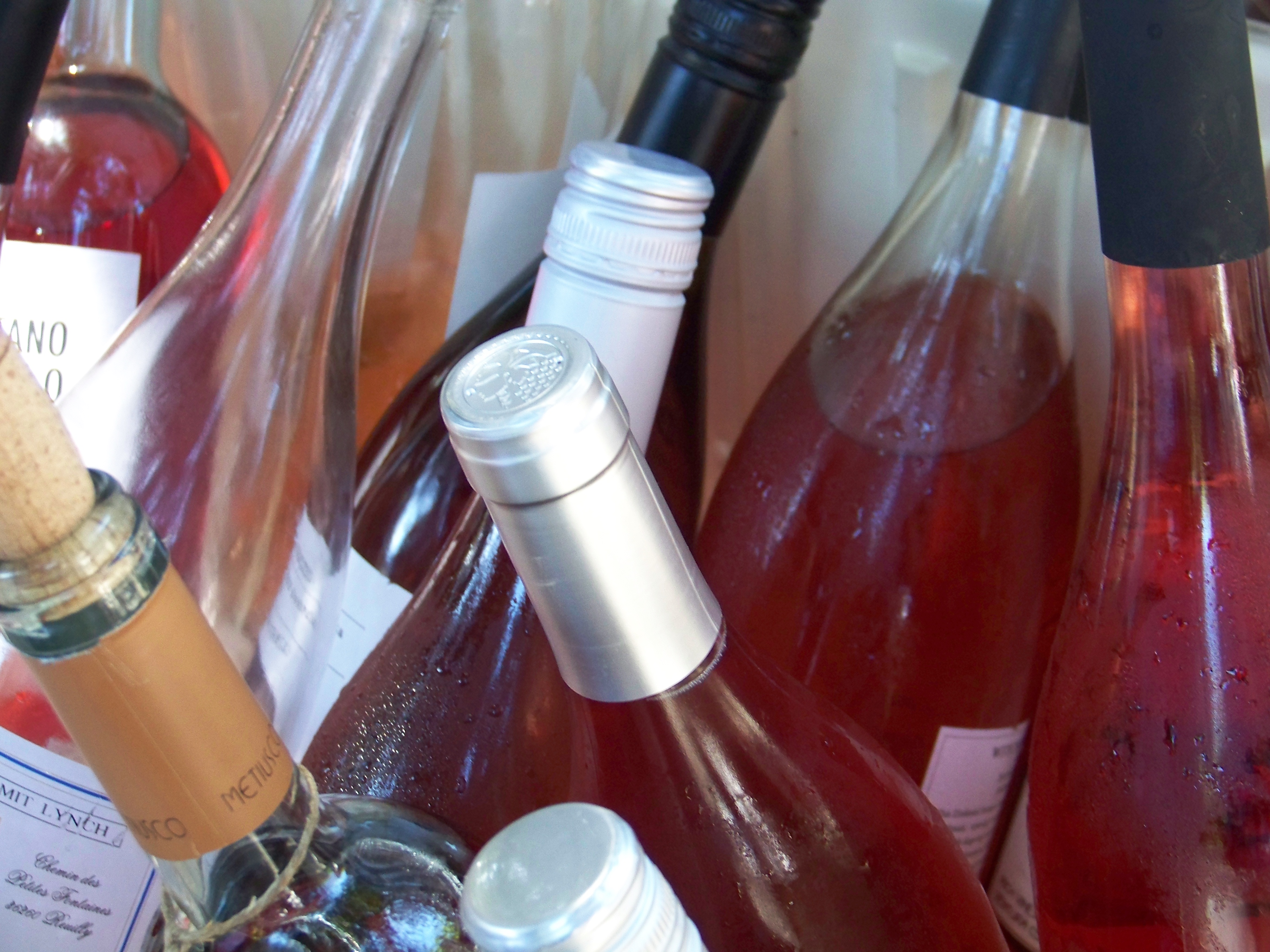
One of several well-stocked coolers at the 2013 Tournament.

One of several well-stocked coolers at the 2013 Tournament.

Twenty years ago, red wines constituted 73.4% of wines sales in supermarkets in France; in 2011 (the most recent year for which I could find figures), they had declined to 56%. Over that same period, rosé’s market share had grown from 13.1% to 27.3%. As per usual, we’re a little behind the curve, trend-wise, but experts in the American wine business are saying that rosé sales are expected to continue to rise here as well. Maybe Brangelina’s recent foray into rosé territory will jump-start the movement here; the first 500 cases of their Miraval rosé sold out in six hours.

A few of the 84 bottles that were consumed at the 2013 Tournament of Rosés.

A few of the 84 bottles that were consumed at the 2013 Tournament of Rosés.

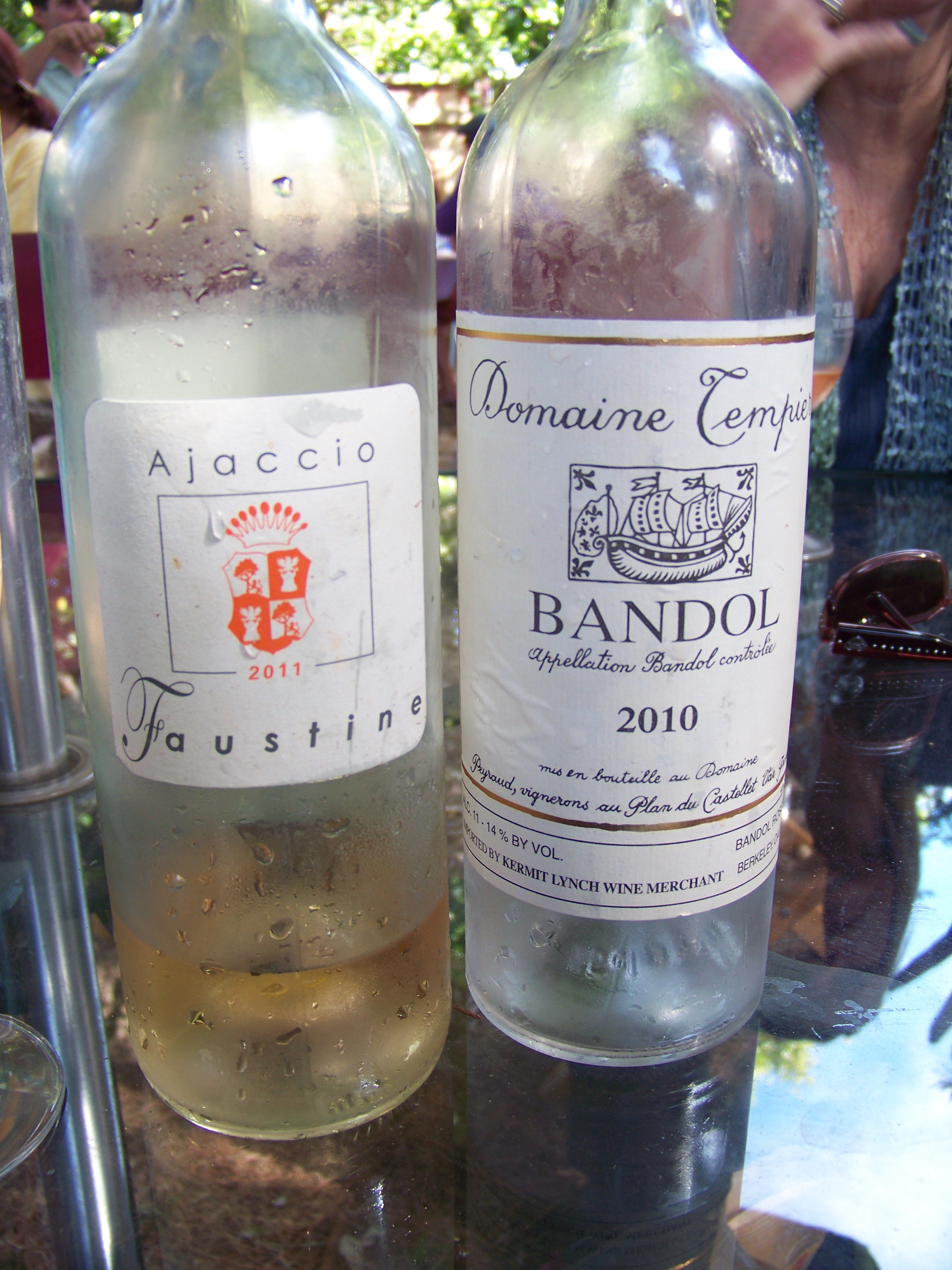
In addition to being a great hang, parties such as this are a terrific way to get exposed to wines you otherwise might never know about. And clearly, having friends who are in the wine business (and who have outstanding cellars) are a positive boon such a gathering. But even without that, getting friends together to share and compare can be both entertaining and educational. [It’s real easy to forget about the educational part after the first few glasses, so I just take pictures of bottles I like.]

A picture of bottles I liked.

A picture of bottles I liked.

I don’t recall who first introduced me to the two-point wine scale, but it’s served me well: ultimately, it’s either “yum” or “yuck.” While far from being an expert, I’ve spent a fair amount of time tasting, reading, and making notes about wine myself, so the last thing I would want to do is disparage others who analyze wine the way people of a certain age used to pore over the cover of Abbey Road for clues that Paul was dead. But the final question for me always boils down to whether or not I would want to consume some particular wine again, ratings be damned. And today, I was richly rewarded.

Rosés, much like roses, come in many colours.

Rosés, much like roses, come in many colours.

Here are a few faves (in no special order) that are widely available, all under $20 and many a good deal less:
2012 Charles and Charles, Columbia Valley, WA
2012 Caves d’Esclans ‘Whispering Angel’ Rosé, Côtes de Provence, FR
2012 Domaine de Triennes Rosé, Vin de Pays du Var, FR
2012 Marqués de Cáceres Rioja Rosado, SP
2010 Château Bonnet Merlot/Cabernet Sauvignon Rosé, FR
2010 Falesco Vitiano Rosato, Umbria, IT
2012 Château de Campuget Costières de Nîmes Tradition de Campuget Rosé, FR
2012 Ameztoi “Rubentis” Rosado Getariako Txakolina, SP
2012 Château de Lancyre Rosé, Pic Saint Loup, FR
2012 Chateau de Lascaux Rosé, Coteaux du Languedoc, FR
2012 Domaine M. Chapoutier Belleruche Rosé, Côtes-du-Rhône, FR

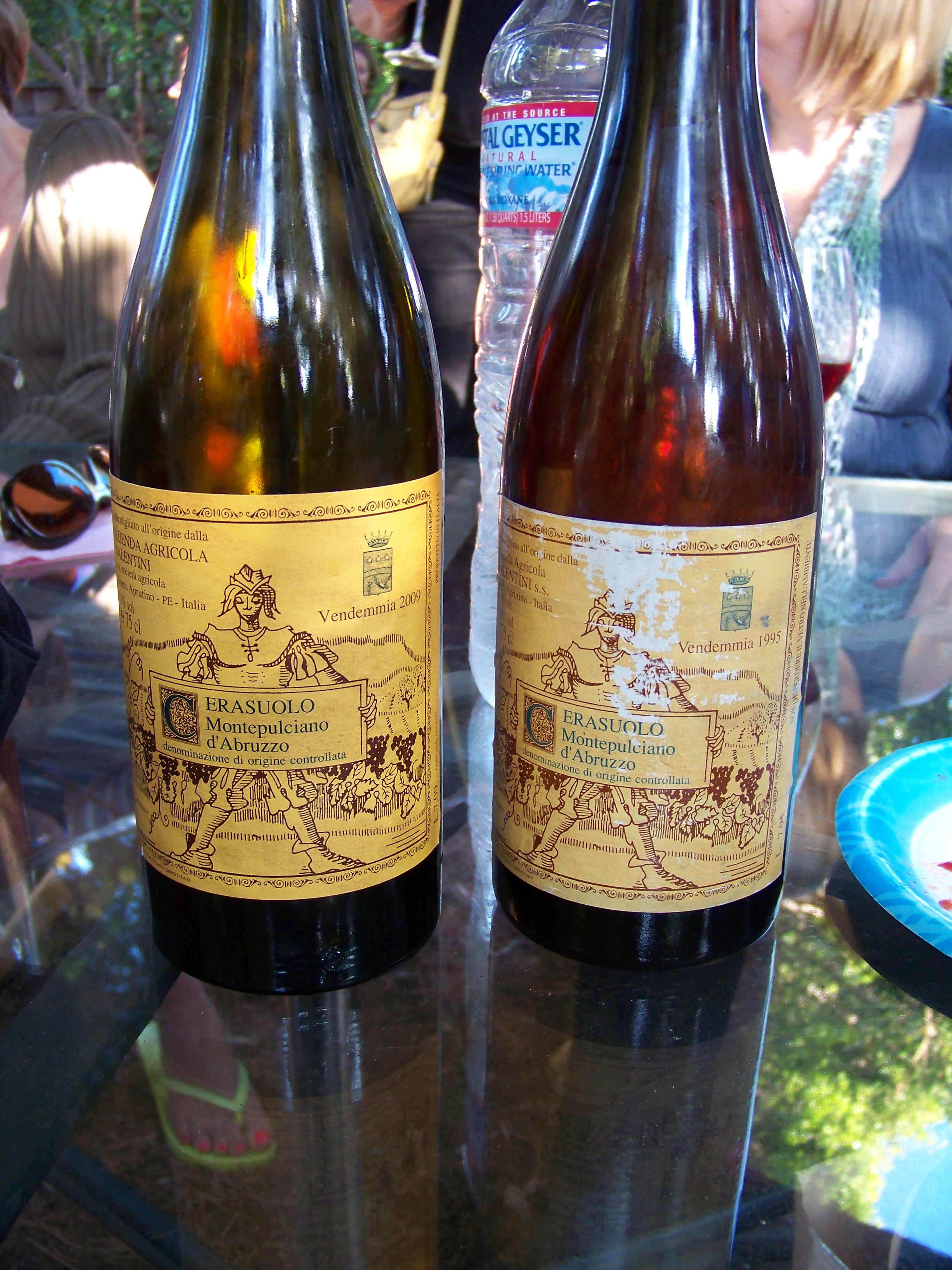
And here are a couple that you probably won’t ever get to taste, and which I will likely never taste again, thanks to the generosity of one of our wine collecting friends, who pulled a couple of special bottles for the Tournament.

From our pal John's cellar. Magnificent.

From our pal John’s cellar. Magnificent.

He Blinded Me — And Darn Near Crushed Me, Too — With Science

1
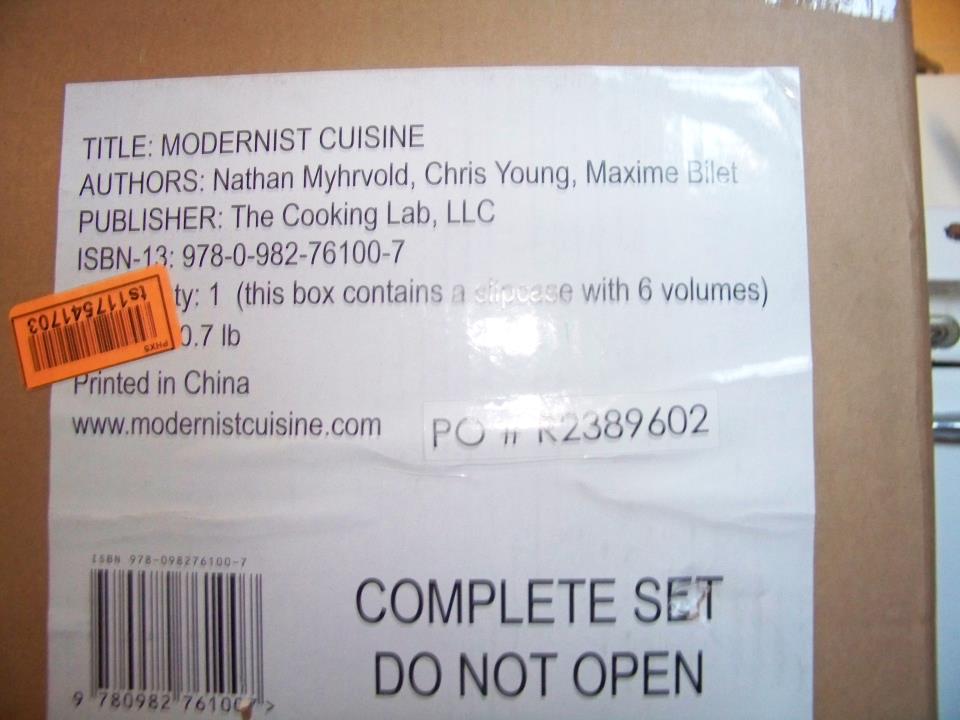
A 50 Pound Box of Books

A 50 Pound Box of Books

You say “po-tay-to,” I say “po-tah-to.” You say “hard-boiled egg,” I say “denatured proteins encased in an ovoid container composed largely of calcium carbonate.” Let’s call the whole thing off. Or rather, let’s not, just for the moment.

Many years ago, when I foolishly (and incorrectly, as it turned out) believed I could balance a Chem major with a second one in Political Science, managing the campus radio station, editing the Editorial page of the campus newspaper, and engineering an entirely unsatisfactory love life, I had a moment of epiphany. Most of the lab experiments we undertook were colloquially referred to as “recipes,” and it occurred to me that “recipes” — the ones I had gathered from family and friends for use in the kitchen — were little science experiments. I know, friggin’ duh. Next I’ll be telling you about water being wet.

When people say “a lot of love went into that recipe,” it usually means, “the cook spent a whole mess of time getting it right, and she can reproduce through sheer muscle memory processes that I (a newbie trying to imitate the outcome) am unable to replicate.” In our mashed-potato-bud-flakes culture, any skill that cannot be mastered in the time it takes to microwave a bag of popcorn is just too darn hard, so we might as well ascribe some mystical attribute to the perfectly cloudlike soufflé rather than admit that your grandma, or Wolfgang Puck, or Eddie down the block, is just better at following directions than you are.

After all, when we prepare food, we generally do one or more of three things: We heat it. We cool it. We mix things with other things. And in performing some combination of those processes, we change the chemical composition of the ingredients at the molecular level. Voilà! Science.

Enter Nathan Myhrvold.

1322

If that picture isn’t the archetypal image of a Scientist Doing Serious Science, I don’t know what is. Oh, wait — he isn’t wearing a lab coat. Nonetheless, he’s something of a polymath, having started college at 14, and breezed through a master’s degree in mathematical economics and a Ph.D in theoretical and mathematical physics from Princeton and a post-doc fellowship with Stephen Hawking at Cambridge before being named Chief Technology Officer at Microsoft. He has also competed on a team that won first place in multiple categories (as well as being named best team overall) at the 1991 World Championship of Barbecue. And here we have that moment of interfacial polymerization, where the two seemingly disjoint circles in the Venn diagram overlap, and magic happens.

Modernist Cuisine

Modernist Cuisine

After having left Microsoft, Myhrvold had enough time to pursue his passion for cooking. Setting aside for a moment the fact that he haunted kitchens like some Phantom of the Spatula, turning up in local Seattle joints as well as Michelin-starred outfits abroad, Myhrvold brought a special piece to the puzzle: money. Much as when Walt Disney was unsure of the eventual success of Disneyland (saying, apparently apocryphally, that even if he landed on his face, he was at least falling forward), Myhrvold wasn’t sure if an audience beyond a couple dozen existed for his $500+ set, but he (like Walt) had resources at his disposal to see his dream through to fruition. Suffice it to say that both ventures exceed initial projections wildly, though we oughtn’t expect to see a Pirates of the Portabello ride any time soon.

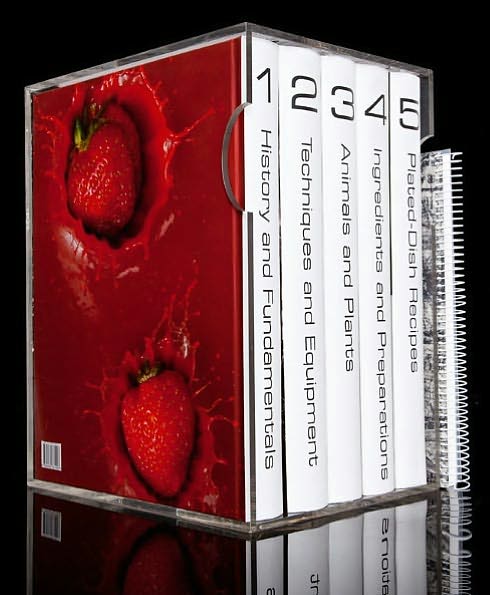
Just as an object, Modernist Cuisine: The Art and Science of Cooking is breathtaking. Profusely illustrated (3,216 photographs), beautifully bound, it’s clear that no expense was spared in its preparation. In fact, there are over four pounds of ink — four pounds — contained between its myriad covers and spread among its 2,438 pages. But its primary appeal is a simple, step-by-step explanation of how this business of preparing food works. Myhrvold (with co-authors Chris Young and Maxime Bilet) isn’t the first person to tread this ground. The distinguished food writer Harold McGee waded into the deep end of the kitchen science pool nearly three decades ago with his indispensable On Food and Cooking: The Science and Lore of the Kitchen. Where Myrhvold et al. go McGee one better is in the use of equipment and techniques not generally common to the home cook… or to the professional chef, for that matter. [I remember one time when I was trying to clarify cactus juice and realized that a centrifuge would be the ideal tool, but who among us has one in the cupboard and would you really want to clarify 20ml at a time? Bring on the cheesecloth.]

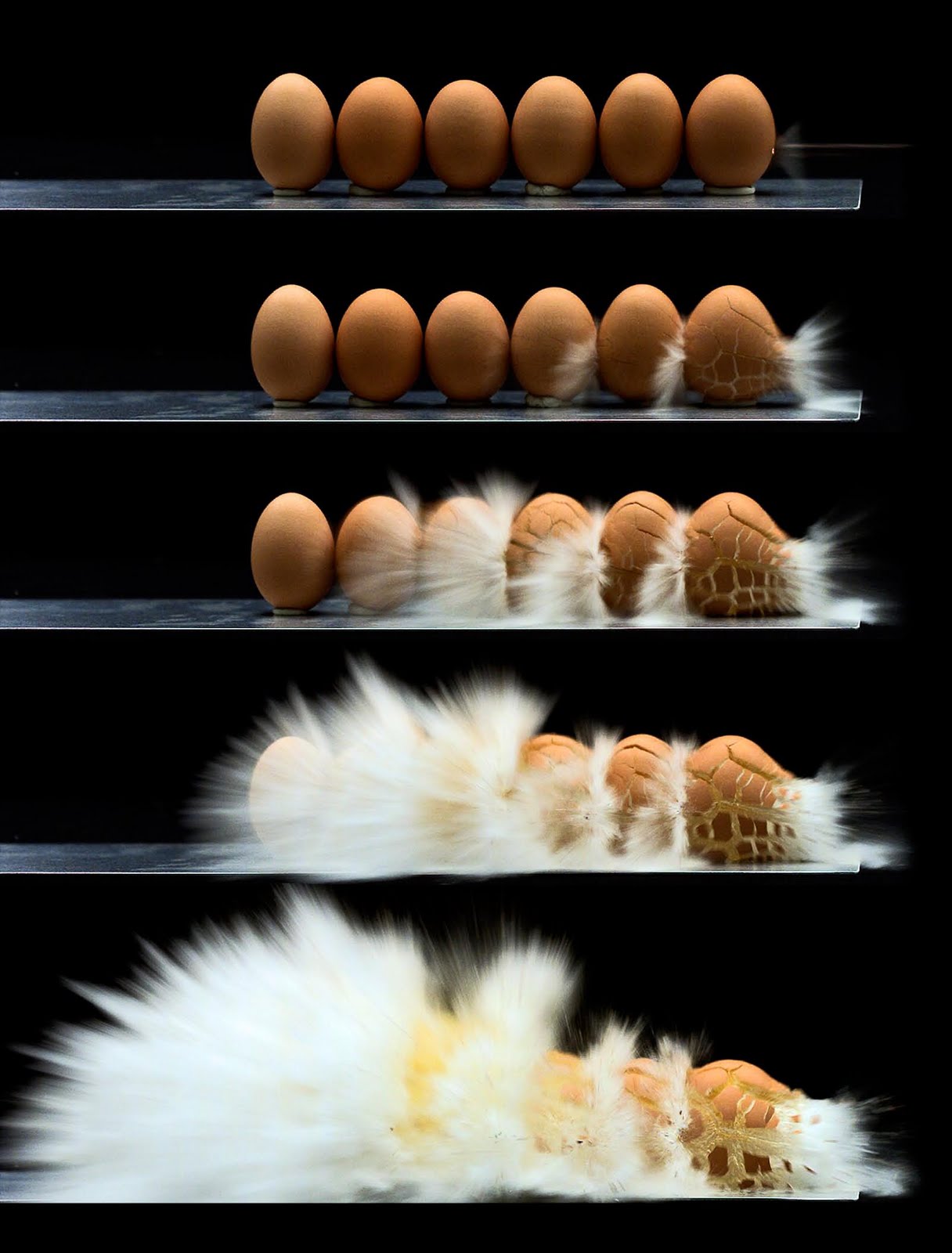
Yeah, you could cook eggs with a bullet, but it would be dangerous, probably illegal, and very messy.

Yeah, you could cook eggs with a bullet, but it would be dangerous, probably illegal, and very messy.

As anyone who has read the blog previously — or even the first part of this post — can clearly ascertain, I’m a geek. I’m fascinated with the idea of working with liquid nitrogen in the kitchen, though if The Bride caught me doing so, she’d probably conk me one with the frying pan. Granite counters, after all, are not cheap. Many of the ideas and techniques enumerated in Modernist Cuisine will, alas, never make their way to my kitchen. But many of them will. As a for instance, his explanation of how a wok works has enhanced my stir-fry mojo.

The workings of the wok.

The workings of the wok.

For those who are less geeky, more thrifty, or would merely like to jump in at the shallow end of the kitchen science pool, Myhrvold and company have distilled the Modernist Cuisine monolith into a handy, single-volume set called Modernist Cuisine at Home. I haven’t read it (yet), but I’m given to understand that it contains more than 400 new recipes, and while pricy (it runs about $115, or the approximate cost of 3-4 cookbooks), I’m sure anyone so inclined will find it well worth the purchase price, given its lineage.

Geek-o and The Man, or, more appropriately, The Man and Geek-o.

Geek-o and The Man, or, more appropriately, The Man and Geek-o.

Gotta give props here to three folks who taught me two very valuable lessons. My late maternal grandmother, who taught me that the kitchen isn’t a scary place. And my favourite chemistry teachers in high school and college, Claude Wiseman and the late Nobel laureate F. Sherwood Rowland (respectively), who taught me that the lab isn’t a scary place, either. [Although I have done some things in their chem labs that were scary, but those are other stories for another time.] In Myhrvold’s Modernist Cuisine, he’s fused those two concepts in a way that would make my mentors — and no doubt his — proud.

Note: Only the first and last photographs in this blog post are original; all others are ©Modernist Cuisine, LLC.

Shameless repurposing, part two — My Dream Date with Emeril

0

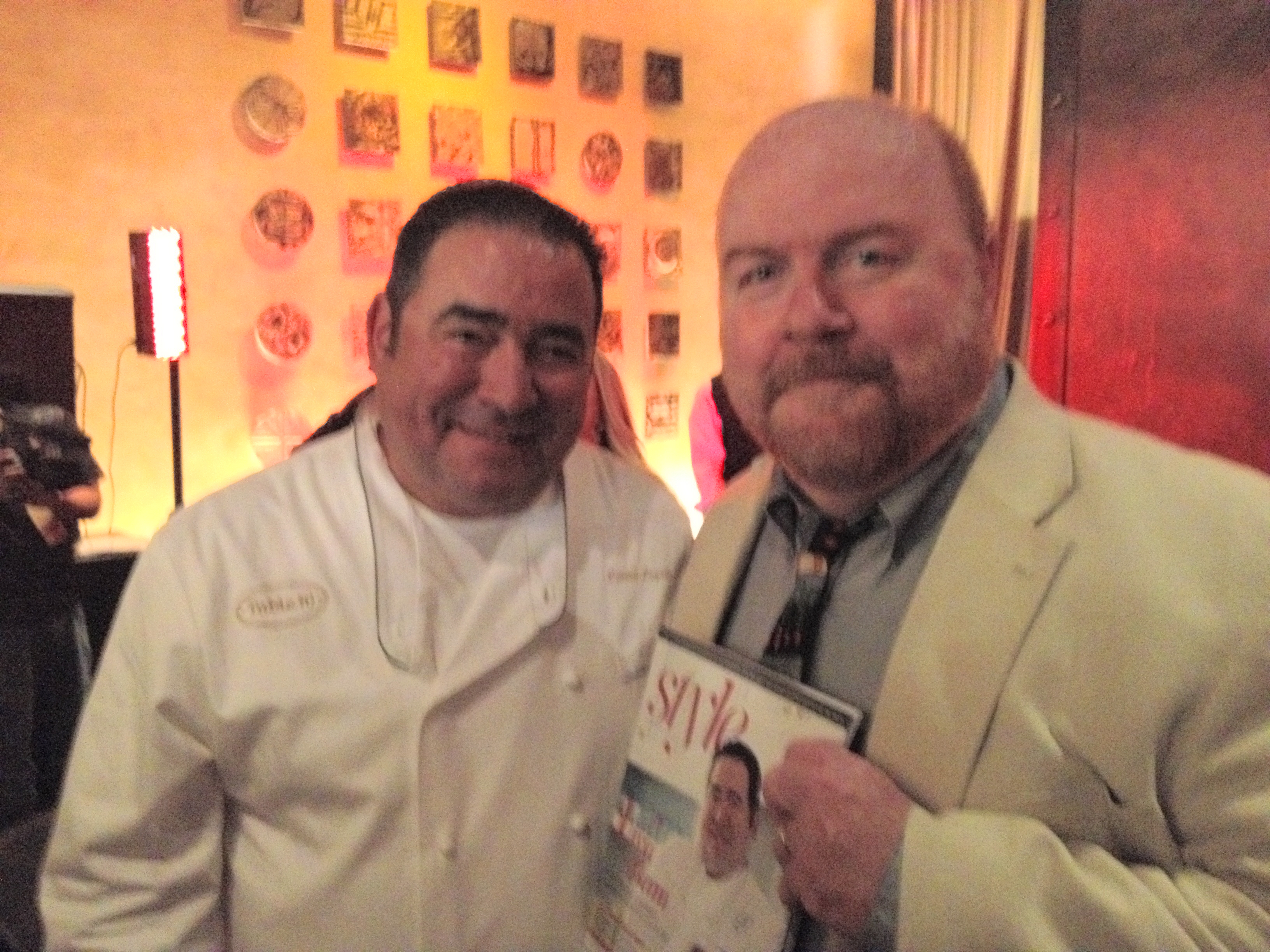
Emeril and Thane

Last summer, I was contacted by the American editor of Style magazine (then Sands Style) to see if I would like to interview Chef Emeril Lagasse for the relaunch of the magazine. Like every cooking fan in America, I’d seen Emeril a gazillion times; unlike many cooking fans, I’ve eaten at one of his restaurants in New Orleans. Naturally, I agreed.

Despite his fireplug stature, Lagasse looms larger than life in virtually ever aspect of his being. He is immediately gregarious and extraordinarily self-effacing. He’s passionate about food. He loves to teach and to share what he’s learned. And he is remarkably generous in spirit.

Here’s a story that didn’t make it into the piece I had published: Part of the craft of managing a celebrity interview is figuring out what to ask him or her first. Way back when I was in college, my brilliant journalism spirit guide, Joseph N. Bell — a lecturer, because he was a working stiff, not an ivy-clad professor — told his class that something like 75-80% of one’s energy prepping for an interview should be devoted to formulating the first question. Famous (and even semi-famous) people are subjected to an endless parade of clueless journos who haven’t read their book or seen their movie or listened to their record, who inevitably kick off the interview with some slow-pitch softball such as “So… what inspired you to _____?” B-o-r-i-n-g. Shockingly, the rest of that sort of interview winds up with a lifeless string of canned answers to the canned questions.

The night before I was to chat with Chef Lagasse, The Bride suggested I might mention a shrimp and grits recipe she’d had at NOLA several years back, and for which she desired the recipe. “Excellent!” I thought. “Here’s a way under his radar.”

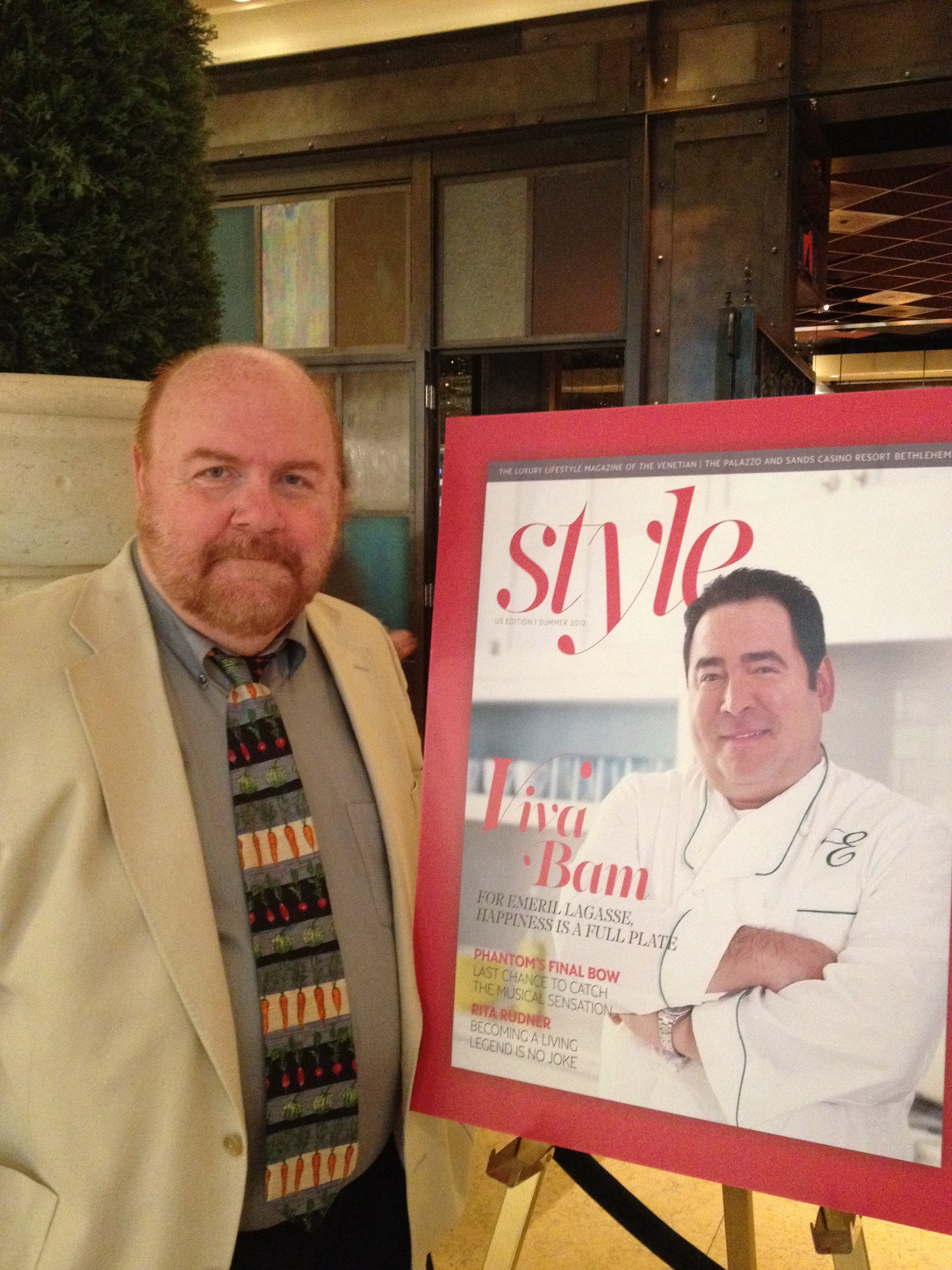
The cover, larger than life. The pic of Emeril, not so much.

The cover, larger than life. The pic of Emeril, not so much.

Our phoner kicked off with the typical pleasantries; underneath it all, I’m sure he was probing to see if I was actually interested in and/or knowledgeable of what he was doing, and I was curious to ascertain whether he was full of camaraderie when the red light was on, only to turn cold as a fish case haddock in its absence. As luck would have it, the two of us fell into sync more or less immediately. Even without asking, when I relayed the story of The Bride and The Grits, he responded with, “I’ll be happy to send you the recipe.” Within an hour of our interview’s conclusion, he (or one of his minions, at his direction) had.

Like most celebrated chefs, Lagasse had served his Malcolm Gladwell 10,000 hour apprenticeship many times over. And, like virtually all of the chefs I’ve had the pleasure of interviewing, he was generous to a fault regarding his team. Many of Emeril’s krewe have been soldiering on with him in excess of a decade (some even two!), a surprising display of loyalty considering the fluidity of movement in the world of haute cuisine. Clearly, the man is doing something right.

Some time after the story was filed, my editor invited me to the magazine’s relaunch in Las Vegas. The Bride and I made the pilgrimage, given that the magazine was kind enough to comp our hotel room. Emeril was just as engaging in person as he had been over the phone, and — ever the businessman — he asked his assistant to jot down my contact info, should we be of some mutual benefit sometime in the future. Fair play, that. I hope our paths cross again, even if just to hear him say “BAM!”

Every now and then, we all aspire to kick it up a notch.

Here’s a link to the article.

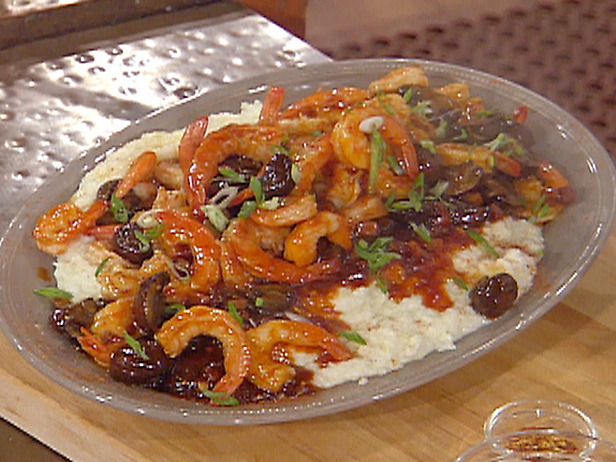
And this is the shrimp and grits recipe that kicked off our conversation:

As prepared family-style.

As prepared family-style.

NOLA’S SHRIMP AND SMOKED CHEDDAR GRITS
Recipe from NOLA Restaurant by Emeril Lagasse.

For the Shrimp:

Ingredients

2 pounds medium shrimp, peeled and deveined
2 1/2 teaspoons Emeril’s Original Essence, recipe follows
3/4 teaspoons salt
2 tablespoons olive oil
4 tablespoons butter, room temperature
1 recipe Smoked Cheddar Grits, recipe follows
1 recipe Citrus Buerre Blanc, recipe follows
1 recipe Abita BBQ Glaze, recipe follows
1 recipe Smoked Cremini Mushrooms and Rendered Bacon, recipe follows
1 recipe Grilled Green Onions, recipe follows

Instructions

In a large bowl, combine the shrimp with the Essence and salt and toss to blend. Set aside as you prepare the skillet. Place a large, 14-inch skillet over high heat and add the olive oil and heat until very hot. Add 1 tablespoon of the butter to the pan. Swirl to melt, then add the shrimp to the pan, being sure that the shrimp are in one layer in the pan. Sear the shrimp until well caramelized on the first side, about 1 minute. Turn the shrimp over and add the smoked mushrooms, bacon and Abita BBQ Glaze to the pan. Continue to cook, stirring occasionally, until the shrimp are well coated with the sauce and just cooked through, about 3 minutes. Add the remaining butter to the pan and swirl until melted into the sauce.

To serve, divide the grits between 8 entrée-sized shallow bowls. Drizzle about 2 tablespoons of the Citrus Beurre Blanc around the edge of the grits near the rim of the bowl. Divide the shrimp, mushrooms, bacon and sauce evenly between the bowls, and place a grilled green onion on top of the grits in a circle. Serve immediately.

Makes 8 entrée servings

For the Emeril’s Original Essence:

Ingredients

2 1/2 tablespoons paprika
2 tablespoons salt
2 tablespoons garlic powder
1 tablespoon black pepper
1 tablespoon onion powder
1 tablespoon cayenne pepper
1 tablespoon dried oregano
1 tablespoon dried thyme

Instructions

Combine all ingredients thoroughly. Makes 2/3 cup

For the Smoked Cheddar Grits:

Ingredients

6 cups water
Salt, to taste
1 1/2 cups quick cooking or old-fashioned grits (not instant!)
1 cup milk
1 cup heavy cream
4 tablespoons butter
6 ounces grated smoked white cheddar cheese
Freshly ground black pepper, to taste

Instructions

In a large, heavy saucepan bring the water to a boil. Add a generous teaspoon of salt and the grits and stir with a wooden spoon to combine. When grits thicken, add the milk, cream and butter and return to a boil. Reduce heat to a simmer, partially cover the sauce pan and cook for 45 minutes to one hour, until grits are very tender, smooth, and creamy-thick. Add the cheddar, season with black pepper, and stir until cheese is melted. Serve hot.

Makes almost 2 quarts

For the Citrus Beurre Blanc:

Ingredients

1/2 cup fresh squeezed orange juice
1/2 cup dry white wine
1/4 cup fresh squeezed lemon juice
1/4 cup fresh squeezed lime juice
1/4 cup thinly sliced shallots
1 2-inch strip orange zest
1 2-inch strip lemon zest
1 2-inch strip lime zest
1 garlic clove, smashed
1/2 bay leaf
1 sprig of thyme
1/2 teaspoon salt
1/2 teaspoon black peppercorns
1/3 cup heavy cream
2 sticks cold unsalted butter, cubed

Instructions

Place all the ingredients except the heavy cream and butter in a 1-quart saucepan and place over high heat. Bring to a boil and reduce until the liquid is nearly evaporated, 12 to 14 minutes. Add the heavy cream to the pan and reduce by half, 1 to 2 minutes. Remove the pan from the heat and reduce the temperature to medium low. Add a few cubes of the butter to the pan and use a whisk to stir constantly until the butter is melted. Return to the heat and add a few more pieces. Continue to place the pan on and off the heat, adding a few cubes of butter to the pan and whisking until all the butter is used. Remove the sauce from the heat and strain through a fine-mesh strainer. Keep warm until ready to serve – do not allow the sauce to boil or it will separate.

Makes about 1 1/4 cups

For the Abita BBQ Glaze:

Ingredients

1 cup ketchup
1 cup Abita amber beer
6 tablespoons packed light brown sugar
1 1/2 teaspoons crushed red pepper

Instructions

Combine the ketchup, beer, brown sugar and crushed red pepper in a saucepan and bring to a boil. Reduce heat slightly and continue to cook at a steady simmer until the sauce is translucent and reduces to a consistency thick enough to coat the back of a spoon, 5 to 10 minutes. Set aside. You should have about 1 1/4 cups of glaze.

Makes 1 1/4 cups

For the Smoked Cremini Mushrooms and Rendered Bacon:

Ingredients

3/4 pound cremini mushrooms, halved, or quartered if large
1 1/2 teaspoons Essence
4 teaspoons olive oil
1/2 pound bacon, diced

Instructions

In a medium bowl, combine the mushrooms, Essence and olive oil. Toss to combine and place on the rack of a stovetop smoker. Prepare the smoker over medium-high heat using applewood smoking dust, or the smoke chips of your choice. When the smoker begins to smoke, close the lid. Smoke the mushrooms until cooked through, about 20 to 25 minutes. Remove from the smoker and set aside until ready to use.

While the mushrooms smoke, place the bacon in a 10-inch sauté pan over medium-low heat and render the fat from them until they are just beginning to get crispy, 10 to 12 minutes. Remove the bacon from the pan using a slotted spoon and transfer to paper towels to drain. Set aside until ready to use.

For the Grilled Green Onions:

Ingredients

8 green onions, root end and tips trimmed
4 teaspoons olive oil
1/2 teaspoon salt
1/4 teaspoon white pepper

Instructions

Place a grill pan over medium-high heat. Drizzle the green onions with the olive oil and season with the salt and pepper. Place the green onions on the grill and cook for 2-3 minutes, turning occasionally to ensure even browning. Remove the green onions from the heat and set aside as you prepare the rest of the dish.

As served at NOLA.


As served at NOLA.
What the hell ever happened to margarine?

1

Image

In 2013, 200 years after the French chemist Michel Eugène Chevreul discovered margaric acid (the vital building block in making the original version of margarine), it’s pretty safe to say (in the manner of the final pronouncement on Iron Chef), in America at least, “The Margarine Battle is OVAH!” Go to the store; try finding something labeled as margarine. Seriously. It just ain’t there. Sure, there are old favourites, such as Parkay and Blue Bonnet and Imperial, all of which used to call themselves margarine, but the word itself is as welcome on their packaging these days as ants at a picnic.

4284238133_a67c40e5e7

Originally produced in 1869, when another French chemist, Hippolyte Mège-Mouriès, rose to a challenge posed by Emperor Napoleon III to make a butter substitute for the armed forces, the new foodstuff was originally called oleomargarine, later shortened to the trade name “margarine.” Mège-Mouriès tried to make a go of producing it commercially, but it failed, and he sold off the patent to the Dutch company Jurgens (not to be confused with the American company founded by Andrew Jergens of Jergens Lotion fame, though both made soap). In 1930, the company merged with Lever Brothers to form Unilever, which continues to make margarine — much of it not billed as such (including Promise, I can’t believe it’s not Butter!, and Country Crock) — even today.

Americans have long had a love/hate relationship with margarine, especially in the dairy states, where manifold laws were passed to marginalize its ability to compete with butter. In 1885, Pennsylvania banned the sale of “any oleaginous substance, or any compound of the same, other than that produced from unadulterated milk or of cream from the same, any article designed to take the place of butter or cheese produced from pure unadulterated milk, or cream from the same, or of any imitation or adulterated butter or cheese,” but it was held unconstitutional by the Supreme Court in 1898. An even more comical statute was passed in New Hampshire, which required margarine to be dyed Pepto-Bismol pink, and it too was struck down by the Supreme Court in Collins v. New Hampshire, 171 U.S. 30. The court concluded, quite sensibly, that “If this provision for coloring the article were a legal condition, a legislature could not be limited to pink in its choice of colors. The legislative fancy or taste would be boundless. It might equally as well provide that it should be colored blue or red or black. Nor do we see that it would be limited to the use of coloring matter. It might, instead of that, provide that the article should only be sold if mixed with some other article which, while not deleterious to health, would nevertheless give out a most offensive smell.”

Margarine Colour Blender

While the states were prevented from altering the product, that didn’t mean that the dairy lobby tucked its bovine tail between its legs and headed back to the barn. Margarine in its natural state is white, so states began to pass laws preventing margarine manufacturers from “adulterating” their product with yellow dye, and many of them levied a significant tax on any margarine that was so modified. By the turn of the 20th century, the dairy lobby had largely succeeded in cutting margarine consumption by more than half. Margarine manufacturers responded by enclosing a special bonus packet of yellow pigment with their wares, so homemakers could DIY their dye. [These colour restrictions persisted in Québec, believe it or not, until 2008!]

oleo-day-06-01-1958-018-M5

In fact, Wisconsin even today has a whole subsection of its state food regulations devoted to oleomargarine, including:

  • (3) No person shall sell, offer or expose for sale at retail any oleomargarine or margarine unless:
    (a) Such oleomargarine or margarine is packaged;
    (b) The net weight of the contents of any package sold in a retail establishment is one pound;
    (c) There appears on the label of the package the word “oleomargarine” or “margarine” in type or lettering at least as large as any other type or lettering on the label in a color of print which clearly contrasts with its background, and a full accurate statement of the ingredients contained in the oleomargarine or margarine; and
    (d) Each part of the contents of the package is contained in a wrapper or separate container which bears the word “oleomargarine” or “margarine” in type or lettering not smaller than 20-point type.
    (4) The serving of colored oleomargarine or margarine at a public eating place as a substitute for table butter is prohibited unless it is ordered by the customer.

It is also prohibited from being served to Wisconsin “students, patients or inmates of any state institutions” unless “necessary for the health of a specific patient or inmate.”

On the national level, the FDA takes over 700 words to define margarine, and the USDA requires that margarine “Shall possess a fine and pleasing buttery flavor. May possess acid, bitter, coarse, flat or oil flavors to a slight degree.” (I’m guessing nobody ever got prosecuted over that.)

04margarine

What flattened the margarine industry (or, more appropriately, the use of the word “margarine”) was the Great Trans Fat Scare of the ’90s. Trans fats, for those of you who skipped either the Food section of your local newspaper or chem class, are unsaturated fats (either mono- or poly-) that have been “partially hydrogenated,” or have had hydrogen added to them, in order to increase shelf life and decrease the need for refrigeration. They’re a cheap substitute for other fats and oils that suspend solids at room temperature, such as palm oil, lard, and butter. They have been linked to increased incidence of coronary heart disease, liver dysfunction, Alzheimer’s Disease, diabetes, cancer, and infertility, among other things. But they’re cheap, and market forces have brought them into our diet in great quantities. Since many margarines/buttery spreads/butter substitutes contained these chemical pariahs, they got swept up in the anti-trans-fat movement. To their credit, most butter substitutes — the former margarines — no longer contain trans fats (though some still do). But the damage was done. The margarine moniker had to go.

These days, there’s a fair case to be made that butter substitutes are no worse for you, and possibly even better, than butter. After all, butter is richly laden with saturated fat, which is itself associated with coronary heart disease. And then there’s the whole animal exploitation/treatment issue, which is another topic for another time, but deserves consideration. Wise consumers will peruse the product’s contents (trans fats are now required to be identified separately from saturated and unsaturated fats), and choose accordingly, striking a balance between the palate and the peril.

Whether you opt for buttery spread, butter substitute, vegetable oil spread, or some other ersatz dairy product, when they say, “I can’t believe it’s not Butter!” you would be more than justified to respond with, “And I don’t believe it’s not margarine.”

Coda: A persistent myth circulating around the Interwebs claims that “margarine is one molecule away from being plastic.” Two quick rejoinders: 1) It’s not true, and 2) So what if it were? Water (H2O) is one atom away from being toxic (hydrogen peroxide, H2O2). Salt (NaCl) is an atom away from being chlorine gas (Cl2). Get over it.

Shamelessly repurposing

0
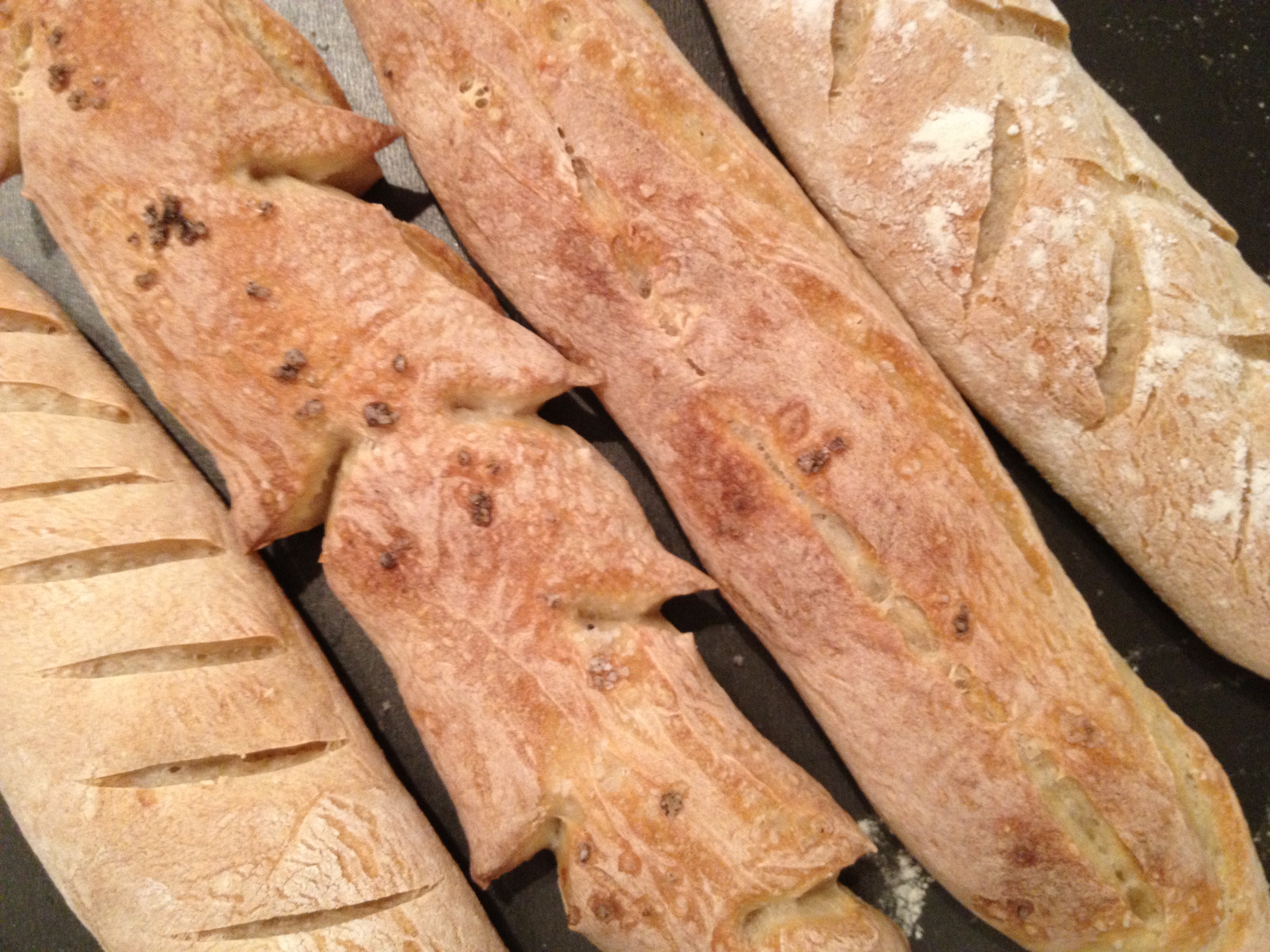
Baguettes I baked in Paris, January 2013

Baguettes I baked in Paris, January 2013

Because I just turned in a 1350-word piece today on Chef Herb Wilson of SushiSamba restaurant in Las Vegas for Style magazine, I’m not feeling especially loquacious this evening, but from what I understand, blogging is like exercise, and once you make some lame excuse to avoid it, it’s all downhill. Accordingly, I’ll point you instead to a fairly long piece I wrote a while ago for the LA Review of Books called “Around the Table,” in which I manifestly did not review a trio of praiseworthy books: The Table Comes First: Family, France, and the Meaning of Food, by Adam Gopnik; Dinner Chez Moi: The Fine Art of Feeding Friends, by Laura Calder; and In The Small Kitchen: 100 Recipes from Our Year of Cooking in the Real World, by Cara Eisenpress and Phoebe Lapine.

Adam Gopnik

Adam Gopnik

Adam Gopnik and I grew up in Philly around the same time, and for some reason that I can’t fathom (unless it’s some combination of talent, luck, drive, and the fact that I spent much of my adult life in what used to be known as the record industry), he has become a fairly famous regular contributor to the New Yorker, while I am writing a after-dinner blog post in my breakfast nook. Like me, he has an abiding love of France — you almost can’t dislike it if you ever visit, and all the advance PR about Parisians being snotty has been, in my experience, just plain untrue.

Laura Calder

Laura Calder

I’d probably be smitten with Laura Calder even if she weren’t such an engaging TV host, cook, and native of New Brunswick, Canada, where I also was born. Her program, irregularly scheduled on the Cooking Channel, is called French Food at Home, and it’s a breezy, fun, entertaining, and informative half hour, fifty of which have made a more or less permanent home on my DVR. This most recent book (Dinner Chez Moi) had been scheduled for an American release last year, and while that somehow that never seemed to happen, it’s readily available on the Amazon.ca site. Her casual style belies the rigorous training she received, not only in a variety of kitchens in France, but also in the Canadian Army (though her food is anything but institutional).

Cara Eisenpress and Phoebe Lapine

Cara Eisenpress and Phoebe Lapine

And finally, Cara Eisenpress and Phoebe Lapine are a pair of “quarter-life” bloggers who turned their website into an Internet sensation and a book. They have an uncommon common touch when it comes to cooking with limited resources (both in terms of space and capital), and their book contains just possibly the Best. Lentil. Recipe. Ever. I wish I’d had their insight — and focus — at their age. Actually, I’d be pretty pleased to have it even now. This is a must-have book for anyone graduating to their first apartment, and who aspire (or ought to aspire) to something more than a life of take-out. It’s practical and fun and full of great ideas for the kitchen and the informal salon that so many of us home cooks wind up hosting.

Howard Johnson's Plate

Howard Johnson’s Plate

Full disclosure: Not long after my piece appeared in the LA Review of Books, I had the opportunity to meet Adam Gopnik, and because both he and I waxed rhapsodically about the joys of Howard Johnson’s in our respective works, I picked up a pair of vintage plates from HoJo’s on eBay and gave him one. The other is in my kitchen, a reminder of two ten-year-olds who grew, each quite happily, in very different directions, but for whom the phrase “28 Flavors” will always evoke a potent memory.

Gluten Allergies — Part in our bodies, part in our minds?

0

no gluten

An interesting post by Alan Levinovitz in the July 9th issue of Slate suggests that the current mania for gluten-free food may spring from a psychological, as well as physiological, condition. Setting aside for the moment the 1.5% or so of the population that has celiac disease or wheat allergies, for which there is medical documentation, I’ve run across a great number of people who say they just feel better on a gluten-free diet.

Quoting from the Slate article, “Scientists are applying themselves to the riddle, and last February Slate’s Darshak Sanghavi reported on an Italian study that confirmed the existence of gluten intolerance (“nonceliac wheat sensitivity”) as a third, “distinct clinical condition.” In the study, one-third of patients who self-identified as gluten intolerant did in fact experience symptom relief after adopting a gluten-free diet. Case closed, right? Pass the gluten-free pasta.

Not so fast. An important implication of the study is that two-thirds of people who think they are gluten intolerant really aren’t. In light of this, the even-handed Sanghavi suggested that “patients convinced they have gluten intolerance might do well to also accept that their self-diagnosis may be wrong.”

The mind is a powerful influence on the way we feel, so even if there is a significant psychological component, that most assuredly doesn’t invalidate the positive effects that many people report when going gluten-free.

You can read the entire article at Hold the MSG.

Thoughts?