Beware the chicken heart! Not.

1
The Deadly Chicken Heart!

The Deadly Chicken Heart!

Seventy-six years ago, the brilliant radio dramatist Arch Oboler wrote a radio play for the NBC series Lights Out called, simply, “Chicken Heart.” The main thrust of the story was that a science experiment had gone terribly, terribly wrong, and what once was a harmless, knuckle-sized, garden variety chicken heart had grown to gargantuan proportions, and was — LUB-DUB, LUB-DUB, LUB-DUB — threatening to take over the world. Good times.

As intended, the story terrified a very young and impressionable Bill Cosby, as well as many others, enough so that the story was repeated the following year and again in 1942. It is still regarded as one of the finest examples of radio drama’s darker side.

I wasn’t around seventy-six years ago, but I was around in 1966, when Cosby described the depth of his dread on the album Wonderfulness. Like most kids in North America, I wasn’t predisposed to eating organ meats anyway, and the now-disgraced comedian’s riff on Oboler’s play gave me one more reason to avoid the deadly chicken heart.

Inside Mitsuwa

Inside Mitsuwa

Jump forward forty-seven years or so, to August of 2013. I happened to be shopping in Mitsuwa Marketplace, an Asian grocery store complex that’s one of my favourite local haunts. Other folks, when they go overseas, visit temples or museums or strip clubs. I visit grocery stores. [Yeah, and temples and museums as well. Strip clubs, not so much.] In between travel jaunts, I try to find the most “foreign” grocery stores I can, preferably ones that don’t have English-speaking help. Mitsuwa is as close as I can get to Japan without going into the Little Tokyo section of downtown LA.

While there, I came across a bottle of yuzu honey. Yuzu, for those of you unfamiliar with it, is an Asian citrus fruit not seen much in the United States except in extracted form, and that generally only in Asian markets. It tastes something like a cross between a lemon, a grapefruit, and a tangerine. It’s really quite a fetching fruit, so I picked up the bottle of “honey” (at $12.99 for 33.86 oz./980g) and tried to figure out what I might do with it. [I put quotes around the word “honey” because its main ingredient is high fructose corn syrup.]

Yuzu Honey

Yuzu Honey

Perhaps because I’d been hankering to visit a (now shuttered) local restaurant called Corazón y Miel (Spanish for “Heart and Honey”), I flashed on the idea of glazing chicken hearts with the yuzu honey. Heck, if the name was good enough to carry a restaurant, it certainly should be able to carry a meal.

This may come as a shock to you, but the Interwebs are not exactly chock-full of chicken heart recipes; nor were any of the cookbooks that were immediately at hand. The best piece of advice I got was that chicken hearts should be cooked either very quickly or very slowly; anywhere in between is likely to result in a tough heart, and who wants that? I did stumble across a blog called Cooking in Sens, which had an interesting recipe for a Chicken Heart and Pepper Stir Fry, and I took some inspiration, if not a recipe, from them.

Yuzu-Glazed Grilled Chicken Hearts

Ingredients
2 dozen or so chicken hearts
1 cup soy sauce (or tamari sauce)
4 cloves garlic, minced
1/2 cup yuzu honey (or honey with a blast of 2-3 tbsp. of some citrus juice, with zest from one lemon or orange)
Kosher salt

Wash chicken hearts, removing as much blood as possible (it is a heart after all). Then trim off the gristle-y bit of connective tissue at the top of the heart (you should NOT remove all the fat). [See picture below.]
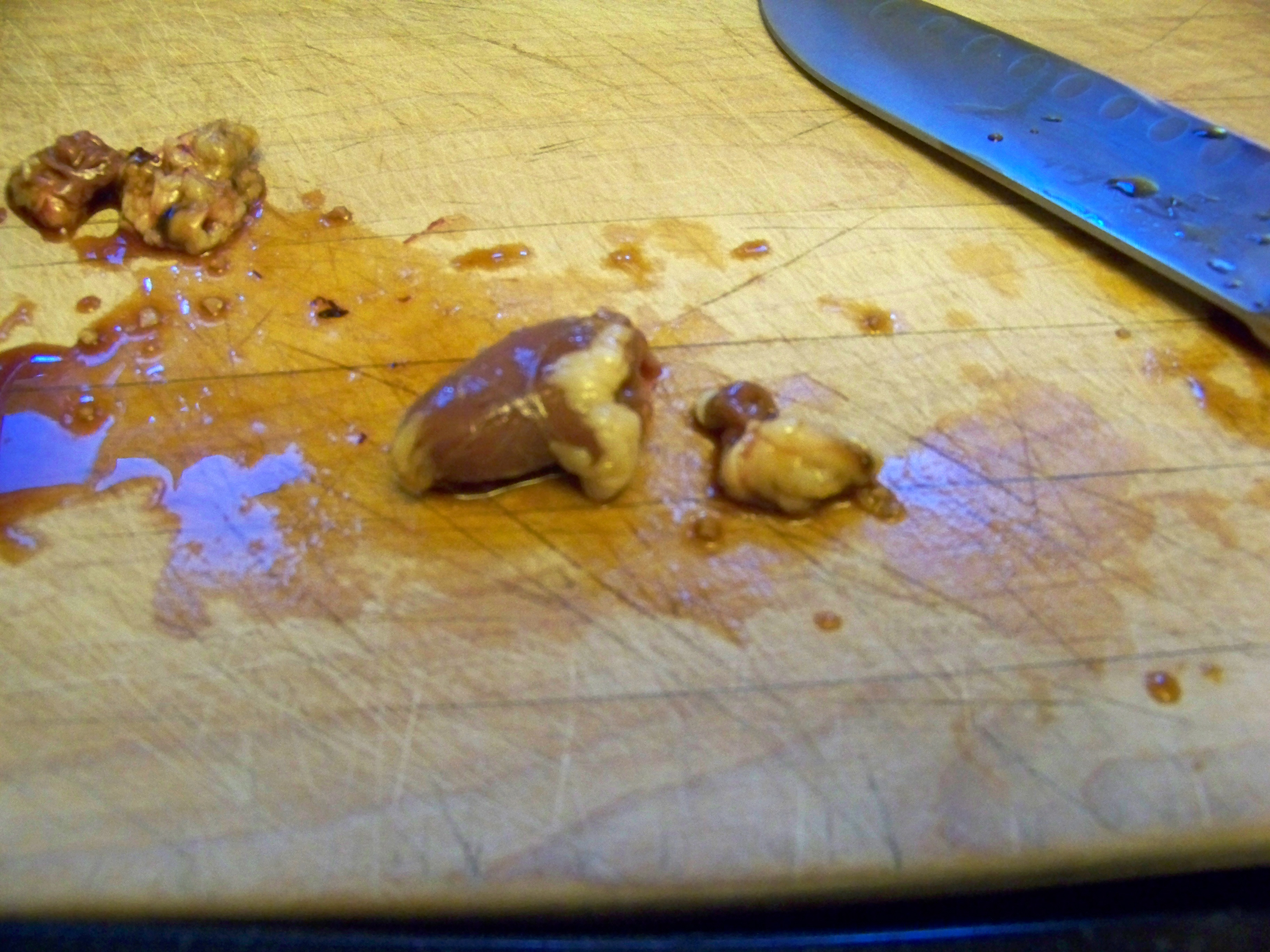
Heart with connective tissue separated. More connective tissue from a previous heart at left.

Heart with connective tissue separated. More connective tissue from a previous heart at left.

Place cleaned chicken hearts, minced garlic, and soy (or tamari) sauce in plastic bag. Seal, and marinate in refrigerator for 30 minutes to 2 hours, depending on the degree to which time is a factor in getting the meal to table.
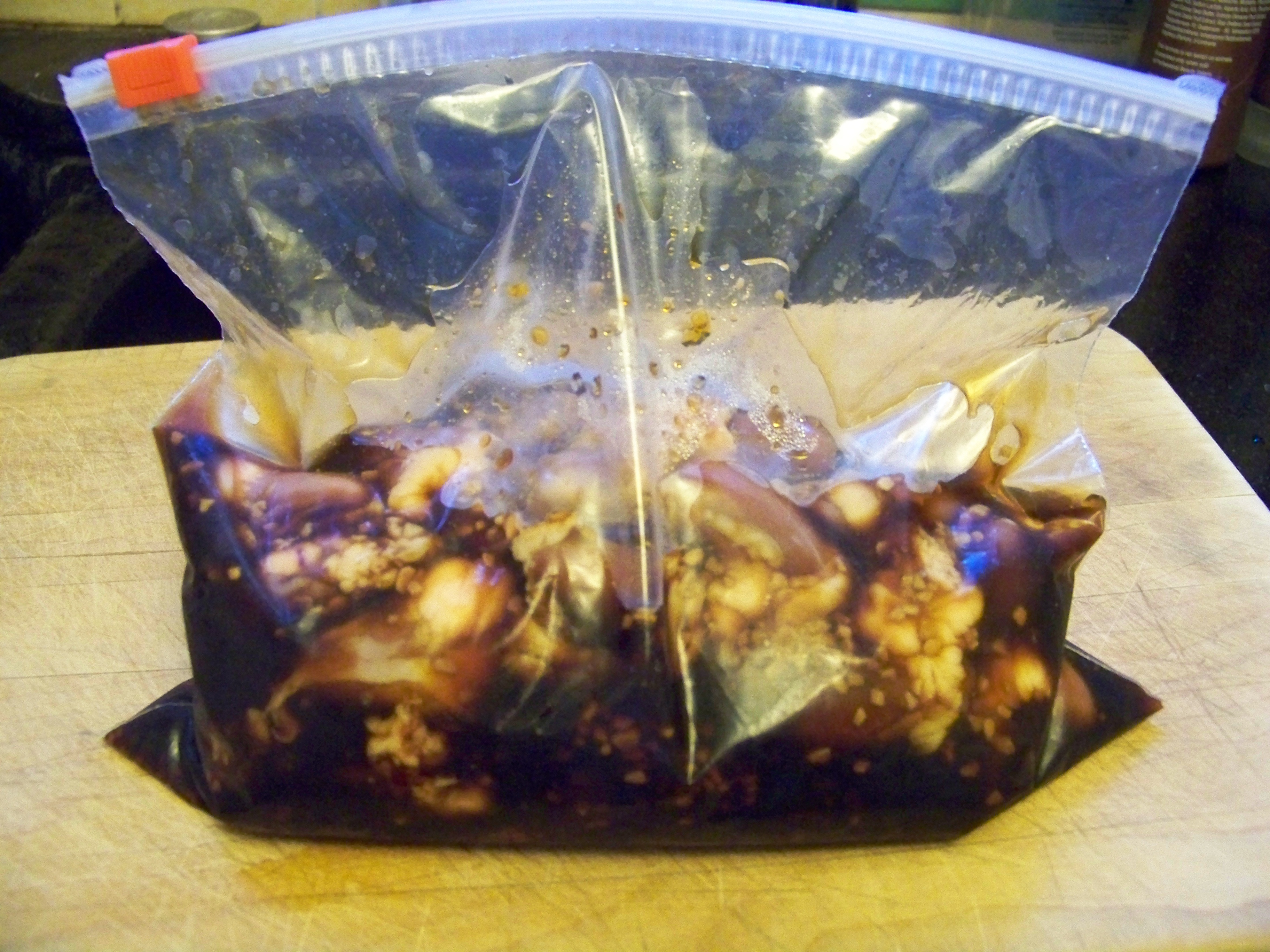
Marinating hearts.

Marinating hearts.

After marinating the hearts, you have a couple of options; you can either pan fry them, or grill them. I chose the grill because my stove top was taken up with rice and stir-fry veggies, so it was an easy choice. Just season them with a little kosher salt and skewer them on either a metal skewer or a pre-soaked bamboo skewer (don’t want it catching fire or turning to ash on the grill). In either event, you’ll want to pre-heat the grill or the oil in the pan.

A quick grill means a tender heart.

A quick grill means a tender heart.

Cook them about two minutes per side, or just as soon as they can be lifted from the grill without sticking. When you first lay them down, brush half the honey on the top side of the hearts; when you turn them over, brush the remaining honey on the now-browned side. After 4-5 minutes (TOTAL!), you can take them off, and they’ll be perfect.

Hearts a-plenty.

Hearts a-plenty.

Because my sous chef was me, I placed the hearts into a 200°F/95°C oven just to keep them warm while I finished off the stir-fry veg and rice. They were in the oven for about 15 minutes or so, to no ill effect. When combined with the rice and veg (which themselves had been augmented by a yuzu seasoning base), they made a — ahem — hearty meal.
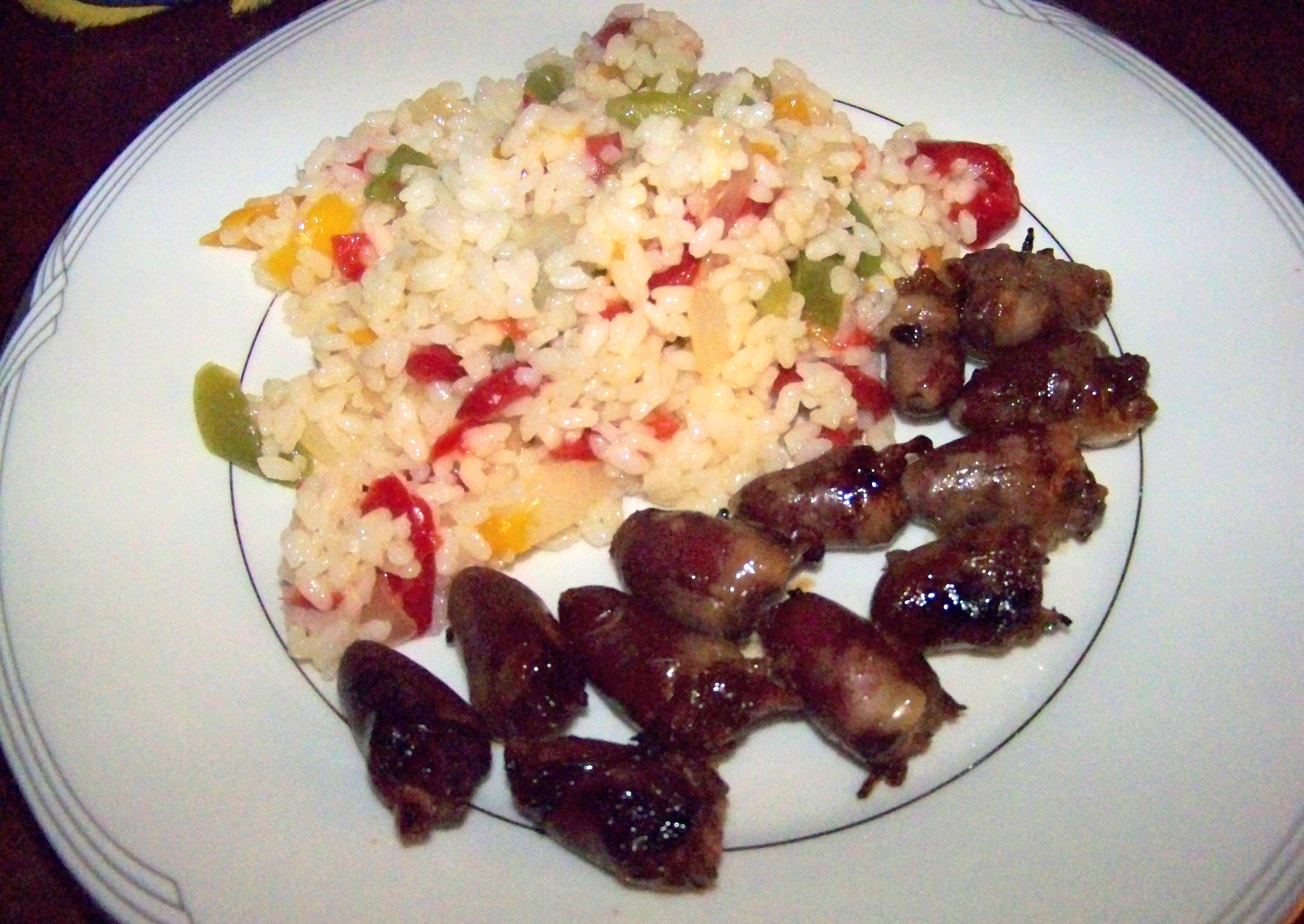
A different way of approaching chicken and rice.

A different way of approaching chicken and rice.

[NOTE: The price on the yuzu seasoning base in the link is confiscatory, and I only put the link in to show you the bottle. It (or something very close) should be available at your local Asian market for something in the neighborhood of three to four dollars or so, if memory serves. For goodness sake, don’t spend $20 on a tiny bottle of yuzu seasoning base. Its ingredients are water, yuzu juice, vinegar, citric acid, orange juice concentrate, evaporated cane juice, yuzu oil, and the ubiquitous “natural flavour.” A little lime juice, vinegar, sugar, and water (with some lime zest, if it’s handy) will work perfectly fine as a substitute.]

Balkanizing My Kitchen, Part two — Ajvar and Pinjur

3
Oops. That's not Ajvar and Pinjur, it's Akbar and Jeff from Life in Hell, with apologies to creator Matt Groening.

Oops. That’s not Ajvar and Pinjur, it’s Akbar and Jeff from Life in Hell, with apologies to creator Matt Groening.

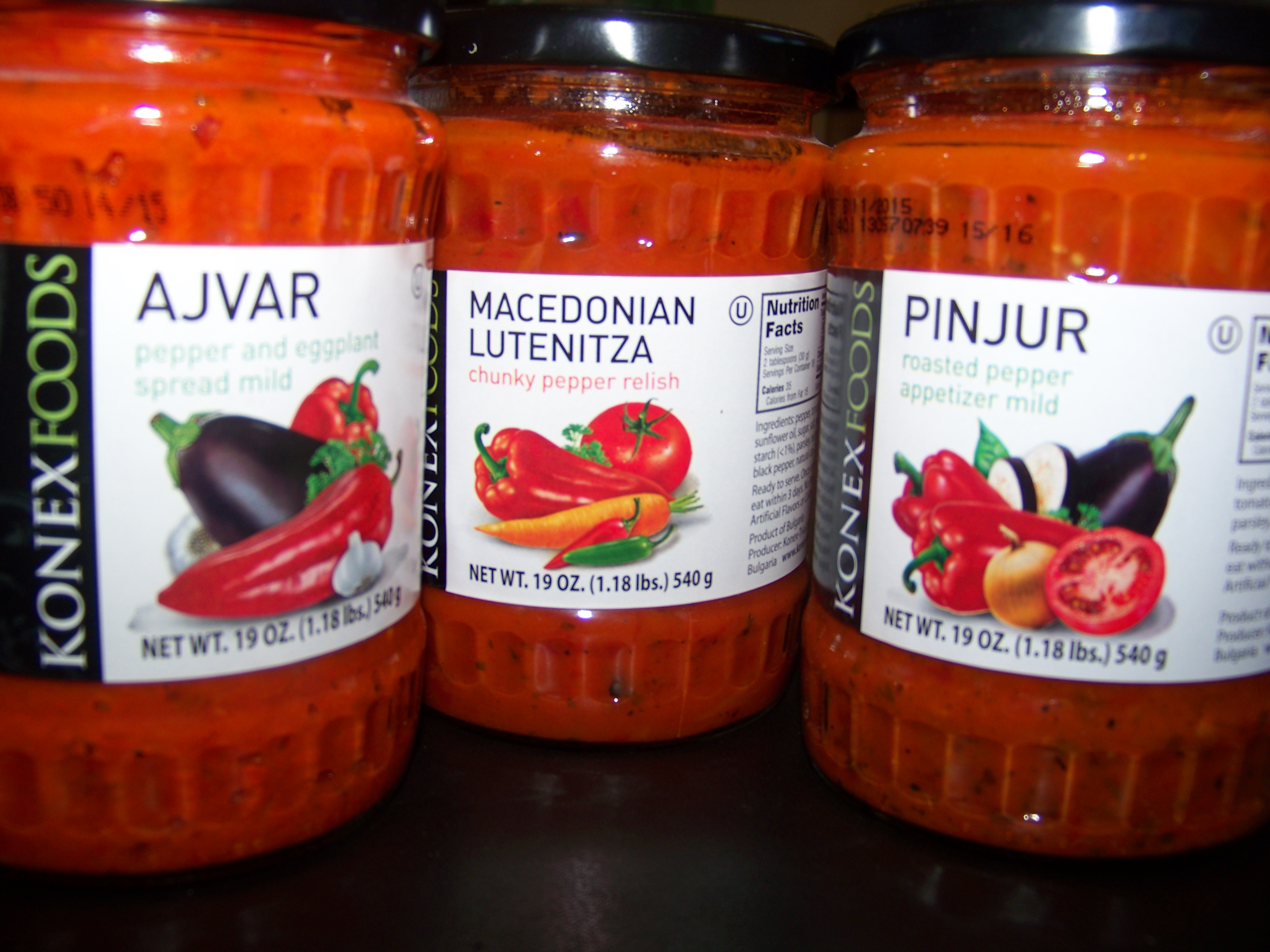
If you happened to see my earlier post on lutenitza, you’ll recall that I promised to return with a further exam of its kissing cousins, ajvar and pinjur. First, let’s have a look at the real deal.

The REAL Ajvar and Pinjur.

The REAL Ajvar and Pinjur.

Although thought to be Serbian in origin, ajvar (pronounced “EYE-var”) is said to have derived its name from the Turkish word havyar, which shares an etymology with “caviar.” [In Russian as well, the word ikra (or икра), can mean both traditional caviar and also a vegetable purée or paté.] It’s made from red peppers, aubergines, garlic, oil, and spices. Both lutenitza and pinjur, which share many ingredients with ajvar, generally include tomatoes, while ajvar does not. Perhaps the most striking difference between ajvar and the other two, though, is its consistency; you can turn a room temperature jar of ajvar upside down without spilling its contents. Pinjur and lutenitza, not so much. Depending on the recipe, ajvar may be made with smoked or roasted peppers or not; in this bottled version, the peppers are not roasted, giving it a lighter, brighter flavour than either the pinjur or the lutenitza.

The FatFree Vegan Kitchen blog has an excellent (and quite healthy) recipe for homemade ajvar, as does the Kitchen Window blog at NPR (where they dub the dish “Serbian Salsa“). In both cases, these recipes opt for roasting the red peppers.

Pinjur (also known as pindur, pindjur, pindzur, and pinđur) is widely available throughout Serbia, Bosnia, Herzegovina, Bulgaria, and Macedonia. Just in case you’re unclear on just where all these places are, here’s a map.

For the geographically challenged, this is where ajvar and pinjur come from. Photo courtesy Univ. of Texas Library.

For the geographically challenged, this is where ajvar and pinjur come from. Photo courtesy Univ. of Texas Library.

Unlike ajvar, which is more of a spread, pinjur (pronounced “PEEN-jur”) resembles a salsa or sauce. And, like salsas and sauces, it comes in a fairly wide variety of styles. It’s generally characterized as being an aubergine (eggplant)-based sauce/relish, rather than a roasted pepper sauce/relish, even though lutenitza generally contains aubergines, and pinjur generally contains roasted peppers. Confusing, ain’t it? In my limited experience so far, lutenitza is a little spicier than pinjur, but there are so many variants on the recipes, it would be impossible to make a generalization that really sticks. Dealer’s choice here.

Both pinjur and lutenitza are terrific mixed in with rice, ladled over vegetables or meat, or as a dip for chips; they can be served either warm or at room temperature. Both are gluten-free and vegan (as is ajvar), and they’re all a great way of dealing with the overabundance of vegetables from the summer garden, offering a tasty treat for home canning enthusiasts well into the winter months… provided you can wait that long to break into those jars.

The Food Network’s UK website has a tomato and pepper-free recipe for pinjur that relies heavily on aubergine for its base, but if you want something closer to the commercially available versions, you can opt for this recipe from the Healthy Food Base blog.

As the Macedonians would say, “Cреќен јадење!” [transliteration: “Sreḱen Jadenje!”] [translation: “Happy eating!”]

Balkanizing My Kitchen, Part one — Lutenitza

2
Three tasty pepper-derived foodstuffs.

Three tasty pepper-derived foodstuffs.

Not to worry: my kitchen has not split into warring factions. I just happened to be at Big Lots! [or, as some stores’ signage reads, Big! Lots (formerly Pic ‘N’ Save)] earlier today, poking around to see if they had any more jars of Macedonian Lutenitza, as one often does on a Tuesday. And that’s when it happened.

Let me back up a minute. Back in the ’50s, in Culver City, California (not far from where I live), a guy named William Zimmerman put together a chain of stores that specialized in overruns and closeouts, and called it Pic ‘N’ Save. Later, as the chain expanded — overexpanded, as it turns out — they redubbed themselves MacFrugal’s, and were purchased in 2002 by Consolidated Stores Corp., who converted the locations they kept open to their pre-existing brand, Big Lots! (and ultimately renamed the entire business Big Lots, Inc., which currently trades on the NYSE with the symbol BIG). While most of the merchandise in these stores is off-brand or otherwise out of favour (see picture below), they occasionally bring in weird little items that magically appear — and then just as magically disappear. So it was with my introduction to Macedonian Lutenitza.

Get 'em while they're not hot.

Get ’em while they’re not hot.

Lutenitza (also known variously as ljutenica, lyutenitsa, or lutenica, plus a dazzling variety of Cyrillic-alphabet spellings) is a type of salsa/sauce/relish widely made throughout Bulgaria, Serbia, and Macedonia. Its basic ingredients are tomatoes, red peppers, aubergines (eggplant), vegetable oil, sugar, and salt, though variants also contain onions, carrots, garlic, and black pepper, among other things. Like salsa, everybody’s grandmother makes “the best,” and family recipes are handed down as prized possessions. I’m sure my Bulgarian friends — if I had any — would blanch at the idea of buying commercial lutenitza, but heck, I didn’t even know about it until a week ago. [Note to self: Make some Bulgarian friends.]

For the geographically challenged, this is where lutenitza comes from. Photo courtesy Univ. of Texas Library.

For the geographically challenged, this is where lutenitza comes from. Photo courtesy Univ. of Texas Library.

While lutenitza itself is entirely vegan, it’s served on meats, fish, breads, roasted vegetables, French fries, and pretty much anything that doesn’t move. Some versions are apparently hotter than others, but if you make your own — which I’m guessing you’ll probably have to do, unless you have a Balkan grocery (or Big Lots!) in your area — you can adjust spices to taste. This recipe, courtesy of rhubarbfool.co.uk, looks like it would match up pretty closely to the one in the bottle I have, except it would seem that this commercial version has upped the pepper and carrot content in favour of using aubergine, and he uses olive oil rather than a more neutral one such as canola.

Lutenitza Serving Suggestion, courtesy http://www.mucizelezzetler.com

Lutenitza Serving Suggestion, courtesy http://www.mucizelezzetler.com

Lutenitza –- Bulgarian Vegetable Relish

Ingredients

2 medium carrots, peeled and diced
1 onion, diced
1 medium aubergine, diced
2 tablespoons olive oil
3 large roasted red peppers, skin and seeds removed and then diced
1 400g (14 oz.) can chopped tomatoes
1 tablespoon sweet paprika
1 teaspoon dried thyme (or summer savory if you have it)
2 tablespoons sugar
salt and pepper to taste

Take a medium sized saucepan and fry the onions, carrots and aubergines in the olive oil until soft. Add the red peppers and fry for a further 2-3 minutes. Add the tomatoes and seasoning, bring to the boil and simmer for 10 minutes. Add a little water if the mixture seems too dry. Mash some of the mixture using a potato masher. You are aiming for a thick ratatouille type texture. Spoon into a clean preserving jar, cool, seal and refrigerate. Makes about 1 kg/2 lb.

If, however, you plan on making it the old fashioned way — which is to say in bulk to put up for winter — this video, which calls for an astonishing 8kg (nearly 18 lbs.) of tomatoes, might serve you better, as might this video, featuring the “Sexy Chef,” Liz Todorova.

More on lutenitza’s cousins, ajvar and pinjur, in a later post. Do come back.

Une fleur pour le dîner

1
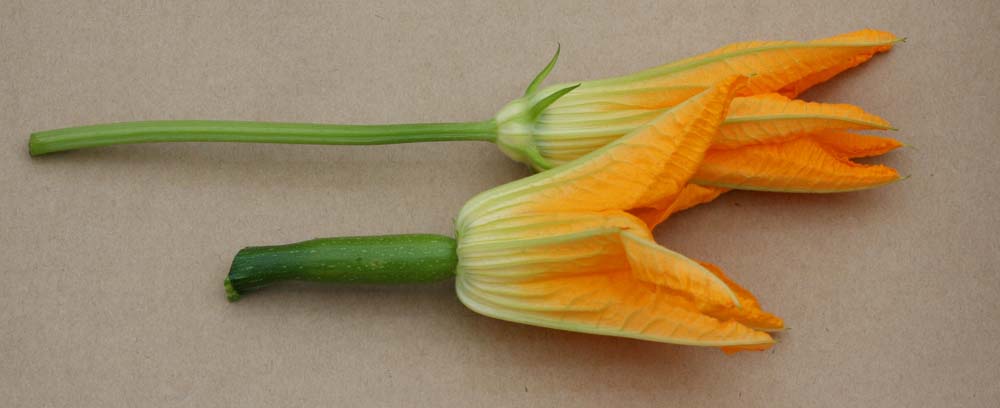
Male and Female Squash Blossoms -- photo courtesy http://www.gardenwisdom.ca

Male and Female Squash Blossoms — photo courtesy http://www.gardenwisdom.ca

Yesterday, while The Bride was having an excess piece of bone excised from her foot, I whiled away the time by visiting the Santa Monica Farmers Market. Lured by the siren song of fresh aubergines and oh-so-ripe peaches, I stumbled upon a couple of stalls that featured squash blossoms, a short-season summer treat. Normally, I stuff them with goat cheese, batter them, and pan fry them; I was keen to try the Cup4Cup gluten-free flour on my longtime fave. As it turned out, The Bride offered up an equally enticing competitive idea. Guided by Mae West’s belief that “between two evils, I always pick the one I never tried before,” I opted for the new recipe (not that either recipe is evil).

Ricotta-Stuffed Squash Blossoms with Tomato Vinaigrette
Recipe adapted from Chi Spacca, Los Angeles, Calif. and reblogged from www.purewow.com

Makes 10 squash blossoms (plus about 3/4 cup vinaigrette)
Start to Finish: 25 minutes

Ingredients

Tomato Vinaigrette

Tomato vinaigrette.

Tomato vinaigrette.


¼ cup cherry tomatoes, halved
¼ cup red wine vinegar (I used white Champagne vinegar, which worked fine)
½ cup extra-virgin olive oil
Kosher salt

Ricotta-Stuffed Squash Blossoms

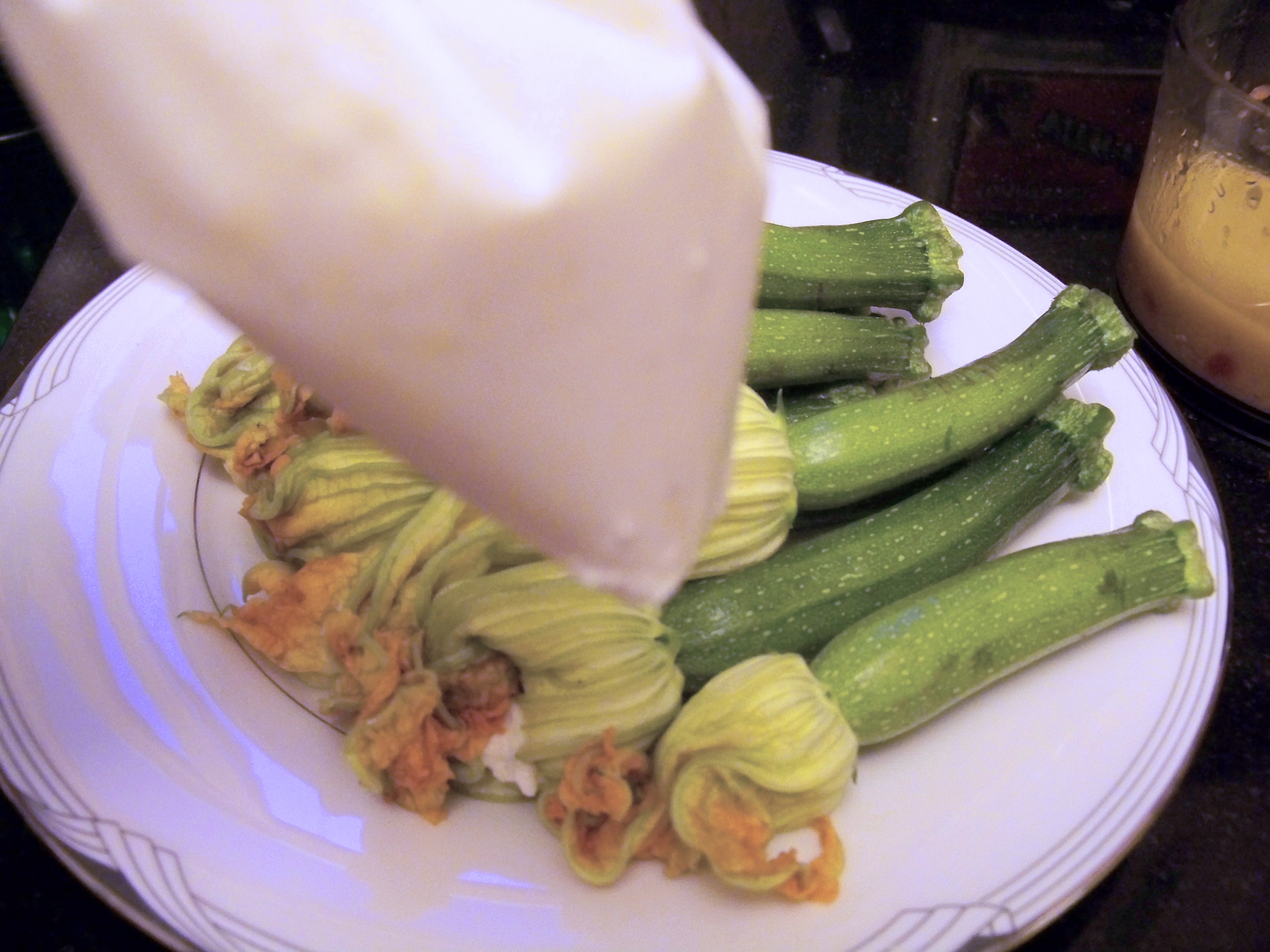
Piping bag and squash blossoms.

Piping bag and squash blossoms.


½ cup ricotta
1 tablespoon finely grated Parmesan cheese (I went with about 3 tbsp., which is more to my taste)
2 tablespoons heavy cream (I substituted sour cream and a splash of water; maybe a teaspoon)
Kosher salt
10 large squash blossoms, stems trimmed and stamens removed
Extra-virgin olive oil, for drizzling
Freshly ground black pepper
Basil leaves, for garnish

Directions

1. Make the vinaigrette: In the bowl of a food processor, combine the tomatoes with the vinegar and pulse to combine. With the motor running, slowly drizzle in the olive oil until combined. Season to taste with salt and set aside. [TOTT note: I just put it all in together and pulsed until I got it where I wanted it to be; because I was using a stick blender and bowl attachment, the “drizzling in” bit wasn’t really an option. Worked superbly, and it meant I didn’t have to assemble and clean the big honking Cuisinart.]

2. Make the squash blossoms: Preheat the oven to 350˚. In a medium bowl, mix the ricotta with the Parmesan and cream until just combined. Season the mixture to taste with salt. Transfer the mixture to a piping bag or large Ziplock bag with a small piece of the corner cut off.

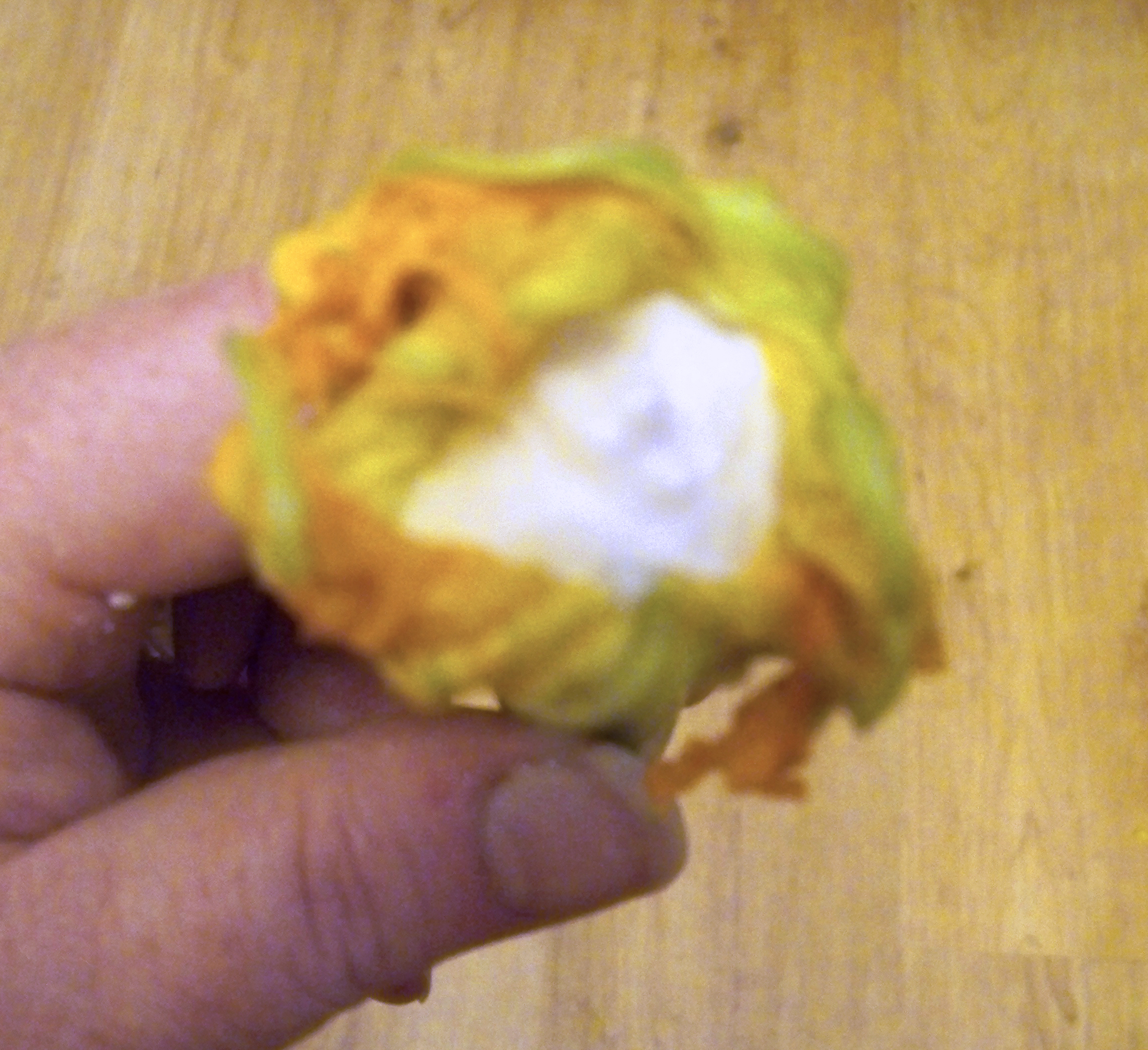
Stuffed blossom, not yet tied.

Stuffed blossom, not yet tied.

Stuffed blossom, tied.

Stuffed blossom, tied.

3. Working with one squash blossom at a time, fill the interior cavity of the blossoms with the ricotta mixture until three-quarters full. Twist the petals gently to seal. (Depending on the size of your blossoms, you may have leftover filling.) Arrange the filled blossoms on a small baking sheet, drizzle with extra-virgin olive oil and season with salt and pepper. Bake the squash blossoms for 2 minutes [TOTT Note: Because I was using the female blossoms, I left them in for about 5-6 minutes.] or until just warmed through.

Ready for the oven.

Ready for the oven.

4. Meanwhile, in a small saucepan set over medium heat, simmer the reserved vinaigrette until warmed through, about 3 minutes, and remove from the heat. [TOTT Note: I thought this was too much of a pain in the ass, so I just transferred the vinaigrette to a microwave-safe bowl and zapped it for 30 seconds on high.]

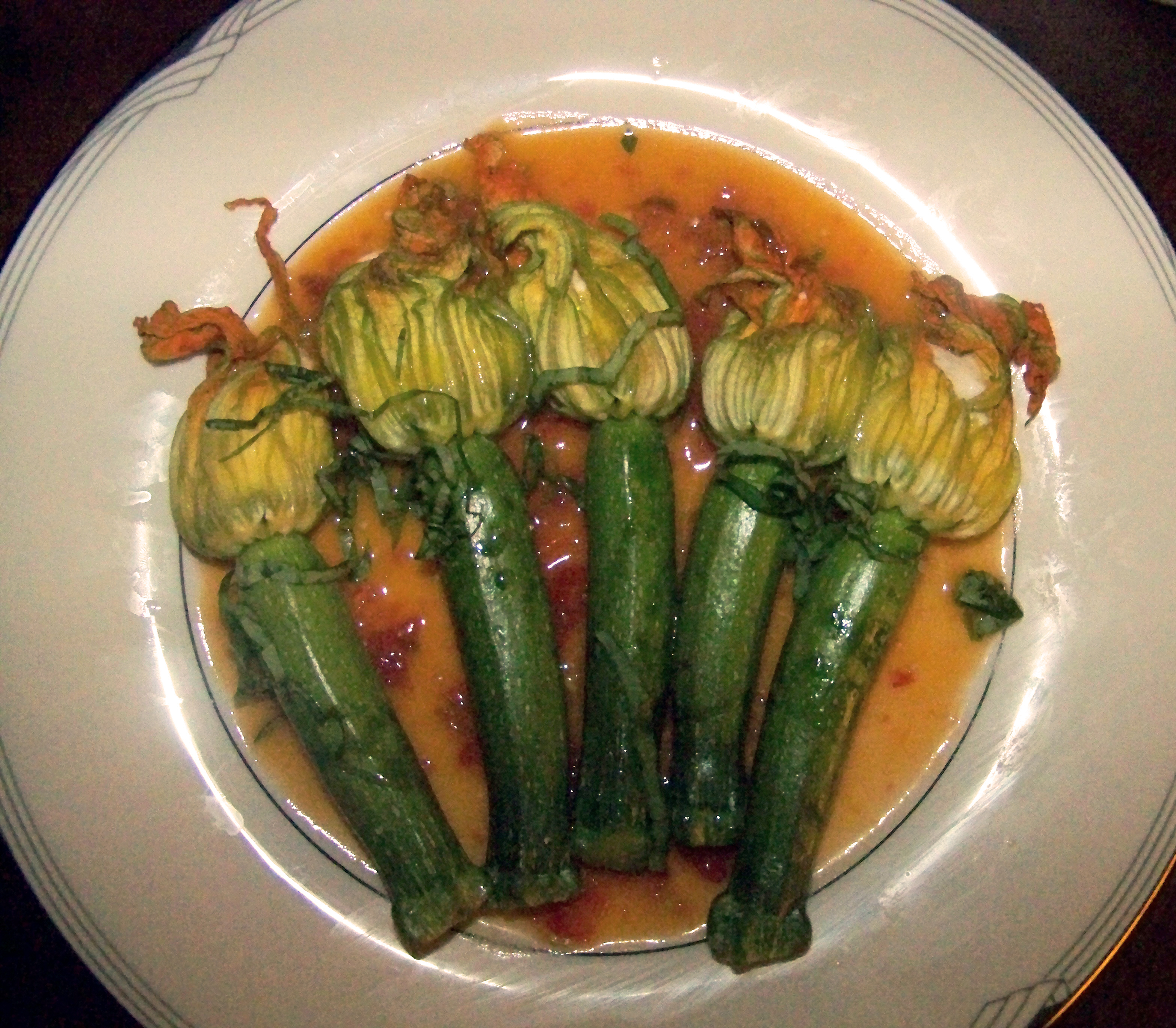
5. Cover the bottom of a large platter [or your serving plate] with a thin layer of the vinaigrette. (Reserve the remaining vinaigrette for another use.) Arrange the squash blossoms on top of the vinaigrette and garnish with the basil leaves. Serve immediately.

Dinner is served.

Dinner is served.

Shameless repurposing, part two — My Dream Date with Emeril

0

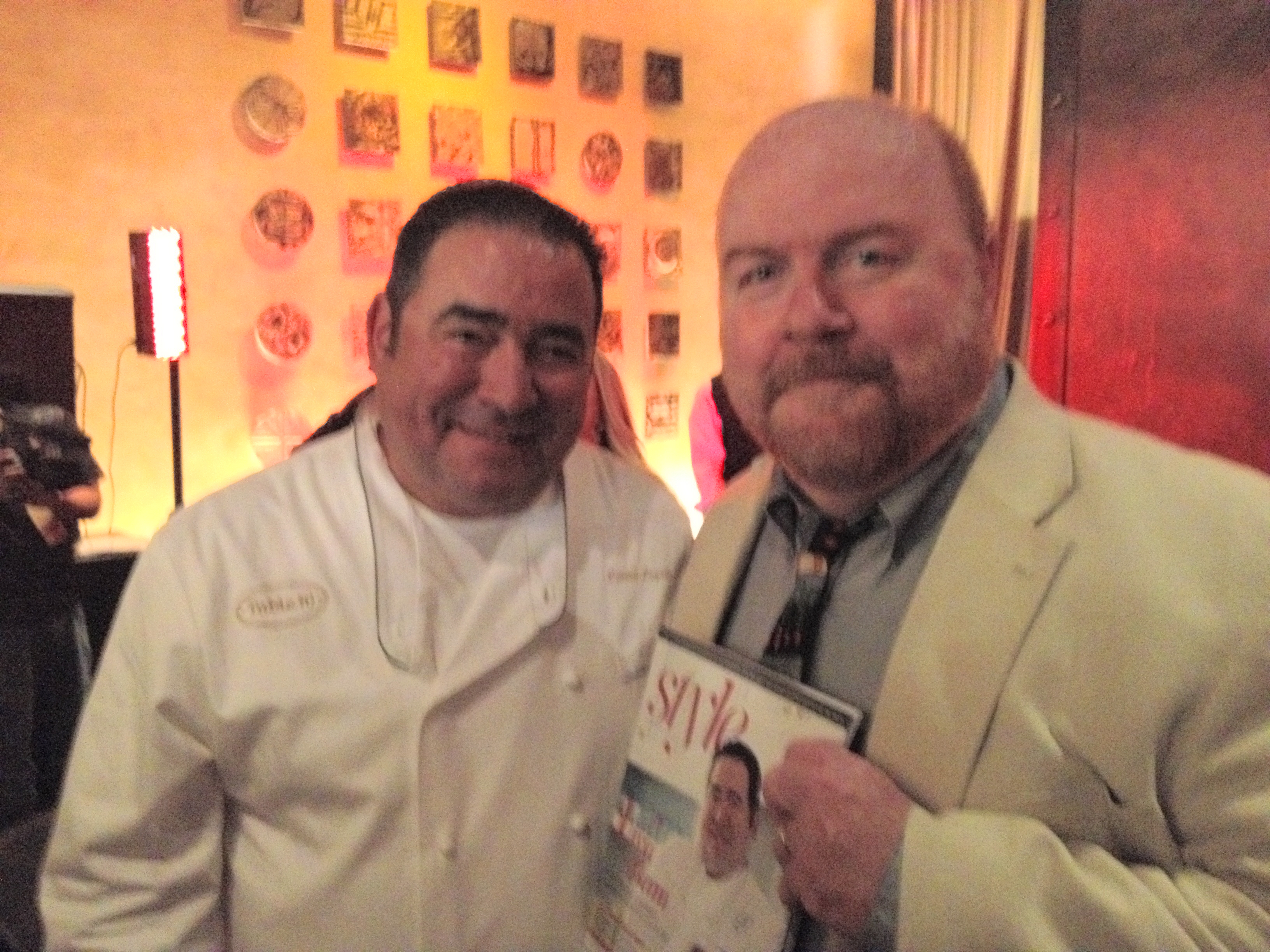
Emeril and Thane

Last summer, I was contacted by the American editor of Style magazine (then Sands Style) to see if I would like to interview Chef Emeril Lagasse for the relaunch of the magazine. Like every cooking fan in America, I’d seen Emeril a gazillion times; unlike many cooking fans, I’ve eaten at one of his restaurants in New Orleans. Naturally, I agreed.

Despite his fireplug stature, Lagasse looms larger than life in virtually ever aspect of his being. He is immediately gregarious and extraordinarily self-effacing. He’s passionate about food. He loves to teach and to share what he’s learned. And he is remarkably generous in spirit.

Here’s a story that didn’t make it into the piece I had published: Part of the craft of managing a celebrity interview is figuring out what to ask him or her first. Way back when I was in college, my brilliant journalism spirit guide, Joseph N. Bell — a lecturer, because he was a working stiff, not an ivy-clad professor — told his class that something like 75-80% of one’s energy prepping for an interview should be devoted to formulating the first question. Famous (and even semi-famous) people are subjected to an endless parade of clueless journos who haven’t read their book or seen their movie or listened to their record, who inevitably kick off the interview with some slow-pitch softball such as “So… what inspired you to _____?” B-o-r-i-n-g. Shockingly, the rest of that sort of interview winds up with a lifeless string of canned answers to the canned questions.

The night before I was to chat with Chef Lagasse, The Bride suggested I might mention a shrimp and grits recipe she’d had at NOLA several years back, and for which she desired the recipe. “Excellent!” I thought. “Here’s a way under his radar.”

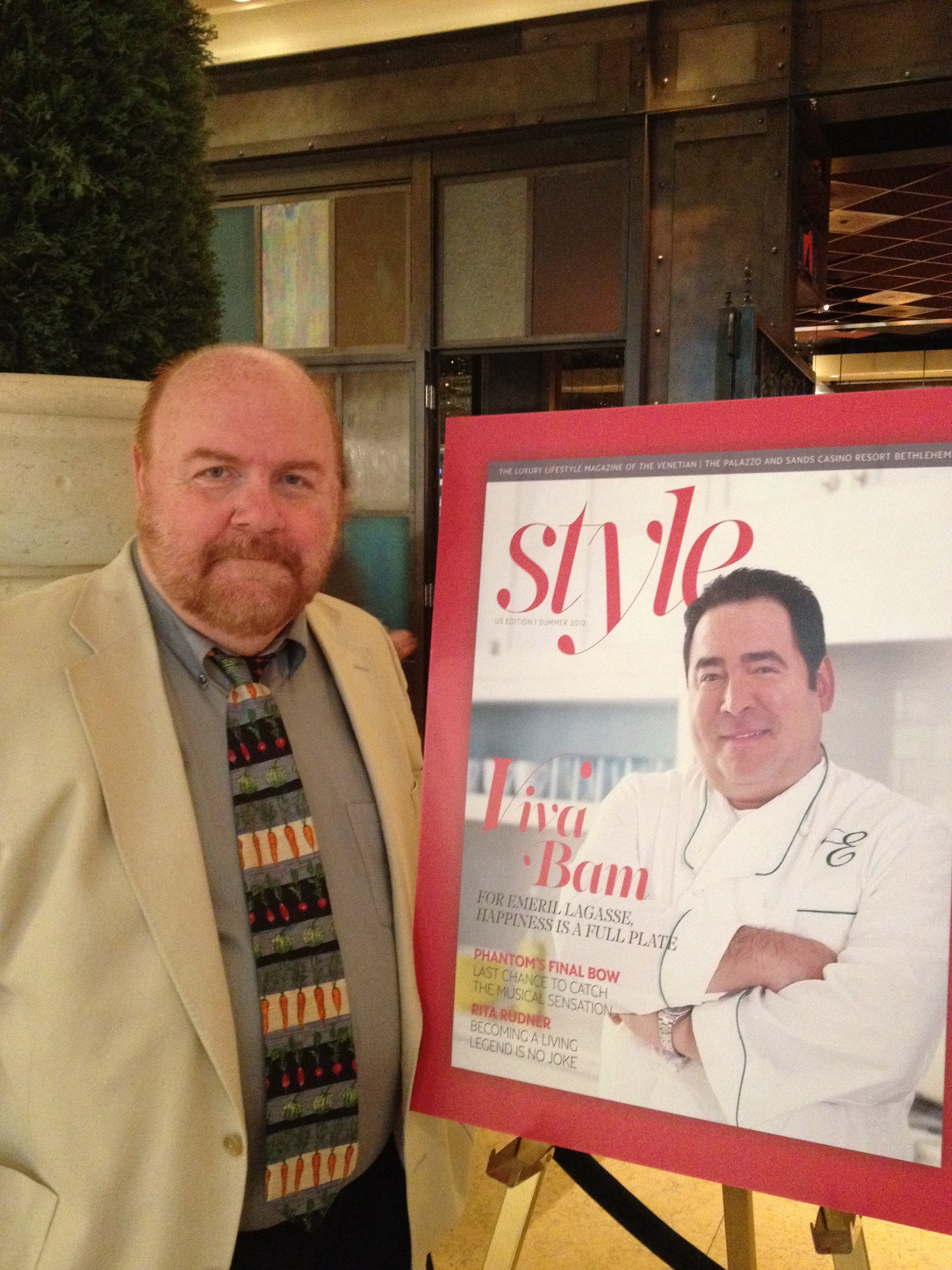
The cover, larger than life. The pic of Emeril, not so much.

The cover, larger than life. The pic of Emeril, not so much.

Our phoner kicked off with the typical pleasantries; underneath it all, I’m sure he was probing to see if I was actually interested in and/or knowledgeable of what he was doing, and I was curious to ascertain whether he was full of camaraderie when the red light was on, only to turn cold as a fish case haddock in its absence. As luck would have it, the two of us fell into sync more or less immediately. Even without asking, when I relayed the story of The Bride and The Grits, he responded with, “I’ll be happy to send you the recipe.” Within an hour of our interview’s conclusion, he (or one of his minions, at his direction) had.

Like most celebrated chefs, Lagasse had served his Malcolm Gladwell 10,000 hour apprenticeship many times over. And, like virtually all of the chefs I’ve had the pleasure of interviewing, he was generous to a fault regarding his team. Many of Emeril’s krewe have been soldiering on with him in excess of a decade (some even two!), a surprising display of loyalty considering the fluidity of movement in the world of haute cuisine. Clearly, the man is doing something right.

Some time after the story was filed, my editor invited me to the magazine’s relaunch in Las Vegas. The Bride and I made the pilgrimage, given that the magazine was kind enough to comp our hotel room. Emeril was just as engaging in person as he had been over the phone, and — ever the businessman — he asked his assistant to jot down my contact info, should we be of some mutual benefit sometime in the future. Fair play, that. I hope our paths cross again, even if just to hear him say “BAM!”

Every now and then, we all aspire to kick it up a notch.

Here’s a link to the article.

And this is the shrimp and grits recipe that kicked off our conversation:

As prepared family-style.

As prepared family-style.

NOLA’S SHRIMP AND SMOKED CHEDDAR GRITS
Recipe from NOLA Restaurant by Emeril Lagasse.

For the Shrimp:

Ingredients

2 pounds medium shrimp, peeled and deveined
2 1/2 teaspoons Emeril’s Original Essence, recipe follows
3/4 teaspoons salt
2 tablespoons olive oil
4 tablespoons butter, room temperature
1 recipe Smoked Cheddar Grits, recipe follows
1 recipe Citrus Buerre Blanc, recipe follows
1 recipe Abita BBQ Glaze, recipe follows
1 recipe Smoked Cremini Mushrooms and Rendered Bacon, recipe follows
1 recipe Grilled Green Onions, recipe follows

Instructions

In a large bowl, combine the shrimp with the Essence and salt and toss to blend. Set aside as you prepare the skillet. Place a large, 14-inch skillet over high heat and add the olive oil and heat until very hot. Add 1 tablespoon of the butter to the pan. Swirl to melt, then add the shrimp to the pan, being sure that the shrimp are in one layer in the pan. Sear the shrimp until well caramelized on the first side, about 1 minute. Turn the shrimp over and add the smoked mushrooms, bacon and Abita BBQ Glaze to the pan. Continue to cook, stirring occasionally, until the shrimp are well coated with the sauce and just cooked through, about 3 minutes. Add the remaining butter to the pan and swirl until melted into the sauce.

To serve, divide the grits between 8 entrée-sized shallow bowls. Drizzle about 2 tablespoons of the Citrus Beurre Blanc around the edge of the grits near the rim of the bowl. Divide the shrimp, mushrooms, bacon and sauce evenly between the bowls, and place a grilled green onion on top of the grits in a circle. Serve immediately.

Makes 8 entrée servings

For the Emeril’s Original Essence:

Ingredients

2 1/2 tablespoons paprika
2 tablespoons salt
2 tablespoons garlic powder
1 tablespoon black pepper
1 tablespoon onion powder
1 tablespoon cayenne pepper
1 tablespoon dried oregano
1 tablespoon dried thyme

Instructions

Combine all ingredients thoroughly. Makes 2/3 cup

For the Smoked Cheddar Grits:

Ingredients

6 cups water
Salt, to taste
1 1/2 cups quick cooking or old-fashioned grits (not instant!)
1 cup milk
1 cup heavy cream
4 tablespoons butter
6 ounces grated smoked white cheddar cheese
Freshly ground black pepper, to taste

Instructions

In a large, heavy saucepan bring the water to a boil. Add a generous teaspoon of salt and the grits and stir with a wooden spoon to combine. When grits thicken, add the milk, cream and butter and return to a boil. Reduce heat to a simmer, partially cover the sauce pan and cook for 45 minutes to one hour, until grits are very tender, smooth, and creamy-thick. Add the cheddar, season with black pepper, and stir until cheese is melted. Serve hot.

Makes almost 2 quarts

For the Citrus Beurre Blanc:

Ingredients

1/2 cup fresh squeezed orange juice
1/2 cup dry white wine
1/4 cup fresh squeezed lemon juice
1/4 cup fresh squeezed lime juice
1/4 cup thinly sliced shallots
1 2-inch strip orange zest
1 2-inch strip lemon zest
1 2-inch strip lime zest
1 garlic clove, smashed
1/2 bay leaf
1 sprig of thyme
1/2 teaspoon salt
1/2 teaspoon black peppercorns
1/3 cup heavy cream
2 sticks cold unsalted butter, cubed

Instructions

Place all the ingredients except the heavy cream and butter in a 1-quart saucepan and place over high heat. Bring to a boil and reduce until the liquid is nearly evaporated, 12 to 14 minutes. Add the heavy cream to the pan and reduce by half, 1 to 2 minutes. Remove the pan from the heat and reduce the temperature to medium low. Add a few cubes of the butter to the pan and use a whisk to stir constantly until the butter is melted. Return to the heat and add a few more pieces. Continue to place the pan on and off the heat, adding a few cubes of butter to the pan and whisking until all the butter is used. Remove the sauce from the heat and strain through a fine-mesh strainer. Keep warm until ready to serve – do not allow the sauce to boil or it will separate.

Makes about 1 1/4 cups

For the Abita BBQ Glaze:

Ingredients

1 cup ketchup
1 cup Abita amber beer
6 tablespoons packed light brown sugar
1 1/2 teaspoons crushed red pepper

Instructions

Combine the ketchup, beer, brown sugar and crushed red pepper in a saucepan and bring to a boil. Reduce heat slightly and continue to cook at a steady simmer until the sauce is translucent and reduces to a consistency thick enough to coat the back of a spoon, 5 to 10 minutes. Set aside. You should have about 1 1/4 cups of glaze.

Makes 1 1/4 cups

For the Smoked Cremini Mushrooms and Rendered Bacon:

Ingredients

3/4 pound cremini mushrooms, halved, or quartered if large
1 1/2 teaspoons Essence
4 teaspoons olive oil
1/2 pound bacon, diced

Instructions

In a medium bowl, combine the mushrooms, Essence and olive oil. Toss to combine and place on the rack of a stovetop smoker. Prepare the smoker over medium-high heat using applewood smoking dust, or the smoke chips of your choice. When the smoker begins to smoke, close the lid. Smoke the mushrooms until cooked through, about 20 to 25 minutes. Remove from the smoker and set aside until ready to use.

While the mushrooms smoke, place the bacon in a 10-inch sauté pan over medium-low heat and render the fat from them until they are just beginning to get crispy, 10 to 12 minutes. Remove the bacon from the pan using a slotted spoon and transfer to paper towels to drain. Set aside until ready to use.

For the Grilled Green Onions:

Ingredients

8 green onions, root end and tips trimmed
4 teaspoons olive oil
1/2 teaspoon salt
1/4 teaspoon white pepper

Instructions

Place a grill pan over medium-high heat. Drizzle the green onions with the olive oil and season with the salt and pepper. Place the green onions on the grill and cook for 2-3 minutes, turning occasionally to ensure even browning. Remove the green onions from the heat and set aside as you prepare the rest of the dish.

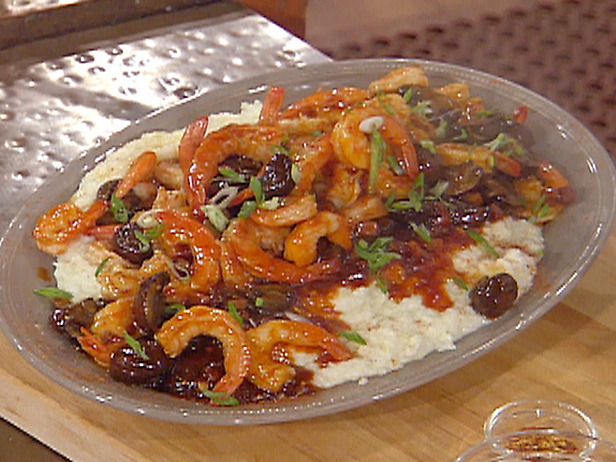
As served at NOLA.

As served at NOLA.

Super fast, super easy, super tasty summer salad

1
Tomato Watermelon Basil Salad

Tomato Watermelon Basil Salad

It’s hot. It’s muggy. It’s summer. Who wants to stand over the stove for an hour or two to make a nice risotto? Not me, that’s for doggone sure. Instead, here’s a no-bake, so-simple-a-kid-could-assemble-it dish magnificently suited for a summer weeknight. I first tasted a version of this at Church & State bistro in downtown Los Angeles, and I was hooked.

TOMATO WATERMELON BASIL SALAD
INGREDIENTS
3 pounds or so seedless watermelon, diced
1 package cherry or grape tomatoes, sliced (12 oz. or more)
4-5 sprigs of basil leaves, chopped or chiffonaded
3-4 tablespoons of balsamic vinegar (or other wine/champagne vinegar) to taste
1-2 tablespoons olive oil
Kosher salt to taste

Slice and dice half a seedless watermelon (or an entire “personal size” watermelon, should you have one), chop up a fistful of fresh basil, take a 12 oz. container (or about 1.5 – 2 cups) of cherry or grape tomatoes and slice them in half, add about 3 – 4 tablespoons of balsamic vinegar and 1 -2 tablespoons of olive oil. Toss together in a bowl, allow the dish to chill for half an hour (or not), and have at it. Sprinkle just a tiny bit of kosher salt on each portion before serving.

For an interesting variation on this recipe, substitute chopped mint for basil.

As you can see from the photo, this salad pairs nicely with Pine Ridge’s Chenin Blanc/Viognier blend, as well as Ironstone Vineyards’ Obsession Symphony.

Santa Fe Sunrise

0

100_4204

The Bride and I, a couple of decades ago, opted for Santa Fe as our honeymoon destination. Practically nothing outside Guantánamo screamed “honeymoon” less to me than Santa Fe — going to the desert in the middle of summer seemed unpalatable in the extreme — but it’s always been a good policy for me to pay attention to The Bride’s desires (as evidenced by the fact that, decades later, she’s still The Bride). As it turned out, the greater Santa Fe area is gorgeous, and our day runs out to several of the Northern Pueblos were both charming and informative. [And when I think of it, Houston in the summer makes Guantánamo seem like Ibiza by comparison, so please disregard my previous knock on Santa Fe.]

100_4202

The cuisine was something of an eye-opener as well, from Cindy’s Santa Fe Bite-Size Bakery’s addictive chocolate pepper cookies to the local sparkling wine, Gruet. We were served a complimentary glass — one of the many perks of being on one’s honeymoon — and we drank it with some hesitancy at first. New Mexican sparkling wine? Seriously? Turns out that the Gruet family, which had been making sparkling wine in France since 1952, was on vacation in New Mexico in 1983, and decided to put down roots and make both sparkling and still wines south of Albuquerque. Quite frequently, we serve it to our friends, introducing it to newbies with the phrase, “How about some refreshing New Mexican sparkling wine,” just so we can see the look of shock and horror in their eyes. It never gets old. Really.

But I digress.

One day, as I was idly wandering the Interwebs, I came across a blog titled The Domestic Mama & The Village Cook, which featured a dish called “Idaho Sunrise,” which was apparently originally adapted from a recipe featured in Marion Cunningham’s The Supper Book. Basically, it’s a twice-baked potato with an egg on top, stuffed with mashed potato and bacon and chives.

As usual, I decided to tinker with the recipe to suit my palate, and came up with something I like to call the “Santa Fe Sunrise.”

Santa Fe Sunrise

Santa Fe Sunrise

SANTA FE SUNRISE (makes 4)
Ingredients
4 previously baked potatoes
4 tbs butter or sour cream or butter-like substitute
1 can chipotle chiles in adobo sauce OR 1 can diced green chiles
4 oz. grated cheese (pepper jack, cheddar, whatever you have around)
salt, pepper
4 medium eggs
scallions, cheese, chopped tomato (or tomatillo) for garnish
dash hot sauce

Bake the potatoes the way you normally would. Then, slice off the top (see picture) and scoop out as much of the interior as you can while allowing the potato shell to hold its structural integrity (I usually leave about a 1/4-inch “wall” in the interior). Mash together the potato innards, sour cream/butter, adobo sauce OR diced green chiles, grated cheese, and salt/pepper to taste. Refill the potatoes with the mixture, leaving a well deep enough to allow for the egg. [One quick note: the adobo sauce is plenty hot even without the chipotle peppers, which you can reserve for another purpose, and one would be wise to mix in only a little of the sauce at a time, tasting along the way to ensure it doesn’t completely immolate your tongue… unless that’s what you like.] Crack an egg into the well, and place potato back into a preheated 375°F/190°C oven for 17-25 minutes or until eggs are just set (you can tell, because the whites are just barely white, maybe even a little translucent still). Garnish with scallions or chives, cheese , chopped tomato or tomatillo, and a dash of hot sauce, if desired. [I prefer Tapatío hot sauce myself, but Tabasco works just fine, if somewhat inauthentic to the Southwest vibe.]

The excellent aspect of this recipe is that it’s as easily adapted to vegans’ diets (you can sub either a vegan spread or almond milk or vegetable broth for the sour cream/butter and omit the cheese), as carnivores’ (fry up some bacon to a crispy crunch and crumble it into the potato stuffing).

gruet-brut-rose

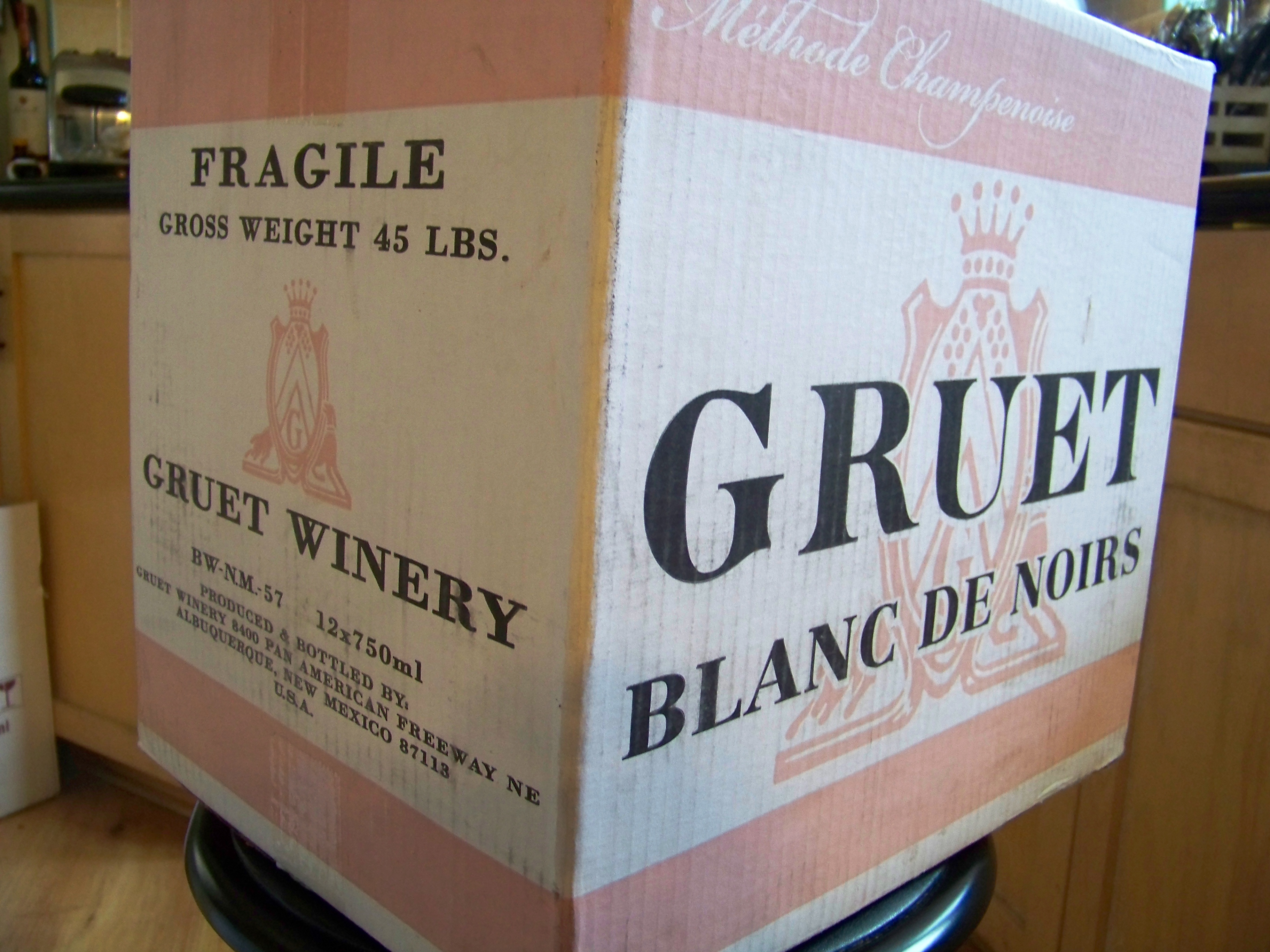
And no matter how you make it, the Santa Fe Sunrise goes great with a glass or two — or a bottle or two — of the Gruet Brut Rosé… just to keep the New Mexico theme intact, of course.

Kicking it, and kicking it off

2
Gluten-free Chocolate Chip Cookies

Gluten-free Chocolate Chip Cookies

When I was a wee sprout, the first real food I ever got to make “by myself” was chocolate chip cookies. The “by myself” is in quotes because I was performing under the hawk-like eye of my maternal grandmother, in whose company I had spent many hours in the kitchen prior to my first “solo” flight.

Chocolate chip cookies are a pretty good place for the budding baker/cook/chef to start, because the recipe on on the back of the Nestlé Semi-Sweet Morsels package is fairly bulletproof. I’ve made my own mods over the years, adding ingredients ranging from malt to orange zest to ground-up Altoids, changing the sweetening agent mix, modifying the flour — graham flour chocolate chip cookies were a remarkable failure, and maybe someday I’ll be motivated to figure that one out — but I had never made gluten-free chocolate chip cookies until the 3rd of July, 2013.

I had interviewed Chef Thomas Keller for Style Magazine, the in-house publication of The Venetian and The Palazzo in Las Vegas, and part of that interview centered around the gluten-free craze, and how his restaurants (The French Laundry, Per Se, Bouchon, Ad Hoc) dealt with it. Turns out, he had commissioned one of his chefs, Lena Kwak, to develop a gluten-free flour that looked, tasted, and behaved like “the real thing.” It is marketed as Cup4Cup.

The flour is not inexpensive, but Gilt.com had one of its flash sales, and I bought a 25lb. bag of Cup4Cup for $69. [Yeah, I know that seems a fairly excessive way to jump into a new product, but it was a great deal.]

Long story short, I made a double batch with my standard recipe, and the cookies came out great. Really tasty, if I do say so myself, every bit the equal of the ones I’ve been making for the better part of half a century. Nicely done, Lena. And Thomas.

You can find Alton Brown’s interesting and informative — if somewhat cornily acted — program on chocolate chip cookie variations at http://www.youtube.com/watch?v=5MYuXRaW0B0. And here’s a link to Cup4Cup: http://www.cup4cup.com/about-us/.

************************************************
Gluten-Free Chocolate Chip Cookies [Double Batch Style]

5 1/2 cups Cup4Cup® gluten-free flour
2 teaspoons baking soda
2 teaspoons salt
2 cups (4 sticks) butter or margarine, softened
3 cups packed brown sugar
3-4 tablespoons vanilla extract
5 medium eggs, room temperature
4 cups (24-oz. pkg.) NESTLÉ® Toll House® Semi-Sweet Chocolate Morsels
2 cups chopped nuts

Preheat oven to 375°F / 190°C

Combine dry ingredients (flour, baking soda, salt) in one bowl. In a separate bowl, beat butter/margarine, sugar, vanilla until creamy, then add eggs and continue beating until they are incorporated. Gradually stir in flour mixture, chocolate chips, and nuts. Drop dough onto ungreased baking sheets. Bake for 9-12 minutes or until golden brown. [I turn the sheet midway through, because my oven doesn’t have evenly-distributed heat, but you probably won’t have to worry about that.] Remove from oven and put cookies on wire racks to let them cool. Eat, or serve to friends, or both.

************************************************

Temple of the Tongue is gonna be (I hope, anyway) a funky amalgam of cooking tips, restaurant reviews, interviews, links to videos, my magazine articles, all sorts of odds and sods about making — and eating — food. Friends have been bugging me to do this for years now, and I’ve finally caved. I hope this little journey we’re taking together will be enjoyable, or, as we used to say back in the radio days, “If you’ve had half as much fun today as I have… well, then I’ve had twice as much as you.”