Sopa do dia: 4X Tomato Soup (Vegan)

0
AI-generated image of what I made. Hilarious, and a little creepy.

2024 seems to have been the big year so far for AI, including my WordPress account, which now allows me to generate hilarious (and a little creepy) photos to go along with my posts. Suffice it to say that the picture above is NOT the tomato soup I made (or anyone made, for that matter). But I will give you a shot of the real thing later in the post.

The inspiration for this soup came from an article in the Washington Post that my bride sent me, and while I originally planned to be fairly faithful to it, I wanted to make a larger batch than the author intended, and I wanted to play with the concept (fennel seeds just weren’t what my palate was craving in terms of spice). But chef Becky Krystal‘s basic idea remained in place: Build the soup from tomato paste, sun-dried tomatoes, and canned tomatoes, each of which would bring its own element of zing to the finished soup.

A mug of this would make an ideal partner for a grilled cheese sandwich, but that’s another post for another day.

4X Tomato Soup
Makes about 12 cups (about 3 liters)

INGREDIENTS
100 g sun-dried tomatoes, chopped and covered in olive oil overnight; OR
2 jars (200 ml / 7 oz) oil-packed sun-dried tomatoes (chopped, but reserve the oil!)
2 medium onions (16 oz / 450 g), diced (I used both yellow and red)
8 garlic cloves, thinly sliced
5 tbsp / 70 g tomato paste
3 tsp / 3 g dried oregano
2 tsp / 12 g sea salt, plus a little extra for taste, if needed
1.5 liter / 6⅓ cups low-sodium or no-salt-added vegetable broth
1 liter / 4¼ cups tomato juice (low sodium if available)
2 large (780 g / 28 oz) can whole peeled (or diced) tomatoes with their juices, preferably low- or no-salt
1 small (390 g / 14 oz) can whole peeled (or diced) tomatoes with their juices, preferably low- or no-salt
Freshly ground black pepper
1 tbsp / 5 g crushed red pepper flakes (optional)
Fresh basil leaves or fresh thyme leaves for garnish (optional)

DIRECTIONS

Separate the olive oil from the sun-dried tomatoes, add it to a soup pot on medium heat, and let it warm. Dice onions and add them to the oil, stirring to coat, and let them turn golden. Add sliced garlic, chopped sun-dried tomatoes, oregano, red pepper flakes (if you’re using them), and tomato paste, stirring continuously; allow them to cook for about a minute, until the tomato paste browns somewhat. Add the broth, tomato juice, and canned tomatoes (which you can break up a bit with your spoon). Be sure to scrape the bottom of the pot to dislodge any browned bits.

Warm over medium heat until just boiling, then back the heat off and allow to simmer for 30 minutes.

Process soup with immersion blender or in batches in a blender/food processor. [If you’re using either of the latter, fill the container no more than half full, and drape a towel over the input tube or lid to allow the steam to vent, or you will wind up with an unwelcome geyser of hot soup.] Adjust salt and pepper as necessary and simmer for five more minutes.

Ladle soup into bowls or mugs and garnish with basil or thyme leaves. I left mine a little rustic; for those of you who want a smoother soup, you could give it a pass through a food mill or sieve. If you desire something creamier, a dollop of crème fraîche or sour cream would be a tasty addition (substitute cashew cream or aquafaba if keeping it vegan or dairy-free is a priority). Should you want to add a little kick, some Tabasco® or piri-piri sauce will accomplish that nicely (especially if you left out the red pepper flakes in consideration of your Scoville scale-challenged partners, guests, or friends).

The pic above is the real deal, as served for dinnner earlier tonight. As you can see, it’s not completely puréed and strained, as the opening photo would suggest, though it could easily be done. When I make this again — and I will — I may substitute either basil or dill for the oregano. Kinda like moving it from B♭ to C; same melody, different key.

Polvo Guisado a/k/a Portuguese Octopus Stew

1
Portuguese Octopus Stew Completed

Seems like almost exactly a year ago I was writing about pulpo/polvo/octopus, then I got caught up in the business of actually moving to Portugal (not there yet), and then the plague hit. Although I have been in the kitchen a fair bit, I’ve been away from the blog. I am intending to change that, but it is subject to intervention from a couple of governments, a shipping company, a real estate agent, and life during COVID-19.

Since I can’t be in Portugal (as is the case for most of us living in America at present), the next best thing is to bring a bit of Portugal to California.

This particular stew is by no means uniquely Portuguese; in Catalunya, there’s a version known as Estofat de pop i patata; in Greece, you can find the very similar Octapodi Kokkinisto, though it’s usually served over rice or orzo rather than with potatoes; in Italy, it’s Polpi in Umido and Polpo alla Luciana, often including clams or other seafood and served with pasta or just bread. And in Galicia, Pulpo a la Gallega omits the tomatoes, but is frequently served over boiled potatoes. I’m sure if I dug a bit deeper, I could find Croatian and Turkish versions of the dish; heck, even the French might have one, although their version would probably be more elegant, since that’s what they do. From what I can gather, this one originated in the Azores, some say specifically on Pico Island.

In most Mediterranean (and Mediterranean-adjacent) countries, polvo guisado is peasant food; the cephalopod was pulled out of the sea, and the tomatoes and potatoes came out of your garden. No real fancy ingredients are necessary (although I did use a South African Pinotage Rosé, because the South African wine industry is currently in desperate straits due to COVID-19).

One quick note before we get to the actual recipe: a number of friends and acquaintances on social media find the eating of octopuses distasteful. They (the cephalopods) seem to be intelligent creatures, and many people, myself included, find them endearing. I understand and respect those whose ethics have led them away from creature consumption, and am happy to engage in conversation on that topic over the telephone or in person, but social media lack the capacity for nuance, so comments will be moderated. If this recipe is not to your taste, please feel free to avail yourself of one of the many vegetarian and vegan options on the blog.

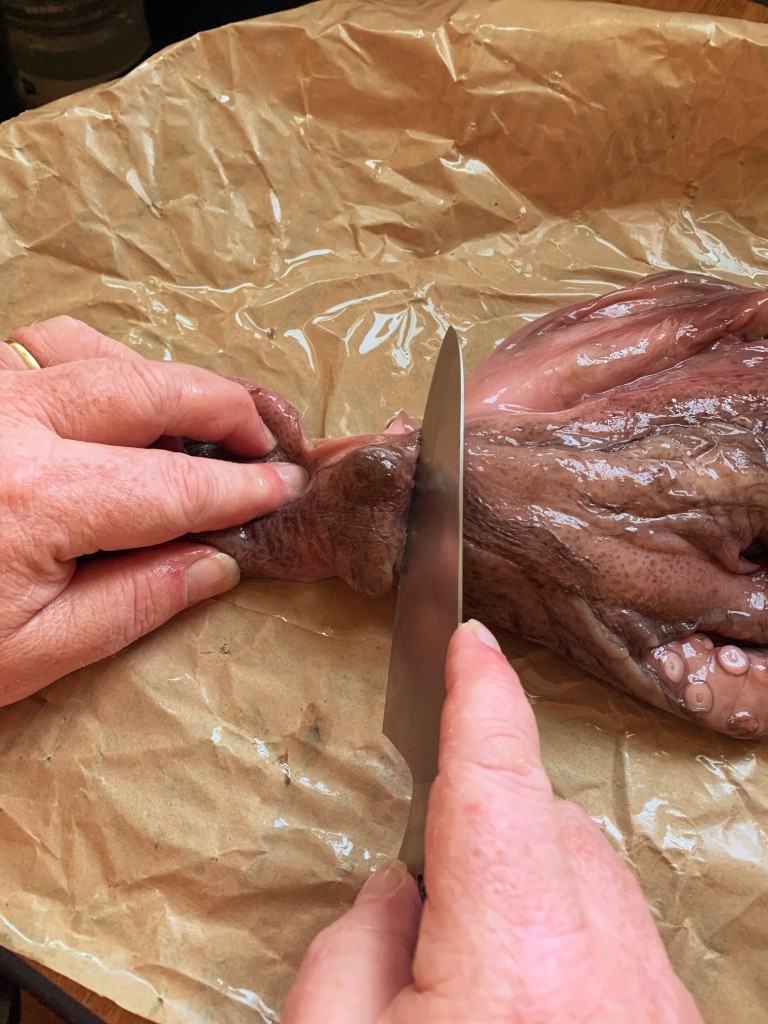
You may be able to get the octopus pre-cleaned from your fishmonger, but if not, you have a little cutting to do.
You may be able to get the octopus pre-cleaned from your fishmonger, but if not, you have a little cutting to do. Removing the eyes, the ink sacs, and the beak are not difficult, and there are many YouTube vids to guide you.

INGREDIENTS
2 lbs. / 1kg octopus, blanched and cleaned
2-3 tbsp. / 30-45ml olive oil
2 large onions, chopped
4 large cloves minced garlic
3 bay leaves
4.25 cups / 1000ml chicken or fish stock (I used Aneto)
2 cups / 500ml wine (rosé, white, and red all work fine)
2 lbs. / 1kg fresh (or canned) tomatoes, chopped (peeling optional)
2 lbs. / 1kg new potatoes (or fingerlings, or whatever you have)
1 thsp. / 5g crushed red pepper flakes
1 bunch fresh cilantro (coriander), chopped
1 bunch fresh parsley, chopped
1-2 small lemons, juiced (or 2-3 tbsp. / 30-45ml lemon juice)
Salt and pepper (to taste)

Our octopus turns a pinky-purple during its five-minute bath.

DIRECTIONS
Set a large pot of salted water on the stovetop to boil.
Remove the octopus’ eyes, ink sacs, beak, and interior of the head (if not pre-cleaned by your fishmonger) then rinse under cold water and set aside.
If you’re using medium or large potatoes, wash and quarter them (peeling is optional), and set aside.
Chop onions and mince garlic and set aside.
Chop cilantro and parsley fairly fine and set aside.
Dip the octopus three times into the salted boiling water to curl the tentacles, then submerge it for 5 minutes.


Drain and let it cool, then cut the tentacles and body into 2-inch lengths or chunks and reserve.
In that same pot, add the olive oil; add the onions, garlic, pepper flakes, and bay leaves, stirring occasionally. Fry in the oil for 6 to 7 minutes, until slightly wilted and beginning to brown.
Deglaze the pan with the wine, bring the liquid up to a boil and reduce it by half.
Stir in the tomatoes, season with salt and pepper, add the potatoes, the octopus, and stock. (Note: I used chicken stock, but fish or vegetable stock will also work, and if necessary, you could just use water with perhaps a bouillon cube or paste.)
Bring the liquid up to a boil and reduce to a simmer.


Cover the pot and simmer for about 90 minutes on low heat.
Add the lemon juice, fresh chopped cilantro (a/k/a coriander), and parsley. Simmer for another 5 minutes or so (it’s okay to go longer).
Adjust the salt and pepper (if necessary), fish out the bay leaves (if you can), allow the stew to cool slightly and serve.
Serve with crusty bread or rolls (optional) for mopping up the sauce.
Incidentally, a nice vinho verde goes nicely with the stew, but don’t be fussy about red or white; both are fine.