Here Comes That Grain Again: Vegan Kamut® Bowl With Peppers, Greens, and Toum

0

The bride’s keen on grain bowls lately, and I’m about 47.8% less enthusiastic about quinoa than she is, so I have been poking around for alternatives. While at the store, ostensibly to pick up some farro, I saw this thing in the grain section that looked like a sibling (of farro’s, not of mine): Kamut®. I had no idea what Kamut® was, but that didn’t stop me from bringing it home like a stray culinary puppy. Long story short, it’s a variety of wheat, whose journey out of Egypt was perhaps less tortuous than, but nearly as interesting as, the Jews’.

Allow me to quote from the trademark owner’s website:

    The story of KAMUT® Brand khorasan wheat began in 1949, when Earl Dedman, a US Airman stationed in Portugal, received some unusual looking grain from a friend who claimed to have taken it from a tomb in Egypt. More likely, the friend had purchased it from a street vendor in Cairo, Egypt with the story that it had come from an ancient Egyptian tomb. Earl sent thirty-six kernels of the wheat to his father, R. E. Dedman, a farmer near Fort Benton, Montana. Within six years, the elder Dedman had grown the small number of seeds into 1,500 bushels, calling it “King Tut’s Wheat.”

In 1977, it fell into the hands of Robert Quinn, who tried unsuccessfully to get the people who make Corn Nuts to manufacture a wheat version of the snack with this grain. But Quinn and his dad continued to grow it on his family farm, which went completely organic in 1989. The following year, the USDA recognized the grain as a protected variety officially named “QK-77,” and the Quinns registered Kamut® as a trademark to guarantee that the original grain would remain unmodified and always be grown organically. From there, it got licenced to dozens of producers and is used in products from cereal to pizza… to this grain bowl.

This recipe follows a general formula I’ve developed for grain bowls: grain, some roasted/pan-fried vegetables, an element to add at least a bit of crunch to the texture, wilted greens for a little bitterness, some salt, and an acid (tomatoes, lemon juice, vinegar, or, in this case, toum) as a brightening agent. Please don’t shackle yourself to this recipe! It was created and modified on the fly, riffing on literally dozens of other options I sifted through from Pinterest pages and Google searches.

Instant veggie stock enhances the water.

A NOTE ON COOKING KAMUT®: A little searching on the Internets yielded some insight on how to cook it in an Instant Pot. Much like dried beans, the typical method for preparing Kamut® is to soak it overnight in water (or, in my case, vegetarian bouillon), but I didn’t have the time for that, and I — quite fortuituously — did have an Instant Pot. Much thanks to cookbook author Kathy Hester, whose The Ultimate Vegan Cookbook for Your Instant Pot: 80 Easy and Delicious Plant-Based Recipes That You Can Make in Half the Time yielded the info that if you press the “Adjust” button once after having set the Instant Pot up on the “Multigrain” cycle, “it will look like it’s going to cook for a normal 60 minutes. But on this setting — only on the multigrain 60-minute cycle — the grain first gets a 45-minute warm water soaking before the 60 minutes pressure cooking time. It’s great for Kamut® and other long-cooking grains.” If you don’t have one of these marvelous devices, you can just soak the grain overnight and prepare it according to the directions on the package. That method works just fine, even if it’s a little (well, a lot) longer. [Reminder from Russ Parsons, former LA Times food editor: “Rinse thoroughly. I mean thoroughly. In a strainer under running water.”]

One cup of dry Kamut® looks like this when cooked.

A NOTE ABOUT TOUM: Toum is a garlic-based Lebanese dipping sauce not far removed from aioli or the Ligurian agliata. The best recipe for it that I’ve found is at the Tori’s Kitchen website (she even thoughtfully includes step-by-step photography). If I deviate from her recipe at all, it’s usually to add more garlic, the cowbell of the pantry. There’s just never enough. When you’re making it, be sure your water and lemon juice are really cold, or the sauce might break up. But it’s super tasty, simple to make, and you will discover a million applications for it, from grilled veggie sandwiches to tater tots to pasta.

A Cuisinart full of toum.

Vegan Kamut® Bowl With Peppers, Greens, and Toum

INGREDIENTS:

For the grain:
1 cup / 225g dried Kamut® khorasam wheat
3 cups / 700ml water
1 tbsp. / 15ml Better Than Bouillon Seasoned Vegetable Base (or other vegan bouillon cube)

For the bowl:
2 cups / 325gm cooked Kamut® khorasam wheat
12 baby bell peppers or 2 medium sized regular bell peppers (red/orange/yellow, chopped)
1/2 onion, finely diced
5 oz. / 1 cup / 150g cashews, preferably roasted and salted
sea salt to taste
5 oz. / 140g coarsely chopped greens (this time it was kale, baby spinach, and arugula)
2 tbsp. / 30ml olive oil

For the toum:
3 1/2 – 4 cups / 700ml sunflower or canola oil, chilled
1/2 cup / 70g / about 1 head peeled garlic cloves
1/2 cup / 120ml lemon juice, divided
1/2 cup / 120ml ice cold water, divided
1 3/4 / 10g tsp salt (preferably Kosher salt, fleur de sel, or sea salt)
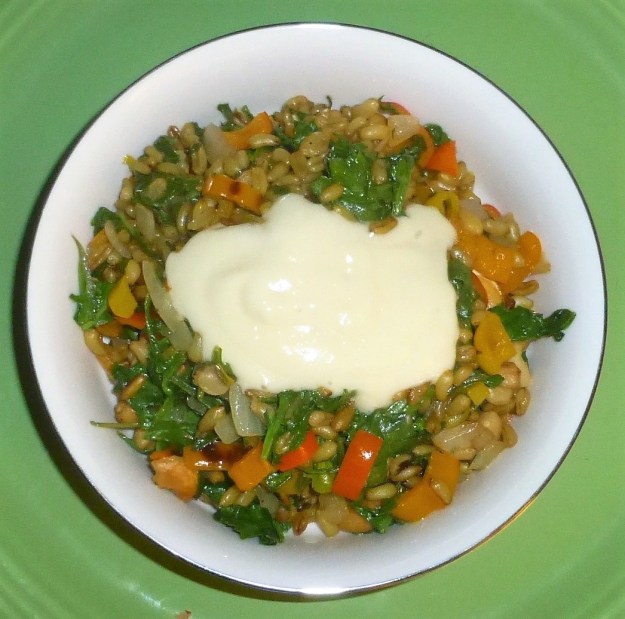
I was generous with the toum.

INSTRUCTIONS:

Cook Kamut® according to instructions (see A NOTE ON COOKING KAMUT®, above). Set aside.

Make toum according to instructions (see link in A NOTE ABOUT TOUM, above). Set aside.

Chop onion and bell peppers, place in bowl, and set aside. Meanwhile, heat olive oil in large pan on high heat until just about smoking. Add cooked Kamut® and toast, stirring occasionally, about 5 minutes or until slightly browned. Lower heat to medium and stir in onion and peppers. Cook for about 8-10 minutes, or until veggies have softened, stirring occasionally. Meanwhile, wash and chop greens. When vegetables have softened, add chopped greens and stir until wilted. Add cashews, stir, and salt to taste. Top with toum and serve. Serves 2-3 as main or 4-6 as side dish.

Praying for Grain: Vegan Fried Rice, Mushroom, and Super Greens Bowl

0

Asked the bride last night if she had any ideas for tonight’s dinner, and she responded with, “I pinned some grain bowls on my Pinterest page.” Some people find Pinterest really useful and convenient. I am not one of those. So after I looked through all 266 pins in the “No Animals Were Harmed” folder, I wound up (as I often do) perusing Food & Wine’s website. On it, I found this recipe, for Kale-and-Shiitake Fried Rice. It was pretty close to where I wanted to go, but it had eggs, and I was in a vegan mood, so I made a few simple mods for tonight’s meal.

This is super easy to whip together if you already have some cooked rice lying around, so I made a bunch in the Instant Pot last night before going to bed. Obvs, you can use any type of rice, but I find that brown Basmati rice is a good middle path between an insipid white and a cloying brown. The author of the Food & Wine recipe (David Lebovitz) recommended day-old rice, which he says works better to absorb the flavourings. Makes sense, since it will dry out a bit in the fridge overnight. As far as the greens go, I used a mix from the local market, but you could easily add or substitute arugula, collard greens, turnip greens, watercress, or even the leafy part (not the stem) of bok choy. Mustard greens, on the other hand, might overpower the dish, so have a care if you are thinking of adding them.

[NOTE: I love my Instant Pot; I made a whole slew of rice all at once with nary a care. Typically, the recipe for rice in the Instant Pot calls for a 1-to-1 ratio between liquid and dried rice; for brown rice, however, I’ve found that a 1.25-to-1 ratio of liquid to rice works better. Also, the “Rice” button on the front of the cooker is calibrated for white rice. If you are making brown rice, you’ll want to cook it at high pressure for 22-24 minutes, then let the cooker depressurize naturally, which takes about 10 minutes.]

INGREDIENTS

1/4 cup / 60ml olive oil
One 1-inch / 2.5cm chunk of fresh ginger, peeled and grated
2 oz. / 57g sliced or slivered almonds
6 scallions, thinly sliced
12 oz. / 350g mushrooms, thinly sliced
5 oz. / 141g coarsely chopped “super greens” (kale, chard, mizuna, and baby spinach or whatever greens you prefer)
4 cups day-old cooked brown Basmati (or other) rice
3 tablespoons / 45ml lemon juice (juice of one medium lemon) or equivalent rice wine vinegar
Sea salt

DIRECTIONS

In a wok or large skillet, heat the oil. Add the ginger, almonds, scallions, and a pinch of salt. Cook over moderately high heat, stirring constantly, until the ginger and scallions are tender, about 2 minutes. Add the sliced mushrooms and a generous pinch of salt and cook, stirring occasionally until tender, about 5 minutes. Add the greens, season with salt and stir-fry until wilted, 2 to 3 minutes. Add the cooked rice and stir-fry until heated through, about 3-5 minutes. Serve immediately.
 Serves 2 as a main course (see bowl in picture), or 4-6 as a starter or side.

Pear and Bourbon Croustade

0

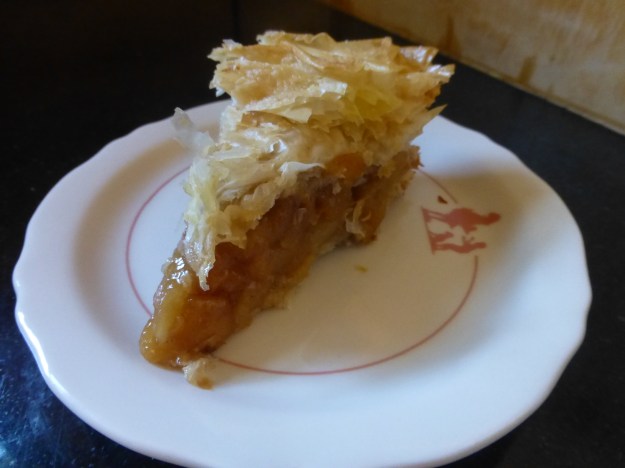
That plate will mean something to readers of a certain age…

Working with phyllo dough is like working with horses, musicians, or people of whichever gender(s) you find sexually attractive; it’s kind of a pain in the ass, but if you are patient and let them (mostly) have their way, you can achieve magnificent results.

Full disclosure: This recipe is derived from “Apple and Calvados Croustade” by Leslie Brenner, originally published in the Los Angeles Times on 12 December 2007. Fuller disclosure: it, in turn, was inspired by a recipe for Apple and Armagnac Croustade in the Cafe Boulud Cookbook by Daniel Boulud and Dorie Greenspan. “Okay, enough with the disclosures already” even fuller disclosure: I have interviewed Boulud and Greenspan on multiple occasions, and their recipes and aesthetic are beyond reproach. So why didn’t I just make their croustade? I’m glad I asked me that. Basically, I wasn’t feeling like apples the night I decided to make it, and pears were in season (and cheaper). It seems that the basic croustade shell could be a happy edifice for all sorts of fruit compotes (peaches, mangoes, and papayas would all likely perform well, so long as they weren’t overripe). I might even have a go at carambolastar fruit — some day, so feel free to play.

Feelin’ hot hot hot.

A note on alcohol, fire safety, and children. When I was a kid, helping out one or another of my grandmothers in the kitchen, I would have just adored being part of a flambé. Well, perhaps not the flambé itself, but part of the process. You are the best judge as to whether your children should be permitted in the kitchen — or the county — when you do this. So long as they stand back at least three feet, everything should be hunky dory, and perhaps even better if you say “Don’t tell [other parent or siblings] I let you help me, okay?” That’s the kind of secret kids love to keep, although they may not be successful in so doing. When it comes to fire safety, I had a sheet pan sitting out that I could employ to cover the flambé pan post-haste, breaking the “oxygen” side of the “oxygen-heat-fuel” fire triangle. Lastly, if alcohol is an issue for you, feel free to leave it out. After all, we’re basically putting a fruit compote into a phyllo dough crust, and there are no fewer than 17,583 ways to do that.

Save some for the baker.

Making your own phyllo dough: Don’t. Life is too short.

The apple version of this croustade seems to have originated in the southwest of France (the name derives from the Occitan crostada, literally “crusted”), and this style of dessert is mainly found in Midi-Pyrénées, now part of Occitanie. It may be known also by pastis (which it is called in the Quercy and the Perigord) or tourtière (in the Tarn and the Landes). In the Gers, the croustade is called Pastis Gascon (not to be confused with the aperitif!).

A bowl of Bartletts.

GEAR

Small fine mesh strainer or sifter for applying powdered sugar
Pastry brush
Silicone mat or parchment paper
Baking sheet
9″ / 225mm tart ring (size may vary some; see below)
Canola oil spray for lubricating tart ring and parchment paper (optional)
Thin, lint-free towel (approx. 18″ x 24″ / 455mm x 600mm)

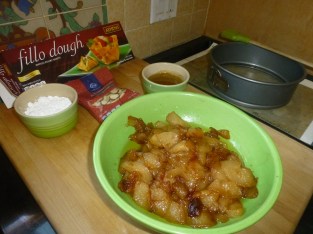
Mise en place after pears are cooked.

INGREDIENTS

1 stick plus 2 tablespoons (113g + 30g) butter, divided
6-8 Bartlett (or other, except Asian) pears, peeled, cored, and cut into 1/3″ / 8.5mm slices
1 moist, plump vanilla bean
1/4 cup / 50g light brown sugar (you can substitute white sugar; i preferred the brown for an extra “bass note”)
1/3 cup / 75ml vanilla-infused bourbon or pear brandy or pear eau de vie or rum (should be 70 proof / 35% alcohol or higher)
1/2 package of frozen phyllo dough (.5 lb. / 225g, containing about 20 sheets or so), thawed
[NOTE: The phyllo take 2 hours to thaw at room temp or overnight in the fridge]
1/2 cup / 60g powdered sugar (or more, as needed)
1/3 cup / 35g sliced almonds, divided

DIRECTIONS

Peel and cut pears into 1/3″ / 8.5mm slices. Set in bowl and set aside. [Normally, I would have the bowl filled with acidulated water to prevent the pears from going brown, but since you’re going to caramelize them, that’s not an issue.] Cut the vanilla bean lengthwise in half and, using the tip of a small knife, scrape the seeds over the pears and drop the pod on top. Add the 1/4 cup / 50g brown sugar to the pears in the bowl and stir gently.

Melt 4 tablespoons / 55g / one-half stick of butter in a large skillet over medium heat. When the butter is foamy, add the pears with the vanilla and the sugar and cook, stirring occasionally and gently, until the pears are lightly caramelized and soft, about 20 to 25 minutes. Add your alcohol of choice and, standing well back while using a long match or grill-style lighter, set it aflame. When the flames subside, turn the pears over in the sauce; when the the alcohol has reduced to a glaze, transfer the pears to a bowl and allow them to cool to room temperature. Remove vanilla bean. [If you started late at night and want to finish up the next morning, as I did, or need to take a break, you can do so here. Just cover the lot with cling film, pop it all in the fridge, and come back when you’re ready to pick up again.]

Center a rack in the oven and heat it to 350°F / 175°C. Grease a 9″ / 225mm tart ring (I used the side of a springform pan) and place it on a baking sheet lined with a silicone mat or parchment. Melt the remaining butter and set it aside. Unfold the phyllo dough on your work surface and cover it with a damp towel.

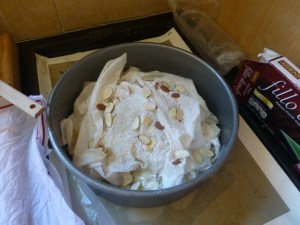
Working quickly, remove the top sheet of phyllo (re-covering the remaining sheets), brush it lightly with butter, and dust it with powdered sugar. Gently and loosely crumple the dough into a circle and lay it into the pastry ring. Sprinkle it with a few of the almonds. Repeat this procedure five more times, until you have six buttered, sugared, and almond-sprinkled sheets of phyllo layered in the ring. Do not press them together — let them keep some height.

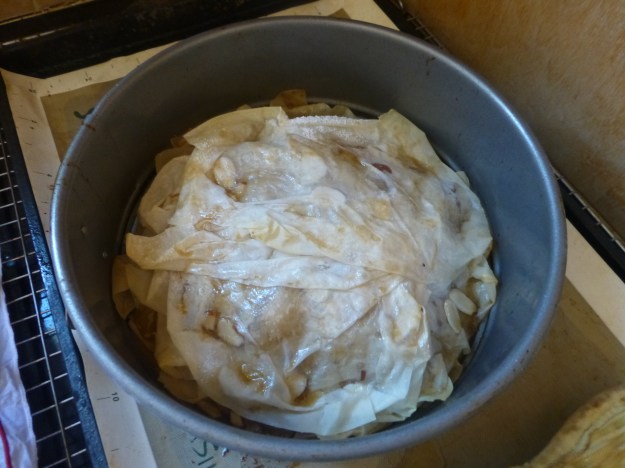
Spoon the pears into the center of the croustade, leaving a 1-inch / 25mm border bare. Working as you did before, butter, sugar, and crumple two sheets of phyllo, fitting them loosely over the pears. Sprinkle this layer with the remaining almonds, and cover this with another pair of crumpled, buttered, and sugared sheets of phyllo. Drape the phyllo artfully, so it looks good. Don’t feel bad if a phyllo sheet tears; just pick up the remaining part and arrange it adjacent to its sibling. And if it goes completely sideways, as, say, cling film sometimes will, you can make a command decision to ditch the dough or just tuck its shards someplace toward the middle for “texture.”

Slide the croustade into the oven and bake for about 10 to 12 minutes, watching the top of the tart carefully to make certain it doesn’t brown too much (depending on your oven, you may want to rotate it at the halfway mark). When the top is just lightly browned, remove the croustade from the oven.

Increase the oven temperature to 400°F / 200°C. Butter and sugar another pair of phyllo sheets, loosely crumple them and place them side by side on the previous layer to make a light, airy crown. Bake for 5 to 10 minutes, or until lightly browned, then remove it from the oven again.

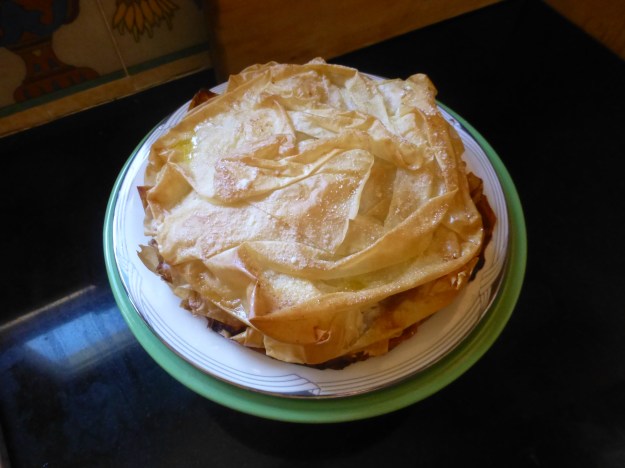
Butter the last sheets of phyllo and, once again, crumple them to make a crown. Place them on top of the croustade and dust it heavily with some of the remaining powdered sugar. Return it to the oven and bake until the top layer caramelizes evenly, about 5 to 10 minutes. Check the progress of the sugar frequently, because — like toast — it can go from brown to burned in a flash. Pull the croustade from the oven as soon as the top is a golden caramel color and allow it to cool for 5 to 10 minutes. Dust it one last time with a little powdered sugar.

To serve, lift off the tart ring and, using two wide spatulas, transfer the croustade to a serving plate. Serve warm or at room temperature the day it is made, with crème fraîche, very lightly sweetened whipped cream, or vanilla ice cream.

[CODA: I used a silicone basting brush for the butter, and while it was okay, it wasn’t brilliant. A paintbrush-style brush would have worked better. It is apparently customary in France to cut these with a pair of long, sharp scissors. However you decide to do it, the croustade is going to shed some of its golden phyllo. If you’re cutting it up in the kitchen, you can gather the crumbs and arrange them as artfully as possible, or just hide them under the whipped cream. Finally, this is plenty sweet without any help, so feel free to serve it plain.]